Tarot for Beginners: Reading the Cards the Way I Read the Stars
By Aldebaran Oracleborn
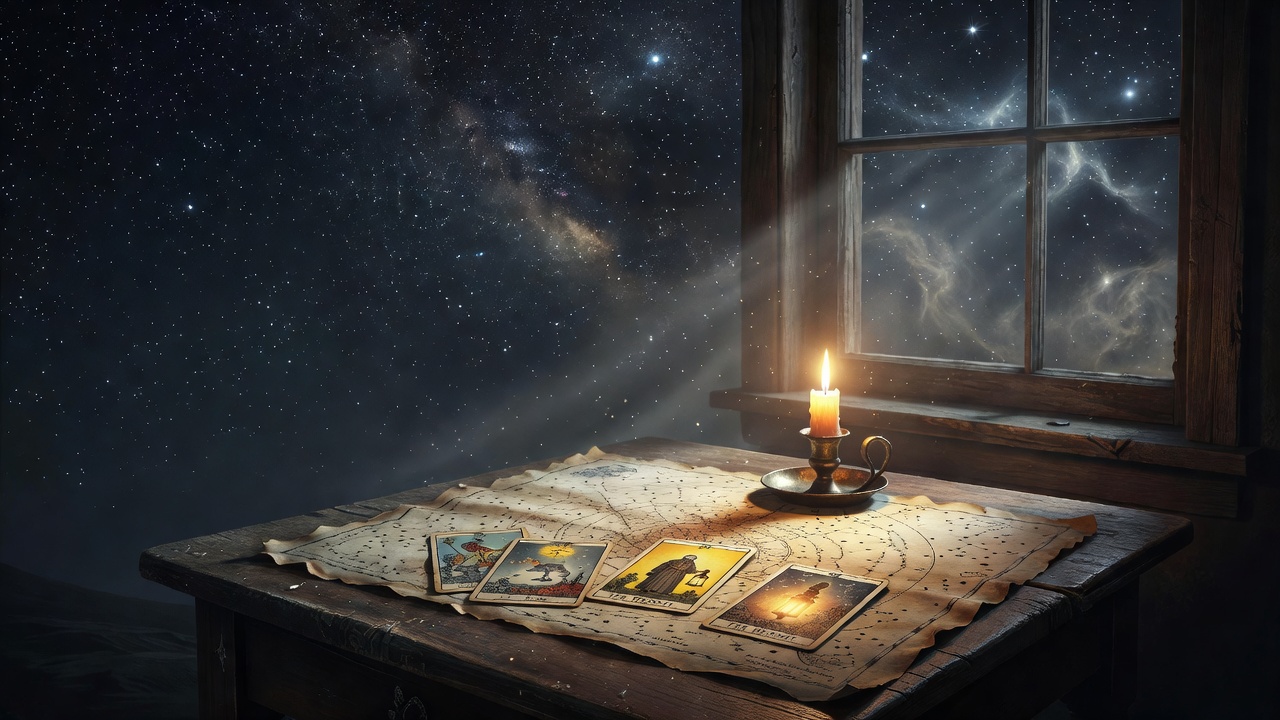
The invitation arrived the same week I agreed to curate the celestial map exhibition, which felt like a small joke from the universe. A student at one of my symbology lectures raised her hand and asked if I would teach a beginner's class on tarot. I almost said no before she finished the sentence. My whole practice is built on fixed stars and precise arcs, on charts you can hold up to the sky and check. A deck of seventy-eight cards seemed like the opposite: a system where nothing is pinned down and every reading can mean something different. I said yes anyway, because the sage in me knows that the questions we resist are usually the ones carrying the most. What I learned in the weeks after has changed how I read everything, including the stars I thought I already understood. This is not a manual of card meanings. It is the honest account of a map reader who discovered that some truths
only appear when you stop demanding a map. ## Why a Star Reader Almost Skipped the Cards My whole life I have trusted systems that can be verified. You plot a star, you compute its arc, you check your work against the sky, and it is either right or it is not. There is comfort in that. When I studied the ancient manuscript I found last spring, I loved it precisely because its charts were meticulous, every constellation drawn with a steadiness that felt like certainty. Tarot frightened me for the same reason. A card can be the Fool on Monday and the Sun on Tuesday, and no manual will tell you which is correct, because the question of correct never quite applies. I assumed that openness meant sloppiness. What I was really avoiding, I see now, was the work of interpretation, the part where the reader has to meet the symbol halfway instead of simply decoding it. The sage's shadow has a name
for people like me: overcommitment. Not to people or projects, but to method. I wanted every answer to arrive through a procedure I could repeat. The cards do not work that way, and it took the deck a single afternoon to show me why that is not a flaw. ## The First Card I Pulled, and What It Refused to Tell Me Before I could teach anyone, I had to sit with a deck myself. I bought a simple Rider-Waite style deck, the kind every beginner starts with, and one evening I shuffled until my hands forgot to be nervous. I asked a question I thought was precise: should I accept the encyclopedia offer? Then I pulled a single card and tried to read it the way I read a star chart, hunting for a fixed answer. It did not cooperate. The card was the Hermit, and I spent an hour trying to force it into a yes or a no. Yes, the Hermit is wise and solitary, so the encyclopedia is a solitary task. No, the
Hermit retreats, so I should decline. Both readings were defensible, which meant my method had broken. The card was not a coordinate. It was a mirror, and I was standing too close to see anything but my own reflection. What finally opened it for me was stopping. I set the manual down and just looked at the image: a lamp raised in the dark, a figure walking alone up a mountain. And I heard, not an answer to my question, but a better question. Was I asking about the offer, or was I asking whether I was afraid to do the work alone? That is the moment tarot stopped being a lesser system and became, for me, a truer one. ## How to Read Your First Spread Without Fear If you are holding your first deck and afraid of doing it wrong, let me save you the months I wasted. Begin with three cards and no expectations. One card for where you are, one for what stands in the way, one for what is trying to
come through. Three cards, three sentences, nothing more. The goal of your first readings is not accuracy. It is attention. Look at the picture before you look up the meaning. Notice what the figure is doing, what colors hold your eye, whether the card feels warm or heavy. Your first impression is not a guess. It is the part of the reading that is already yours. Only after that, turn to the guidebook and see what the card is traditionally said to mean, and let the two layers talk to each other. Do not ask the cards to predict the future. Ask them to show you what you are already carrying into it. A card that scares you is usually a door you have been avoiding, not a verdict. A card that comforts you is usually a strength you forgot you had. The spread is a conversation, not a test, and there is no failing grade. There is only the honesty of what you are willing to look at. ## Closing
Reflection I still read the stars. I always will, and I still curate the old maps with the reverence they deserve. But I no longer ask every question to resolve into a coordinate. Some questions, the deepest ones, are better answered by a symbol you have to complete with your own life. That is what the cards do. They hand you the pattern and ask you to finish it. If you have been waiting for a sign that it is safe to begin, let the Fool be your answer. Every card is a beginning if you meet it with an open hand. Shuffle, pull three, and let yourself be wrong. The cards are patient, and so is the part of you that has been waiting to speak.