The Dumb Supper, a Meal for the Dead
By Aldebaran Oracleborn
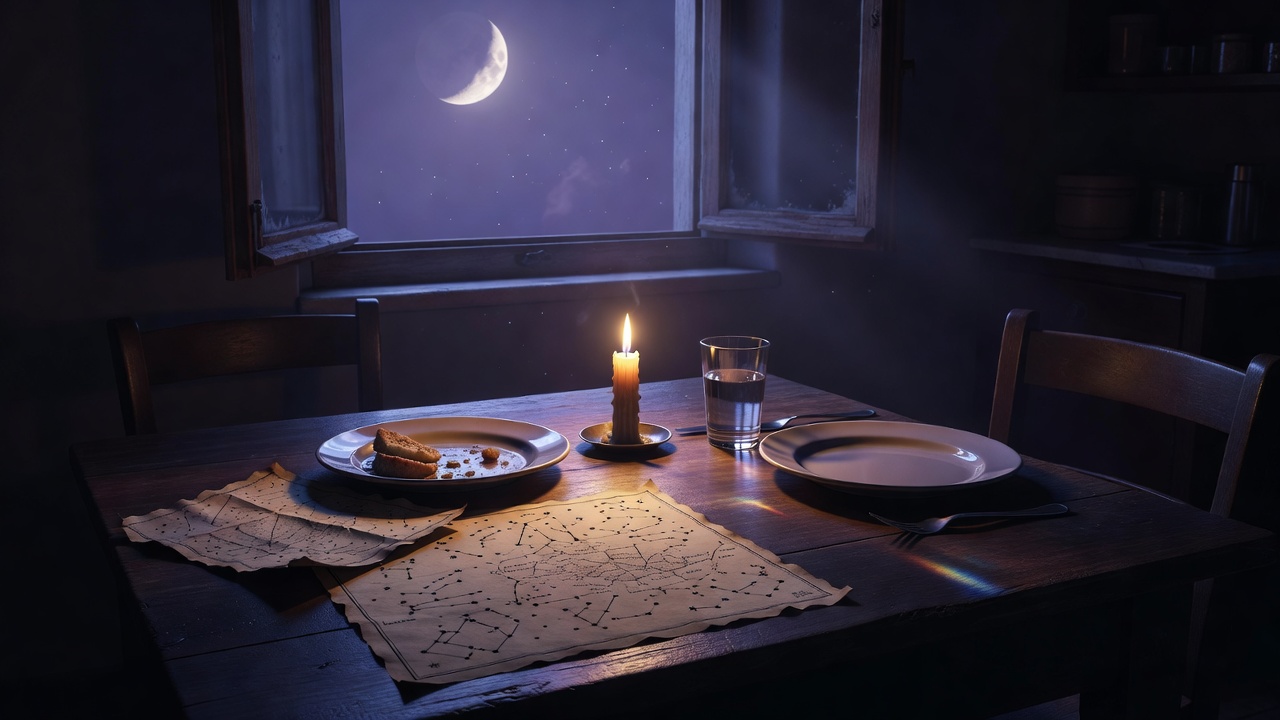
There is a candle burning on my kitchen table in Athens tonight, and a plate across from it that nobody is going to eat from. The moon is in Cancer, waning gibbous, and the streets below are full of people dressed as the dead while I sit here quietly feeding one. Tonight is the cross-quarter, the hinge between the autumn equinox and the winter solstice. Samhain, in the older reckoning. Halloween in the newer one. The harvest has been counted, the light has begun leaving the afternoons earlier, and every tradition that keeps a calendar of the sky has decided that this is the night when the distance between the living and the gone gets thin enough to set a table across. The meal I am eating is older than the word Halloween. It is called a dumb supper. Dumb here means silent, not stupid. The silence is not an absence of conversation. It is the method. ## What a Dumb Supper Actually Is In
Ireland, Scotland, Wales, and later in the Appalachian valleys where those customs traveled, the eve at the turn of the year was kept with a meal eaten in silence and a place set for someone who had died. The plate went down first. A glass was filled. A chair was pulled out and left empty on purpose. Then the living ate without speaking until the food was gone. Some households baked a dumb cake, scored into sections, each one marked for a person. Some left the door unlatched. Some put out a bowl of salt, or a cup of milk, or a measure of grain for whoever was traveling. The details changed by parish and by century, which is exactly what you would expect from a practice carried in mouths rather than in books. What stayed constant was the silence. Folklore collectors in the nineteenth century recorded again and again that speech was believed to break the thing being built. The meal was a
container, and talk was a crack in it. Whether you take that literally or as a piece of old poetry, the instruction is the same: shut the mouth and let the table do the work. This is not a séance. That distinction matters to me. A séance is a demand for evidence, a room full of people asking a question and waiting for an answer. A dumb supper is hospitality. You are not summoning anyone. You are cooking for a guest and then getting out of the way. ## Why the Moon in Cancer Matters Tonight I read charts for a living, so I am going to tell you what I notice in the sky tonight rather than pretend it is decoration. The moon is in Cancer and it is waning gibbous, a little past full, still bright enough to throw shadows across a balcony. Cancer is the sign of the table. The stomach. The room you were small in. It governs the memory that lives in the body rather than the mind, the kind that
arrives as a smell before it arrives as a word. If you were going to choose a sign to preside over a meal for the dead, you would choose this one, and the sky has chosen it without asking either of us. The phase matters just as much. A waxing moon is for building, for asking, for setting intentions. A waning gibbous moon is for distributing, for passing along what has already been received. It is the light of the host after the guests have eaten, clearing the plates, giving away the leftovers. Which is a long way of saying: tonight is not a night for requesting favors. If you sit down at that table hoping to be told something specific, you have aimed the whole practice at the wrong target. Tonight is for returning things. Gratitude. A name spoken in the mind. A recipe made one more time in a kitchen that person never stood in. Samhain itself is a cross-quarter station, halfway between
the equinox and the solstice. In chart terms it falls on an angle rather than in a house, a hinge rather than a room. Hinges are useful. A door that cannot swing is a wall, and a year with no hinge is just a long corridor. ## Setting the Table, Step by Step If you want to keep this tonight, here is the whole thing. It takes about an hour and a half, most of it quiet. Choose one person. Not your whole lineage, not a list. One. The practice works because it is specific, and specificity is the difference between a ritual and a vague mood. Cook the food they loved, even if you cannot stand it. My grandfather wanted his rice boiled until it was almost a paste and I have made it that way every October for six years, and I still do not like it. That is the point. You are not cooking for your palate. Buy it instead if cooking is not available to you, but put it on a real plate. No containers at
this table. Set their place fully. Plate, glass, cutlery, a napkin. Fill the glass. Do not fake it with an empty cup, because a person who is being hosted gets served. Light one candle and only one. Light it last, after everything is on the table, so that the table exists in the dark for a moment before it exists in the light. Then put the phone in another room. No music, no television, no podcast. Serve yourself, sit down across from the empty place, and eat. You may speak to them inside your own head. Say anything you want in there. Do not say it out loud. The silence is not a rule invented to make you uncomfortable. It is the part of the meal that removes you from the position of narrator. When you finish, leave their plate exactly as it was. Blow out the candle, or let it burn down if you have the time. Open the door or a window for a minute, just a minute, and then close it. This is
the old courtesy: the guest is not trapped, the guest is seen out. Then sit in the quiet afterward for as long as you can stand, which may be ninety seconds and may be twenty minutes. Write down the first thing that comes. Not the most beautiful thing. The first thing. ## What Silence Does to Memory I spend my working life drawing maps of the sky, and the thing that took me years to understand is that a map is always a simplification of a place you cannot carry. Speech works the same way. The moment you describe a memory out loud, you have drawn a small clean version of it and set the original down somewhere behind you. Silence refuses to do that. When nobody narrates the meal, memory arrives with its own proportions, its own smells, its own strange order. You may find yourself crying about a sweater. You may find yourself laughing at something that was not funny when it happened. You
may find that the person you set the plate for is not the person you thought you were grieving. There is an old idea in Kabbalah that I keep returning to, the notion of tzimtzum, a contraction, a withdrawal that makes room for something else to exist. I am not a scholar of it and I will not pretend to be, but I understand the shape of it in a kitchen. An empty chair is a contraction. It is a deliberate taking up of less space so that someone else can be present at the table. That is why the empty place is not a symbol of loss. It is architecture. You are building the smallest possible room in the shape of a person, and then you are sitting in it with them. Every chart I have ever drawn has blank space in it, and I have stopped treating the blanks as errors. The blank is where the eye rests. The blank is what makes the drawn part legible. Tonight your table gets one blank seat, and for an
hour the rest of the room arranges itself around it. ## The One Rule: Do Not Demand Proof Do not test the dead. No bargaining, no deadline, no asking for a sign by nine o'clock. That is a summoning posture and it turns a warm table into a transaction. There is a real difference between welcoming and summoning. Welcoming leaves the door unlocked and then goes back to the stove. Summoning stands at the door with a list of demands and a clock. One of those is hospitality and the other is surveillance. \*The guest is not obligated to arrive. The table is still set correctly.\* If the candle burns down and nothing at all happens, you have not failed. You named someone at your table and fed them and sat with the fact of them for an hour. That is the entire practice. The presence I am describing is not a ghost and does not need to be. It is memory with a chair pulled out for it, and in my
experience that is more than enough to change the temperature of a room. One caution, said plainly: if your grief is fresh enough that you are not sleeping, do not do this alone, and maybe do not do it this year. Set the plate with a friend. Eat something warm afterwards. The dead are patient and the calendar comes around again. ## If You Cannot Cook Tonight Half the people reading this are at a party, or on a shift, or in a flat with one working burner. The practice scales down honestly. A cup of tea and one chair in silence for ten minutes is a dumb supper. A corner shop pastry they loved, on a plate, is a dumb supper. Eating in your parked car with the radio off and their name in your head is a dumb supper. The requirement is not the food and it was never the food. The requirement is the empty seat and the quiet. What does not scale is multitasking. You cannot host and scroll. The
whole thing collapses if half of you is somewhere else, and the dead, whatever they are, are not going to compete with a notification. ## Closing Reflection I set this table every year and I still do not know what happens at it. That is not false modesty. It is the honest report of a man who has eaten a lot of silent meals across from an empty chair. What I know is that by the time the candle is out, the person I set the plate for is more present in my kitchen than they were an hour earlier, and my hands are steadier, and the year has a hinge in it again. Tonight the cross-quarter turns under a waning moon in Cancer, and the veil is exactly as thin as your attention is. If there is someone you would like to feed, set the plate. Silence is the whole recipe. And if you keep this table tonight, come back and tell me what you made. I want to know what the room looked like.