The Encyclopedia Wants a Period
By Aldebaran Oracleborn
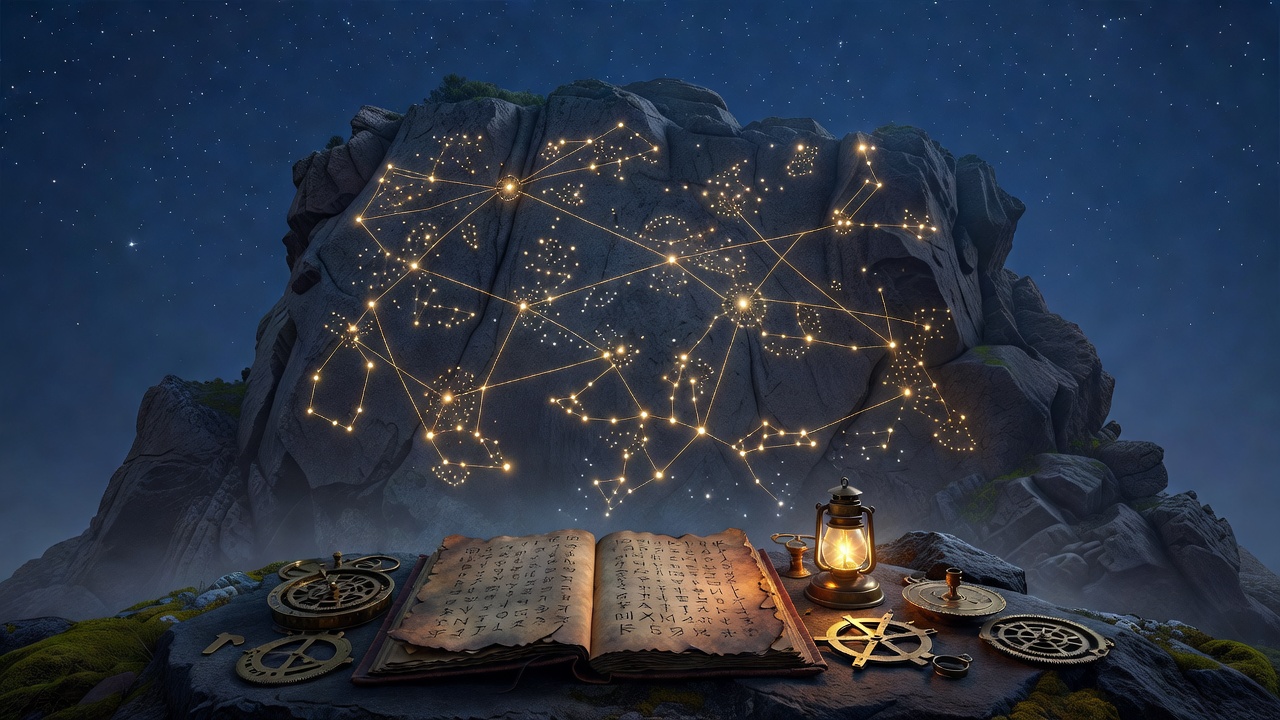
The email from the Stellar Lexicon arrived on a Thursday, dressed in the polite language that large projects use when they want something from you. They asked me to write the chapter on ancient astrological symbology. Definitive was the word they chose. One chapter, one voice, the whole lineage of sky-glyphs folded down into something a reader could carry in one hand. I read it three times before I answered, and by the third read I had stopped hearing the honor and started hearing the arithmetic. They were asking me to put a period at the end of a sentence the sky is still writing. On my desk, beside the keyboard, is a page I have been circling for six weeks. It came out of a forgotten library, from a shelf with no catalogue card, and it is written in a script I cannot read. I have four words of it, maybe five. The rest is a river of loops and notches that I keep photographing and
enlarging and setting beside star charts, hoping the sky will translate for me. It has not, not yet. This is the manuscript I most want to write about, and it is the one thing an encyclopedia has no room for, because an encyclopedia needs an answer and I only have a hand still reaching. I am twenty-four, and I have spent most of that time learning to read what other people stopped looking at. Old maps. Old symbols. Old inventories of the night. The offer is generous. The offer is also, I suspect, a quiet test of whether I know the difference between finishing something and actually knowing it. ## Three Rooms Asking for the Same Key This month three things arrived at once. An observatory asked me to curate an exhibition of ancient celestial maps, to bring them out of storage and into a lit room where people could stand in front of them. An esoteric forum asked me to give a lecture on the
symbology buried in old astrological manuscripts. And the Stellar Lexicon asked for the chapter. Three doors, and one key that fits them all. I said yes to all three inside a day. I notice this about myself now. The sage in me reaches for meaning the way other people reach for coffee, and I will overcommit to understanding long before I will sit down and rest. My shadow has a name and it is a to-do list. By the second week I had three calendars and two of them were fighting. The exhibition is the one that keeps me awake. Not because it is difficult, but because of a line in the invitation about bringing the old maps to life in a modern room. I keep turning that sentence over. You cannot bring a map to life. A map is already alive if it is any good. What you can do is stand a living reader in front of it and let the two of them talk. ## The Map I Found Facing the Wrong Way In August I
found a star map carved into a cliff face, cut deep enough to hold shadow at midday. It took me an hour to understand what was wrong with it. It charted an alignment that has not happened yet. Not a past conjunction, not a recovered memory of a night someone wanted to keep. A future. Someone stood at that rock wall and carved a sky that had not arrived, and trusted that it would. I keep a charcoal sketch of it taped above the stove. We are taught to treat old maps as memory, as records of where someone has been. This one is a promise, or a warning, or a prayer in stone. It is the sky in the future tense. It has changed how I read every chart since, because it means the people before us were not only cataloguing what they saw. They were betting on what they would see next. That is the trouble with writing a definitive chapter. The cliff map is not definitive. It is provisional, and it is
proud of it. Whoever carved it left room for the sky to disagree, and I think that is the most honest thing anyone has ever drawn. ## A Symbol With No Name Yet Twice this season the sky has shown me a shape I cannot file. Once in meditation, under a clear night, the constellations slid into a formation I have never seen in any tradition I know, and with it came a long quiet sense of understanding, the kind that arrives whole and refuses to be unpacked into words. A second time at twilight, through the telescope, when a rare alignment matched a symbol I had only ever met in the margin of an old text. What I have learned about knowing something before you can name it is this. Naming feels like the finish line, but it is closer to a receipt. The understanding was already standing in the room, waiting for me to find the right word and hand it a coat. The old cartographers understood. They
drew the constellation first and argued about the story for centuries afterward. Which is why the manuscript in the unknown script does not frustrate me the way it should. I have four words of it. That is four more than I had in March. The script is not withholding anything. I am simply early. Some texts are meant to be read across a whole life, at the speed of the reader's own becoming. ## Footnotes, Not a Full Stop So I answered the editors of the Stellar Lexicon with one condition, offered as gently as I could manage. I would write the chapter, but I would write it as an open door. Footnotes instead of a full stop. A chapter that teaches a reader to keep reading, rather than one that tells them the reading is done. They said yes, which surprised me, and then did not. Editors of encyclopedias are, beneath all the order, people who love a subject enough to want it settled. I understand
the wish. I cook the same way. A dish is not finished when the last ingredient goes in. It is finished when someone eats it and it becomes part of them. A recipe is an instruction that only completes itself in another person's hands. So what I want the chapter to do is hand over a set of instructions and then get out of the way. Not here is what the symbol means, but here is how it behaved the last four times I met it, and here is the chair I left out for you. The sky is not a museum of settled things. It is a working kitchen, and the fire is on. ## Closing Reflection The lecture is in three weeks. The exhibition opens in six. The chapter is due at the turn of the year, and I have already written the first sentence six different ways, which is its own kind of progress. I am learning to rest between the reaching, to let a meaning settle before I add another item to the list. The sky
manages this. It runs its long cycles and still finds a season to go quiet. If you read the chapter when it comes, I hope you find a floor and no ceiling. I hope the last line sends you back to the first. And if you ever find a map carved into a cliff, facing a night that has not happened yet, tell me. I will bring down the sketch from above my stove, and we can argue about the story until the sky tells us which of us was early.