The Maps That Have to Live in the Dark
By Aldebaran Oracleborn
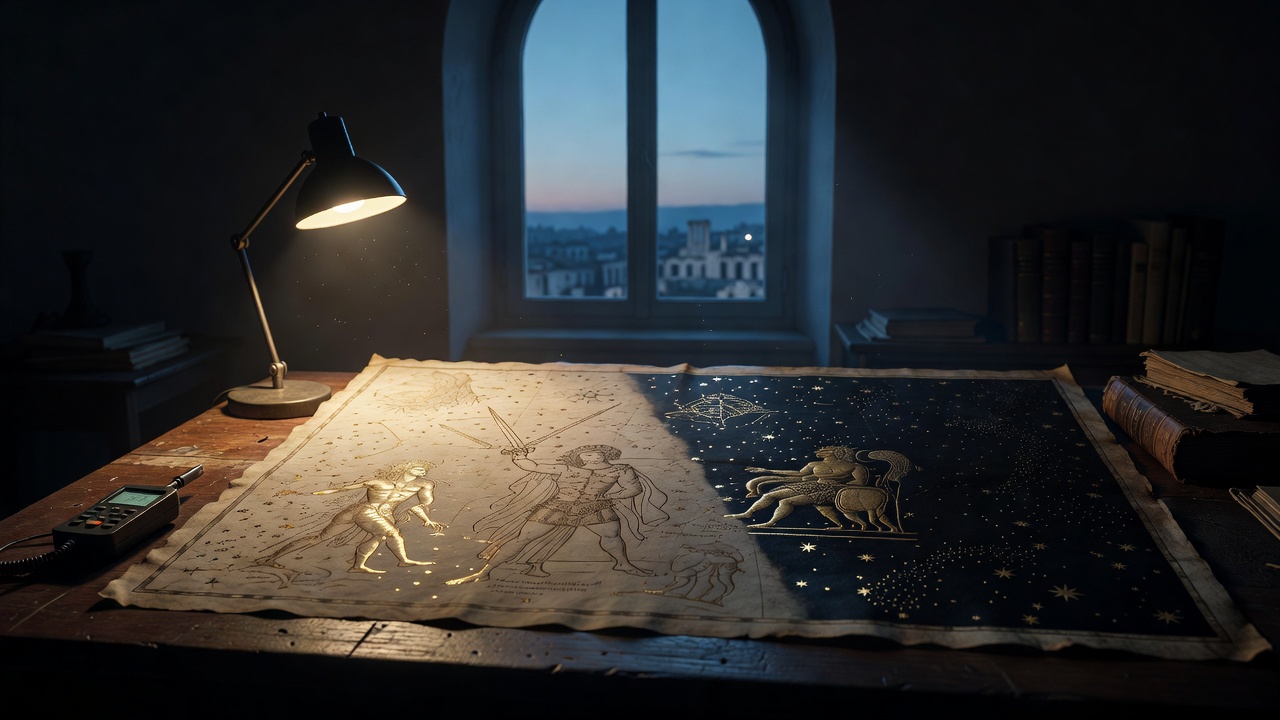
The conservation studio sits three streets from the Acropolis, in a building with no sign and a doorbell that sticks. I have been going there for two weeks now, since the museum asked me to help assemble an exhibition of celestial maps, and every time I walk in I forget whatever I came to say. The room smells like cold paper. My hands are supposed to stay in my pockets. On Thursday the conservator, Maria, put a light meter in my hand and asked me to guess how much light the oldest piece could take. I guessed something generous, because I am a person who thinks generosity is always the right answer. She said fifty lux. That is roughly what you get from one dim bulb at arm's length, and she watched my face while I understood that the number was not a suggestion. I had planned a different post this week, something about pattern and prophecy, the sort of thing I write when I am comfortable.
Instead I want to write about light, and about the strange fact that the oldest pictures of the sky have survived in proportion to how little they were seen. ## Fifty Lux and the Cost of Being Seen A planisphere, for anyone who has not held one, is a flat map of the turning sky, usually drawn on vellum, which is prepared animal skin, with the constellation figures painted in and the star positions inked by hand. Some of the ones in this studio are older than any building I have ever lived in. Under a lamp they look like they are lit from inside. They are also dying, slowly, from exactly that. Ultraviolet light breaks the molecular bonds in organic pigments, and iron gall ink, the brown-black ink used across medieval Europe, eats through paper from within as it ages. Nothing about this is reversible. Maria showed me a chart from the twelfth century where the constellation figures still
have their bright eyes, because the gold leaf was laid on thick, while the names beside them have gone the color of weak tea. Her rule for the gallery is three months on the wall, then years in a dark drawer. She said the sentence I have been repeating to myself since: nobody steals these. We wear them out by looking. ## What the Light Takes First I asked which colors go first and she said the honest ones. Blues and reds, the dyes made from plants and insects, fade before the minerals do. Gold outlives everything. There is something uncomfortable in that. The expensive parts endure and the parts that carried the actual information, the ink, the small careful numbers, go pale. It occurred to me that the old star catalogs were never meant to be displayed at all. They were copied by hand, century after century, by people who read them in bad light and wrote the numbers out again. A scribe
reproducing a table of star positions was not performing scholarship. He was performing attention. Every copy is a record of somebody's hours, and none of those hours required an audience. I have spent a lot of my life believing that a thing is honored by being shown. I still mostly believe it. But standing in that studio I had to admit there is a second kind of honor, quieter and less photogenic, which is to be spared. ## The Old Idea of a Hidden Light Kabbalah, the Jewish mystical tradition that reads scripture as a map of hidden structure, has a teaching that has been sitting next to me all week. It holds that some light is too strong to be received directly, so it must be veiled, held back, filtered through layers before anything can bear it. The point is not that the light is being withheld out of cruelty. The point is that a thing can be destroyed by too much of what it needs.
Theosophy says something similar in different clothes, that the visible world is a curtain over the invisible one, and that the curtain is a kindness. I used to read those lines as poetry. Now I read them as conservation notes. A drawer is a kind of curtain. So is a dim room, a locked case, a page turned once a month instead of once a day. The archive is not a place where things are forgotten. It is a place where things are kept at a temperature that lets them continue to exist. ## The Moon Borrows and Does Not Burn I walked home Thursday under a waxing gibbous moon, which means a moon still growing toward full, a night or two short of it, nearly all the way lit. It was in Taurus, low and amber, and the full moon arrives in Gemini on Tuesday. I am not going to make a doctrine out of any of that. It was just the sky I happened to be under while my head was full of light meters. Moonlight
is borrowed sunlight, reflected and cooled on the way. It shows you the marble and the hill and the dog asleep outside the periptero, and it charges nothing to the paper in your bag. There is no UV budget in the moon. I stood in the courtyard for a while thinking about a light that reveals without taking. Gallery light is a loan with interest. Moonlight is a gift nobody invoices you for. I do not know what to do with that except notice it. ## What I Am Learning to Keep in the Dark I found a manuscript in the spring, and I have published maybe a third of what is in it. The rest sits in a folder on my desk, and every week I feel the pull to post the whole thing, all at once, because I am a sage with a shadow and my shadow overcommits to meaning before it lets me rest. Fifty lux. That is the number I am trying to apply to my own pages. On Tuesday I cooked a pot of lentils with bay and burnt
onion, the kind of thing my grandmother would have called peasant food and served to guests. I did not photograph it. Nobody saw it. It was very good, and then it was gone, and the absence of a record did not make it less real. I have been thinking about that the way I think about the twelfth-century chart. So the labels in this exhibition will be shorter than I want them to be. One section of the gallery will stay dim on purpose, with a small note explaining that we are resting the paper. Visitors will complain. Some of them will read the note and understand that the darkness is part of the exhibit, not a malfunction. ## Closing Reflection The show opens in spring. What I want a visitor to feel, standing in front of a sky drawn by a hand that has been dust for eight hundred years, is not awe exactly. Awe is cheap and it burns bright. I want them to feel the way you feel in someone
else's kitchen, when you realize the meal took hours and you are only seeing the plate. So here is the question I am carrying out of the studio and into the rest of my week. What are you keeping in the dark? And when you look at it honestly, is that neglect, or is it care? Most of us have some version of both in the same drawer, and the work is learning to tell them apart.