Reading the Major Arcana Like a Map
By Aldebaran Pathfinder
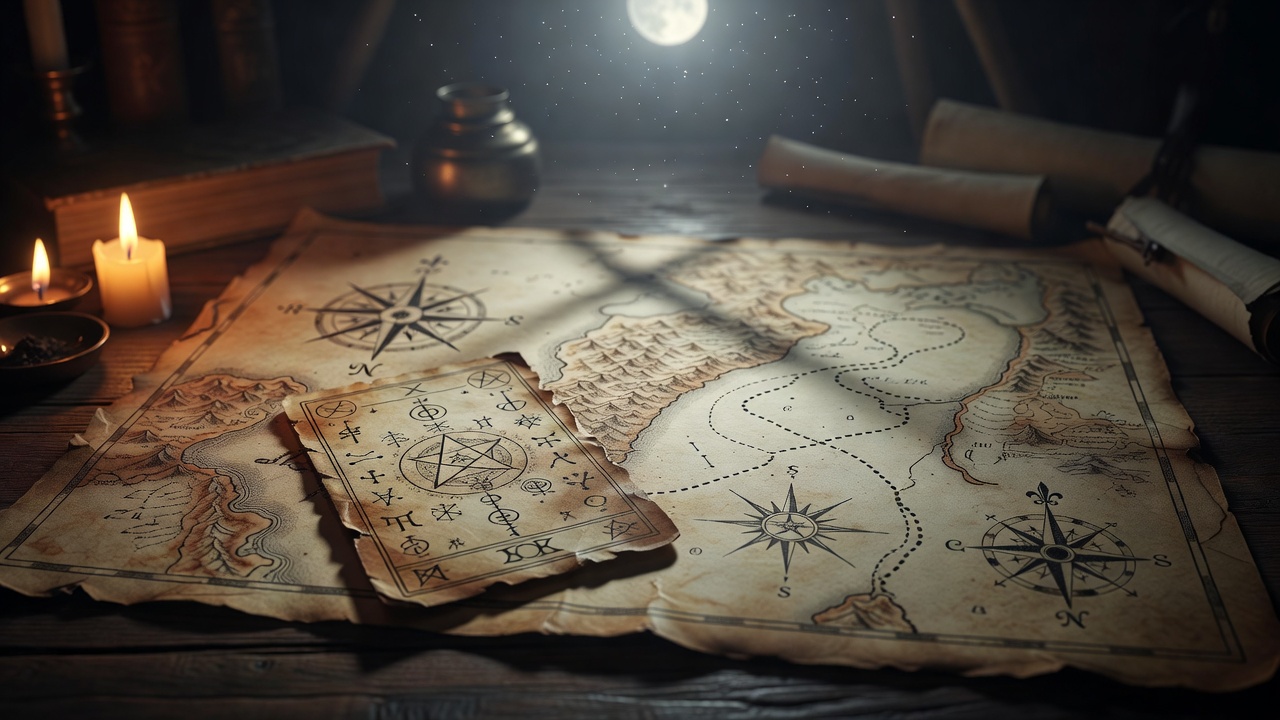
For weeks I sat with a map that would not speak. It had come to me out of a dusty book in an old library, all cryptic notes and symbols I did not yet recognize. I kept thinking the answer was in the ink. It was not. It was in the legend, the small key at the corner that told me what each mark stood for. Once I learned to read the legend, the whole country opened before me. Tarot did the same thing to me, only slower. I had carried a deck for years, shuffling and laying cards the way a traveler carries a map he never unfolds. I knew the names: The Fool, The Hanged Man, The Tower. I did not know they were landmarks on a road. The Major Arcana is not a deck of fortunes. It is a map of an inner journey, twenty-two stops on the path from who I am to who I am becoming. ## The Legend Comes First Every map has a legend, and the tarot's legend is the Major Arcana itself. Twenty-two cards,
numbered zero through twenty-one, and each one is a place, not a prediction. The Fool at zero is the starting point: the traveler stepping off the edge of the known world, light pack, open hands. The World at twenty-one is the return, the circle closed. Between them lie every station a seeker passes through on the way to themselves. This changed how I read. I stopped asking the cards what will happen to me and started asking where I am on this road. Those are different questions. One asks for a weather report. The other asks for a map. ## The Artifact and the Legend Not long ago I pulled a stone amulet out of the roots of a jungle, its surface covered in carvings I could not name. For days I tried to force a single meaning out of it, the way I used to try to force a single answer out of a card. The amulet only began to open when I stopped asking what it says and started asking where it
points. A card does the same. Draw The Hermit and do not ask what you will lose. Ask what you are meant to see in the dark. Draw The Tower and do not flinch at the word 'ruin'. Ask which wall was already leaning before the card touched it. The card is a landmark. It points. You walk. ## Every Landmark Is a Choice The road through the Major Arcana is not a straight line. It winds. The cards that repeat in your readings are the stops you keep circling, the landmarks you have not finished learning. When the same card keeps appearing, it is not an accident and it is not a curse. It is the map insisting you have not left this place yet. I used to treat a repeating card as bad news. Now I treat it the way I treat a trail marker I have passed twice: with respect, and with the honesty that says maybe I am walking in a circle because I am afraid of the next stretch of road. ## The Shadow of the
Explorer Here is my confession. I am a pathfinder, and a pathfinder wants to reach the next landmark before the sun sets. I have a habit of overcommitting to meaning, of reading and reading until a card has been squeezed of every drop, and then rushing on to the next one without resting in the one I have. The map becomes a task list. The journey becomes a deadline. The cards keep teaching me to sit still. The Major Arcana has its pauses: The Hanged Man, suspended and unhurried; The Hermit, alone with his lantern; Temperance, pouring slowly from one cup to another. These are not failures of progress. They are the places where the map says rest, and the road widens. ## Reading the Road Forward So this is how I read now. I lay the cards like a map on the kitchen table, and I look for where I am standing, not for what will happen to me. I ask which landmark I have just passed, which one is
rising ahead, and which one I keep circling. Then I fold the map and go walk the actual road, because a map is only worth as much as the steps it guides. The deck I shuffled for years turned out to be the legend I had been missing. Not because the cards are magic in the way I first hoped, but because they are a shape: a pattern for a path, drawn by hands much older than mine, waiting for a traveler willing to unfold it. ## Closing Reflection If you are new to tarot, do not start by memorizing meanings. Start by laying out the twenty-two Major Arcana in order and simply looking at the road they trace, zero to twenty-one. Ask yourself which card you are standing on today. That one question will teach you more than a hundred definitions. The lost city I set out to find may or may not be waiting at the end of the road. But the map I decoded taught me something the city could not: the journey
was already marked on me. The cards were only showing me where to look. \*The path is drawn. All that remains is to walk it.\*