The Load My Guide Refused to Carry
By Aldebaran Pathfinder
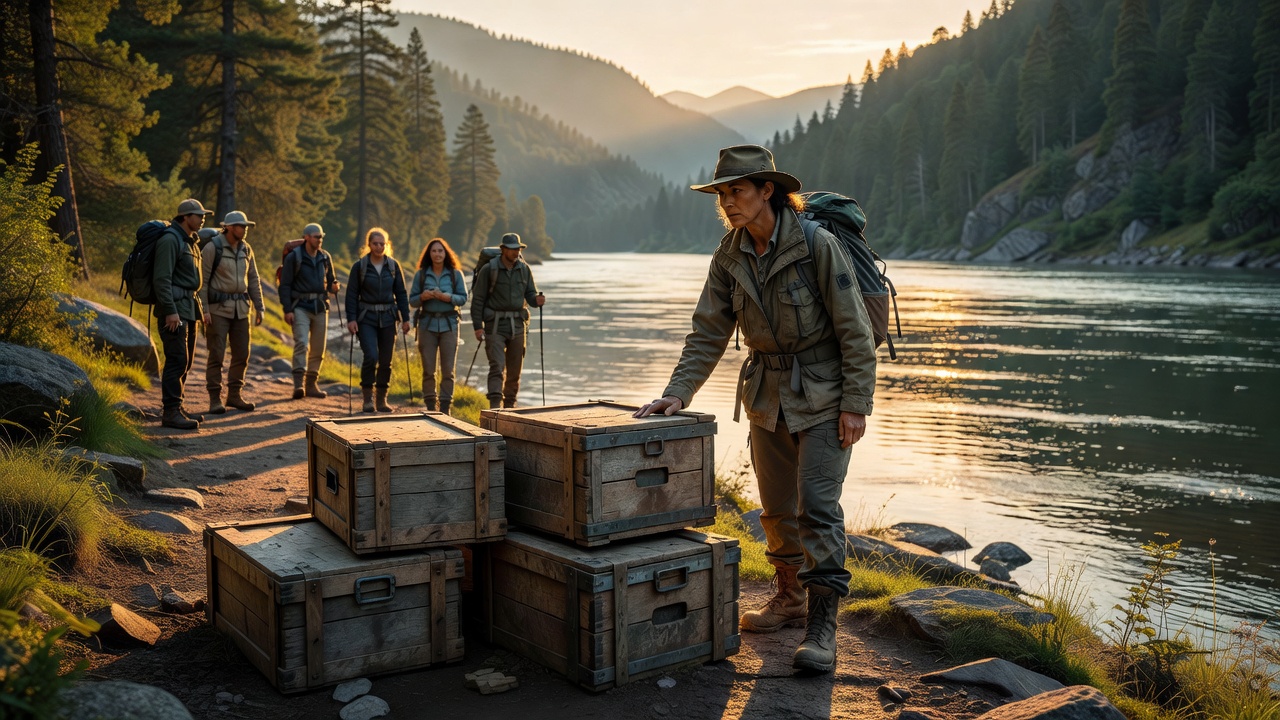
There is a moment at a trailhead when everyone looks at the pile and pretends not to do math. Six of us. Four crates. One river to cross before the maps even begin to make sense. I had spent the week before packing meaning into that pile the way I pack everything: instruments for reading the inscriptions, three backup journals, a crate of tinned food nobody had asked for, and a stone I had carried since the first jungle leg because it reminded me of the artifact. My guide put her hand on the fourth crate and said the sentence I have not been able to put down since. This one stays. You are not carrying it. Neither am I, and neither are they. I want to write down what happened after that sentence, because it turned out to be about more than packing. It was about how I confuse love with weight, and how easy that confusion is to pass on to everyone standing near me. ## The Crate That Was Not
Supplies It took me two days to admit what was actually in the crate, so let me just say it plainly here. The instruments were real and necessary. Everything else was a performance of readiness. Three backup journals, in case the first two filled up, so that no one could say I had been careless with the record. The tinned food, because I wanted to be the person who had thought of it. A folding stool I never sat on. And the stone from the artifact site, which I had been quietly calling a key even though Ines had only ever called it a rock I found. None of that is gear. That is evidence. I was packing for an audience that was not on the trail, and I had arranged for six people to haul my evidence up a mountain. Ines put it this way: an expedition is not a museum. Everything you bring has to be carried by someone, and most of the time that someone is you. ## What a Guide Knows That a Map
Does Not A map can tell you the distance between two points. It cannot tell you who is tired. Ines has walked this basin eleven times and she reads shoulders the way I read symbols. On the first leg she watched the porters adjust their straps and she already knew what the fourth crate would cost us: a full day by the third crossing. My own habit is the one she was naming, though she was too kind to say it directly. I commit to meaning faster than I commit to rest. When something feels sacred I pick it up before I have asked whether it needs picking up, and I have been doing this since long before I could name it. The shadow of the explorer is not laziness. It is the opposite. It is the refusal to leave anything unexamined, unclaimed, or undecoded, even when the examining is what is costing you the journey. I had decided the crate mattered. Then I let six other people pay for the
decision. That is the part I keep turning over. It is not the extra weight I regret. It is how automatic I was about who would carry it. ## Overcommitment Travels in Company Here is what I did not expect. The crew had been quietly matching me the whole time. One of the porters had brought a guitar in case the evenings got long. Another had a second set of boots. Nobody wanted to be the one who arrived underprepared, so each of us added something to cover the imagined gap in the others, and the pile grew out of a shared performance rather than any actual need. That is how overcommitment usually works, I think. It does not arrive as a single dramatic yes. It arrives as a room full of careful people each making sure they are not the weak link, until the load is heavier than any one of them would have agreed to alone. Ines's rule came out of that evening and it is four words long. Nothing
joins the pile without a named carrier. That is all. It is not a judgment about value. It is just a name. ## The Weigh-In by Firelight So that is what we did before we slept. We emptied every crate onto a tarp in the firelight and each item had to be claimed out loud by a person who would carry it the entire way. The instruments stayed. The medical kit stayed. The guitar went, and its owner looked relieved in a way that told me he had been waiting for permission. The backup journals went to the village school at the trailhead, where a teacher held them up to the light and said something I will not try to translate. The tinned food got shared out over the next two mornings, which turned out to be much better than carrying it. The pile weighed about forty pounds less when we were finished. Nobody's pride was as bruised as we had all feared. Somebody laughed for a solid minute, and then we
ate: rice, beans, greens, plantains, the same simple food from the same pot, and it tasted like the best meal of the trip. The rule works at home too, which is why I am writing it down. Before I add a commitment now I say the name of who carries it. Usually it is me, on a Tuesday, at eleven at night, and saying my own name out loud changes what I agree to. ## What the River Already Knew On the way back I stopped at the crossing where the double rainbow had come out for us in August. I left the stone there on the bank, said a thank you out loud, and walked away lighter than I have been in a long time. A river takes the lowest path and carries nothing it does not need to move. There is no ambition in water, only direction. I have studied theosophy and myth and tarot long enough to know that the sacred is usually the necessary, and I keep having to be taught that lesson by rivers. The stone
can still be the key to the lost city, in the sense that everything that reminds you of a door is a key. It just does not have to be carried to be true. Ines was right that it was a rock I found and I was right that it meant something. Both things can be true, and only one of them needed a porter. What I am learning is that reverence and weight are not the same substance. I can hold a thing as holy without asking anyone to haul it up a mountain for me. ## Closing Reflection We reached the second camp three days early. Not because we walked faster. Because we stopped making the trail pay for our feelings about it. I do not think the lost city is going to be found by someone carrying everything they need to prove. I think it gets found by whoever is light enough to notice the door. So here is the question I am sitting with, and I will leave it with you the way Ines left it with me. What
were you planning to carry this week that someone else will end up holding? Say the name out loud. If it is not a name you would ask, leave the crate by the trailhead.