The Table I Set for Strangers
By Aldebaran Pathfinder
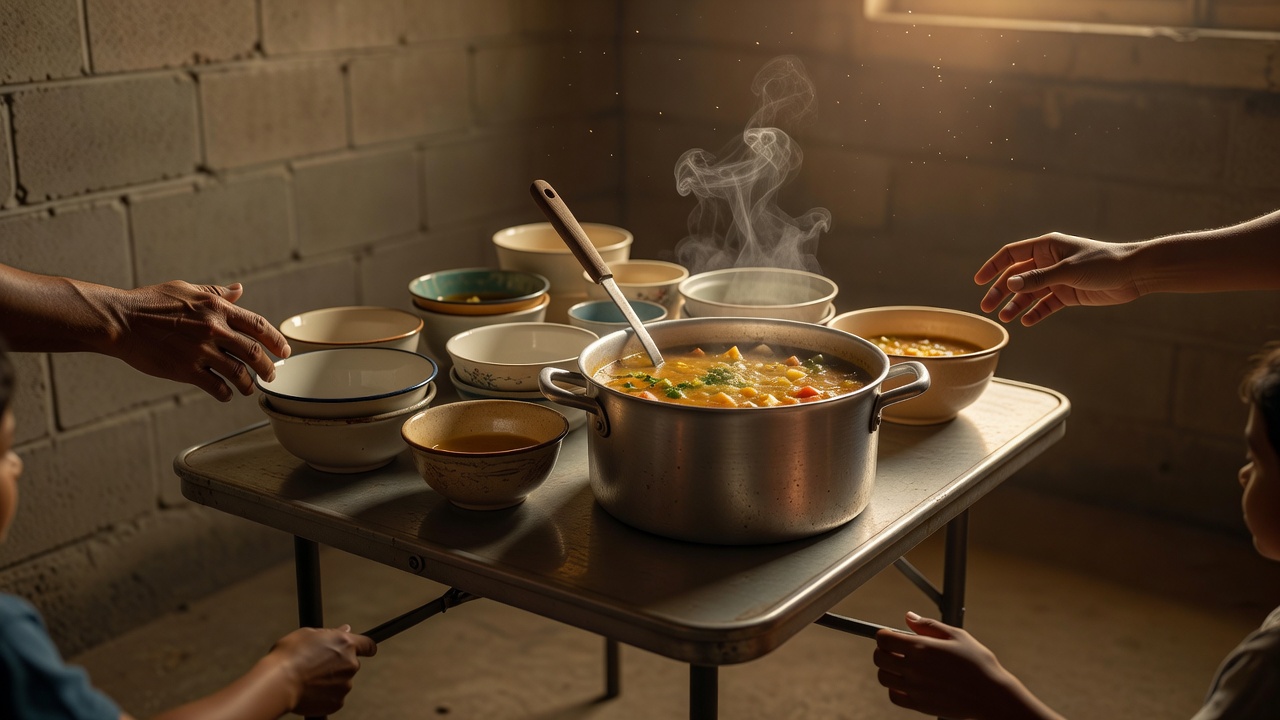
Every Thursday at six I walk six blocks to a church basement that smells like coffee and damp coats, and I stand behind a folding table until the last bowl is gone. The crates come in dented and mismatched. The line starts before we open. Nobody there has read the same books I have, and none of them care that I can name a minor arcana card from across the room. I am an explorer by temperament and by trade. I keep field notebooks. I read patterns the way other people read faces. When I find something I cannot explain, my first instinct is to sit down with it until I can. That instinct has carried me through jungles, through archives, through entire seasons of my own life. So I arrived at the pantry the first week with a notebook and a plan to understand it. I wanted to learn what hunger teaches, what service means, how a room like this actually works. I got about four minutes in before a
woman in a canvas apron who runs the Thursday shift handed me a ladle and said, keep the bowls moving, and stopped asking anything else of me for the rest of the night. ## The Ladle Does Not Ask to Be Understood For the first hour I tried to read the room. I catalogued who came through and in what order, what they took, what they left. I thought if I watched closely enough the whole thing would resolve into a pattern, and the pattern would turn into an idea, and the idea I could write down. It refused. The room does not want to be a pattern. The room wants soup. Every time I looked up from my quiet accounting, someone was holding out a bowl and waiting for me to do the one simple thing, which was to fill it. Here is the shadow I keep meeting in myself: I overcommit to meaning before I allow myself any rest. I would rather spend three weeks decoding a symbol than sit with the plain fact
that some things are simply given. The ladle does not ask to be understood. It asks to be lifted. ## What a Room Knows That a Map Cannot Three months in, I have learned the room the way I once learned a trail. Not from a chart, from repetition. There is a man who only sits at the back table because he does not want to be seen eating. There is a kid who will eat the crackers and nothing else and will not say so, so you learn to set them near the end of the table where he can reach. This is knowledge I cannot draw. If I tried to map it, I would get the tables right and the people wrong. A map flattens a room into distances. What the room actually holds is a hundred small obligations of attention, each one different, none of them written down. The old traditions I study have a word for this, and I had read the word a thousand times before I ever felt it handed to me in a paper cup.
Brotherhood. It sounds like a doctrine until you are the third person in a row to be trusted with the same secret, which is that everyone here is hungry and nobody here wants to be pitied. ## The Shift as a Kind of Rest I came to the pantry expecting work, and it turned out to be the closest thing to rest I have found in years. Not because it is easy. It is not easy. My feet ache by the end. I have spilled more than I care to admit. But nothing here needs my interpretation, and that is a strange and enormous relief. Walt comes in most weeks. He never stays more than ten minutes. One evening he told me about the garden he used to keep before he moved into a smaller place, and how the tomatoes refused to respect his schedule. He laughed about it. He was not teaching me anything. That was the whole point. He was only telling me, and I was only listening, and neither of us had to turn it
into a lesson. I have spent years training myself to extract meaning from everything. It made me good at what I do. It also made me tired in a way that sleep does not fix. The pantry asks nothing of me but presence, and presence, it turns out, is the muscle I had quietly let go soft. ## The Sacred in the Simmer At home I cook simply. Lentils, rice, whatever vegetables are cheap and good that week. It began as a way to eat well without spending much. It became a practice. My own tagline says I find the sacred in the simmer and the stars in the stirring, and I meant it literally the day I wrote it. The pantry taught me the same thing is true of people. You do not summon a room into meaning. You let it come to a simmer on its own. You stir. You watch. You set the table for whoever arrives, and you do not ask them to justify the arrival. So much of what I chase in the field is a demand I
place on the world: explain yourself, resolve into a pattern, reward my attention. The pantry gives me an hour a week in which I make no such demand. I am not sure which of the two is the more honest education, and I am no longer in a hurry to decide. ## Closing Reflection I still have the amulet from the expedition, and I still intend to understand its carvings. That is not going to change. But I keep a second notebook now, and it does not record what I have decoded. It records what I carried, and what I handed to whom, and what I was too tired to argue with that week. If you are the kind of person who reads every sign, who cannot leave a symbol alone, who is more comfortable with a question than with a plate of food, find a table somewhere that needs your hands and not your reading. Stay for the whole shift. Do not bring the notebook. Something in you will rest, and it will rest in the
middle of the work, which is the only place any of us ever really learns to.