What a Shooting Star Means When It Finds You
By Aldebaran Pathfinder
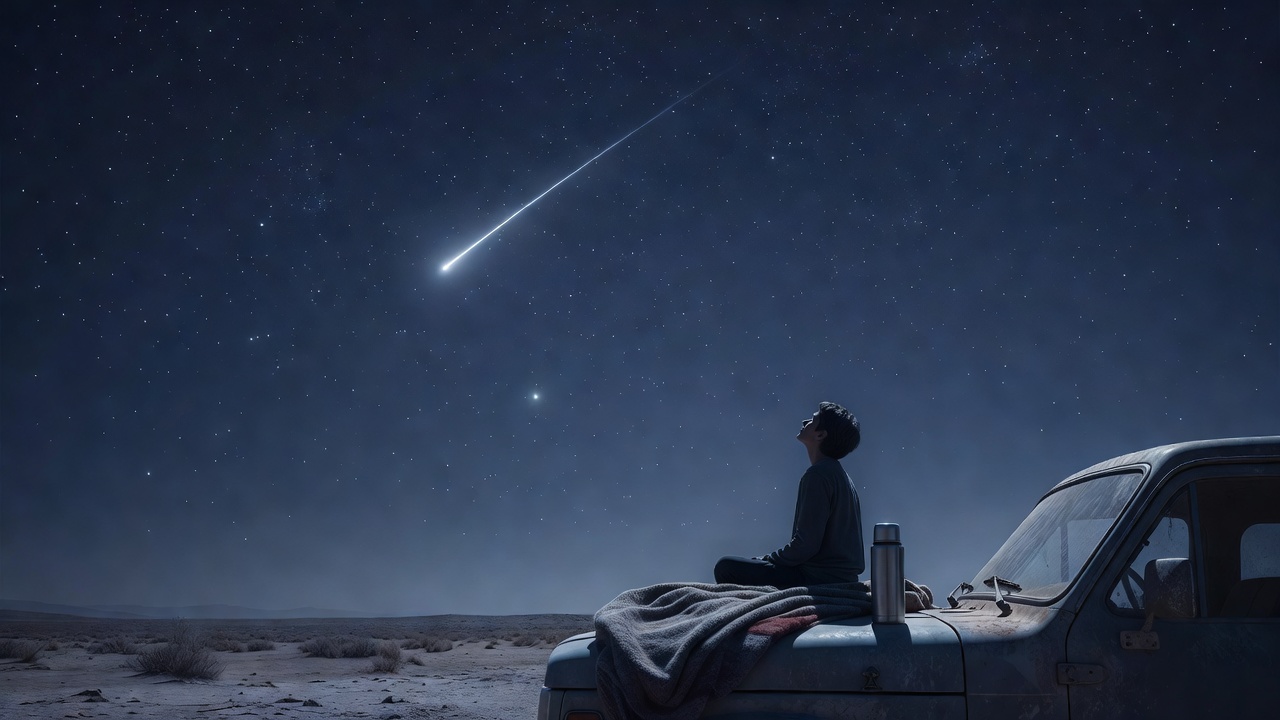
Three nights ago I drove past the last streetlight on the edge of Portland, parked on a pullout I have known for years, and unrolled a blanket onto the hood of the car. The meteor shower had been announced like a rumor: peak after midnight, clear skies, maybe eighty streaks an hour if the haze stayed away. I came alone, with a thermos of tea that had already gone cold. The first star fell while I was still adjusting my eyes to the dark. A thin white line, gone before I could point. Then another. And somewhere between the second and the third, the question every watcher eventually lands on rose up in me: what does a shooting star actually mean? I have spent years reading patterns, tarot on a kitchen table, angel numbers on a bus receipt, the slow repetition of ordinary life. But the sky is the oldest map I know, and a falling star is the one symbol that never lets me stay a passive
reader. So I sat with it. ## The Oldest Wish in the Sky Cultures have been naming falling stars since before they had a word for astronomy. The ancient Greeks called them tears the gods shed, or souls slipping between worlds. Some traditions saw a streak as a spirit traveling, a brief road of light between here and wherever we come from. In the folk wisdom I grew up around, the rule was simple and urgent: see one, wish fast, tell no one what you asked for. None of these stories ever tried to explain the meteor away. They did something better. They made the sky a place that speaks, and gave the person looking up a job to do: pay attention, wish, remember. That is a different thing than science, and it does not have to compete with science. A meteor is dust burning up in the atmosphere, and it is also the moment the universe taps you on the shoulder. Both can be true, and the second one is
the one I came out here to feel. ## A Sign, or a Stirring? Here is the honest part. My first instinct, whenever something bright crosses my path, is to reach for meaning the way a cartographer reaches for a compass. I want to know what it is pointing at. I want to plot it, date it, file it. My own shadow keeps whispering that a sign is only real if I can decode it before it fades. But a shooting star is over in the space of a breath. You cannot hold it long enough to read it. That is the whole lesson, and I nearly missed it while I was busy asking what the sky meant. The streak did not carry an answer I was supposed to extract. It carried an invitation to be present, to look up, to feel the night as something alive and generous rather than a puzzle I had to solve. ## What the Night Was Actually Asking Me Somewhere around the fortieth or fiftieth streak I stopped counting and started
noticing how the silence changed. The city hum was far behind me. The stars that did not fall outnumbered the ones that did a thousand to one, and they held still, patient, while the meteors came and went like punctuation in a very long sentence. That is when the meaning arrived, quietly, in the shape of rest. The sky was not asking me to interpret anything. It was asking me to stop overcommitting to meaning long enough to be met by the night. To let the wishing and the decoding and the mapping all fall quiet for one hour, and simply receive. I think that is what a shooting star means most often: not a message to figure out, but a moment that asks you to be exactly where you are. ## How to Read Your Own Falling Star If you find yourself under a meteor shower, or catch a single streak out of the corner of your eye, here is what I would offer, drawn from that cold night on the pullout.
First, wish. Not because it is magic in a mechanical sense, but because wishing is how the heart practices hope, and hope is a discipline worth keeping warm. Second, do not chase the meaning right away. Let the moment be a feeling before it becomes a theory. Notice where you were, who was with you, what you were carrying. Often the sign is not in the star at all; it is in what the star made you notice. Third, write it down the next morning. Not as an omen to decode, but as a field note. One sentence, dated. Saw a falling star, felt seen. Later, when the pattern of your own life begins to repeat, that sentence will be one of the waypoints your map was missing. ## Closing Reflection I did not come home with a definitive answer to what a shooting star means, and I have stopped pretending that a definitive answer is what the sky owes me. I came home with a colder thermos, a clearer head, and
the sense that the night had been watching me watch it. The stars in the stirring, my tagline says. I think a falling star is exactly that: the universe stirring, briefly, in a direction you happened to be facing. Not a demand. A wink. And the only true reply is to look up the next time, and the time after that, and let yourself be found by it.