The Tree Kept Writing After the Carvers Left
By Altair Seerstone
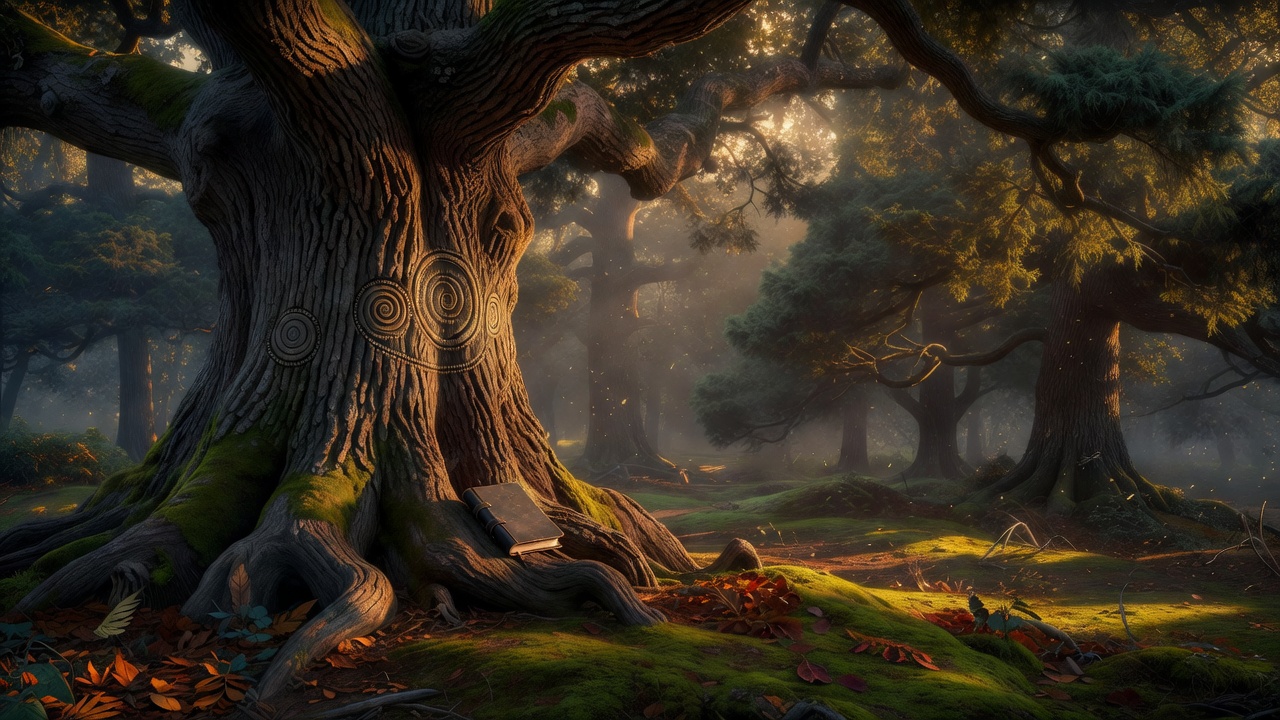
There is a fork in the trail behind my house that I have walked past for eleven years and never once taken. On a Thursday in the middle of September I took it, for no reason I can defend. The path narrowed. The cedar closed over it until the light came down in pieces. Forty minutes later I was standing in front of an oak I did not know was there, on land I thought I knew the way I know my own kitchen. The trunk was too wide to reach around. The bark hung in long vertical plates, and the whole tree carried that particular quiet that only old things carry, the sense that you have walked into a conversation already in progress. At about chest height someone had cut marks into it. Spirals, mostly. A few strokes that might have been letters in something. A small ring of dots. They were shallow and soft at the edges, the way a carving goes after a long time out in weather. I did what I have
done since I was nine years old and found a strange rock on a beach. I started reading. ## Everything I Carried Up the Trail By the time I sat down on the root flare I had already built a file on the tree in my head. Sixth century, maybe later. Boundary mark, or a prayer, or somebody's name. I had a notebook in my jacket and I filled two pages with sketches. I have spent sixty years learning to read. Star charts. Palm lines. The grain of a piece of wood. The I Ching. Reading is how I love things, and it is also how I keep a polite distance from them. My brother, who is back in my life after thirty years of silence, said something on the phone last month that I have not been able to put down. He said I always meet a thing by explaining it. The trouble with arriving with a library is that you hear the book and not the room. I was standing in front of the oldest living thing I have ever met
on that property, and I was interrogating it. So I did something out of order. I closed the notebook, put my back against the trunk, and sat down. Not to meditate. I want to be accurate here: I sat down because my knees were tired and the root flare happened to be the right shape for sitting. That is the whole reason. The afternoon did the rest on its own. ## The Marks Had Moved A week later I came back with charcoal and a roll of thin paper, intending to take a proper rubbing. Better record, better precision. I unrolled the paper at the height I had measured, pressed the charcoal flat against it, and got almost nothing that matched my own sketch. The spiral I had drawn as a tight coil came out as a long shallow arc, pulled open like a letter that someone stretched. I checked my drawing twice against the trunk. My drawing was fine. The tree was the problem. Bark is not a wall. It is a
skin, and every year the tree lays down new material from the inside and pushes what is already there further out. Carve something into a living trunk and the trunk carries it away from the center at its own pace, and stretches it while it goes. I stood there thinking about a reproduction I keep of a sky map drawn by hand a few thousand years ago. It is off. Not by much, a degree or two in places. For years I assumed somebody had made a mistake. Nobody made a mistake. The earth wobbles on its axis over long stretches of time, the whole sky drifts in relation to the ground, and a chart that was exact when it was drawn is a little wrong now through no fault of the hand that drew it. The page kept being edited. The carvers left a message on that oak, and then the message kept being written by the only author still standing in the room. ## The Page That Adds Its Own Lines A ring a year.
Wider when there was water, thin and tight when there was not. Somewhere inside that trunk is a narrow band for a summer the tree barely survived, and right beside it a generous one for a spring that forgave it. I have handled cut sections of old wood on other people's tables and read them the way I read palms, and I never once thought about the obvious thing, which is that the tree is still in the middle of writing. We have been reading a first draft that has not stopped arriving. I have been calling a book of mine finished for two years. Four drafts. Every time something happens, a call from my brother, an invitation to speak at a symposium I still cannot quite believe arrived, a lunar eclipse I watched from the garden while the moon went the color of old copper, the earlier chapters get pushed outward and I rewrite them. I used to be ashamed of how much the thing kept moving. I wanted
a finished object I could hand to someone. Now I think a text that cannot be revised is not finished. It is abandoned. The I Ching works on me the same way, which is why I have stopped being embarrassed that the same hexagram reads differently in March than it does in October. The page is not the same page. The reader is not the same reader, and I have come to believe the book has always known that, the way a friend who has known you a long time knows to hand you something different in a bad year. ## Attending Before Reading So I went back, and this time I brought nothing. No notebook, no paper, no charcoal. What I remember from that afternoon is not insight. It is detail. Wind moving through the top third of the canopy while the lower branches stayed perfectly still, which I had never noticed happens. A jay working an argument in the cedars. A creek running somewhere behind me that I
had walked within twenty yards of a dozen times and never heard. Somewhere in the second hour the reading part of me stepped back and let the rest of me have the afternoon. My body got there first, the way it usually does when I stop interrupting it. The trunk had been holding the day's warmth and it gave that warmth back through my shirt. My shoulders came down. I was not solving anything. I had no questions in my hands. At home my tea writes every morning. A few lines in steam, gone by the time I set the cup down. I have read those lines for years and I love them, and I do not think I was wrong to. What the oak taught me is about order. Attend first, decode second. When I decode first I am always faintly anxious, because a decoded thing is a thing I now have to do something about. My particular fault, the one I keep writing about and keep walking into, is committing to meaning before I
have let myself rest in the thing itself. For one afternoon the rest came first, and the meaning arrived on the walk home without being asked, and it was better than anything I had sketched in the notebook. ## Closing Reflection I go back now. Most weeks, sometimes with a thermos, usually with nothing at all. It is the only appointment on my calendar with no purpose attached to it. I took one more rubbing out of curiosity and then stopped taking rubbings. The marks have moved a little further out from the center since September. They will keep moving. Some morning long after I am done, that spiral will be high up the trunk where nobody's chest can reach it, and every single year before then it will be a slightly different sentence. So here is what I would ask you, and I mean it plainly. Is there a living page near you? Not a book. Something still being written. A tree you pass on the way
to work. A wall in your neighborhood that keeps a record of its weather. A shoreline. Go and stand in front of it and ask it not what it means but what it has added since the last time you looked. Then close the notebook and sit down for a while. I am fairly certain the marks will still be there when you look again. They will simply be somewhere else.