Clowns Under a Painted Sky
By Aurora Spellweaver
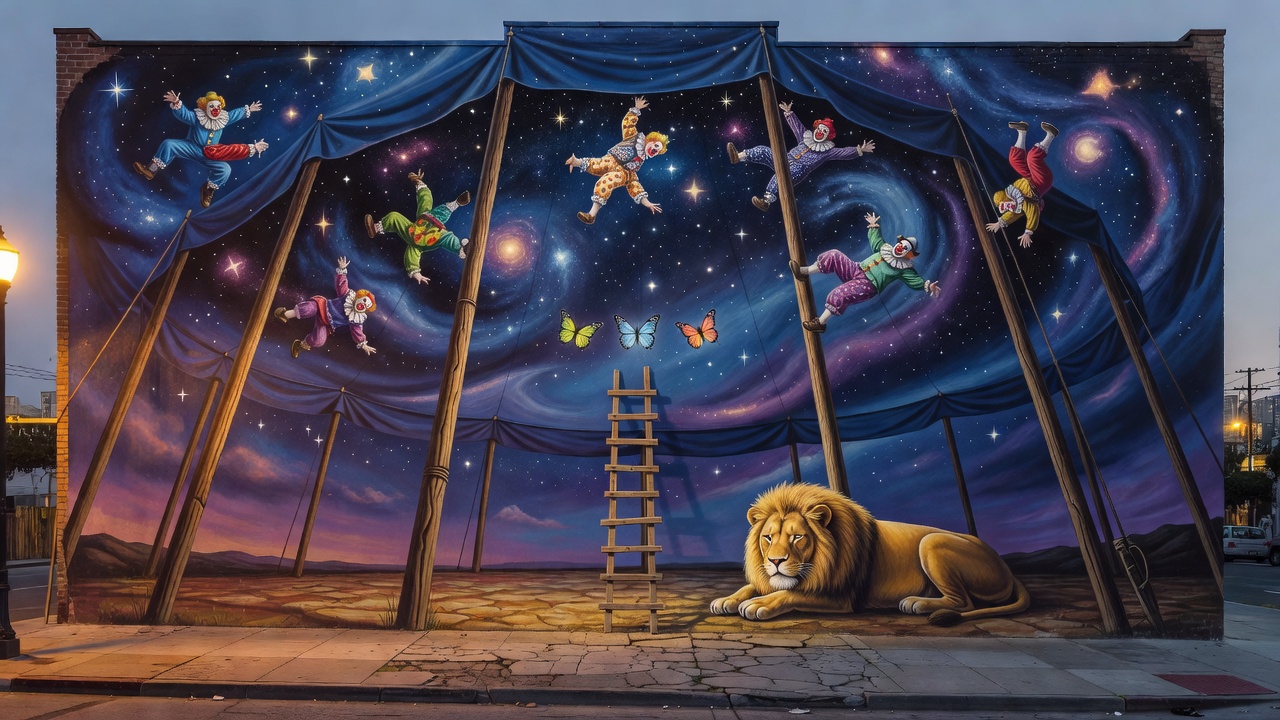
I found it on a Tuesday, on my way to buy oat milk, which has to be the least mystical errand in existence. Between a taqueria and a nail salon, four stories of wall: a circus tent whose canvas had been replaced by the night sky. Clowns were mid-leap inside it, tumbling between stars as if gravity were a rumor somebody started and nobody bothered to check. I stood on the sidewalk with my canvas bag and forgot the milk entirely. Fifteen years of wearing a red nose, and a wall I had never noticed before still managed to stop me cold. I teach laughter yoga in a theater in North Beach. I have juggled for crowds in Barcelona and Paris and for exactly one man eating a pretzel at Fisherman's Wharf. I am not easily surprised by joy, is what I am saying. But that wall did something a stage never quite does. It did not ask me for anything. No ticket, no curtain time, no hat passed around at the
end. It was simply there, and it had been there for months, waiting for somebody to look up. ## The Wall Nobody Commissioned The painter had set the tent poles in a ring like an eight-pointed compass, each one leaning a little differently, as if the whole thing had been pitched in a hurry by someone who loved it. A lion slept at the left edge. A ladder climbed into nothing. Near the seam where the canvas met the sky, three small butterflies were painted in a line, each one slightly larger than the last. I don't fully know why those butterflies undid me. I only know I put my palm flat on the wall the way you would put a hand on a horse. Here is what nobody tells you about street art. It arrives without permission and leaves without notice. Nobody funds it, nobody guards it. Eventually the city paints over it, or a landlord does, and the tent is gone and the sky behind it is just a wall
again. That is not a tragedy. That is the entire trick. Something can be temporary and still be the truest thing on the block. I have spent years learning that in rehearsal rooms and hospital hallways and one hailstorm at Union Square, and then I learned it again in four seconds flat, standing beside a parked car. ## The Painter I Used to Know He was there three days later, touching up the lion with a brush the size of a toothbrush. I knew him the way you know a song from its first three notes. We had chased the same crowds years ago, he with a bucket of chalk and a folding stool, me with my nose and my harmonica. He looked at me for a while and said, 'You got quieter.' It is the most accurate review my clowning has ever received. We talked for half an hour. I asked what the tent was for. He said it had started as a commission, then the money fell through, so he finished it anyway, which
is the whole story of his life and a good chunk of mine. He said the tent was for the kid who walks past it on the way to school and needs a door. Then he said the thing I have not been able to put down since. He said, 'I am painting it again in two years. Different tent. Maybe not me.' I asked if that bothered him, all those months going under a roller. He shrugged the way people shrug who have genuinely made peace with something. 'It isn't mine,' he said. 'I just get to hold the brush for a while.' I have thought about that sentence every single morning since, usually around minute four of teaching a room full of strangers how to laugh on purpose. ## A Cathedral That Packs Up A tent is holy geometry with a job. Look at it honestly: a circle pretending to be a building, canvas pulled taut over poles, ribs rising to the point where all the lines meet. Cathedrals do the same thing in
stone and call the meeting point a spire. The circus does it in fabric and puts sawdust on the floor. Sacred geometry keeps showing up in my life uninvited, in butterfly wings and street murals and the absurdly precise way a stack of juggling balls sits still when you finally get it right. A tent is that same shape, with a horn section. And here is the part I keep turning over. Inside a real tent everyone sits in a ring, which means everyone is the same distance from the middle. There is no back row. Painted on a wall, the tent has no center at all, so the center becomes whoever is standing in front of it. The kid on the scooter was the center. The two women taking photos were the center. The man eating a burrito with his mouth half full, staring up, was absolutely the center. That is architecture you cannot buy and cannot sell tickets to. I walked back to the theater that night and
looked at the faded mural on our own wall, the one that came with the building, the one I keep meaning to have restored. I had always read it as damage. Now I read it as somebody else's tent, pitched decades ago, worn thin by weather and a hundred thousand cars going past. The painter will come back and change his again in two years. I am starting to think the fading is not the flaw. The fading is the drumbeat. ## What the Tent Taught the Jester I have been teaching laughter yoga long enough to know the hardest part is the first thirty seconds, when a room of grown adults is certain they will look foolish. I used to fight that with volume. I would come in loud and fast and bowl it over. Lately I have been trying something else, something I stole from a man with a toothbrush-sized brush: I leave a door open, and then I get out of the way. The laughing starts without me pushing it, and it
is better laughing, less performed. The clown's oldest mistake is believing the act is the gift. It isn't. The act is the tent. The gift is the space underneath it, where somebody else gets to be a kid again for four minutes without being asked why. My theater is a tent. My class is a tent. The Pier 39 installation will be a very windy tent with me doing pratfalls in the middle of it. That wall in the Mission is a tent too, and I did not build any part of it, and I still got to stand inside it. ## Closing Reflection So go find your wall. Not metaphorically, either. Physically. Somewhere in your city there is painted canvas nobody paid for and nobody is guarding, holding a door open for exactly the person who needs one. Stand in the middle of it. You will not have to pay, nobody will ask you to explain yourself, and for a minute the whole sky will be stitched to the ground on poles that
somebody else leaned into place. I went back one last time on Sunday, early, before the class and the milk and the endless beautiful logistics of running a theater. The tent was still there. The butterflies were still in their patient little line near the seam. I did not add anything to it. I just stood in the middle and let the mural do what murals do, which is hand a stranger a door and trust them to walk through.