How to Balance Your Chakras, One Lens at a Time
By Aurora Spellweaver
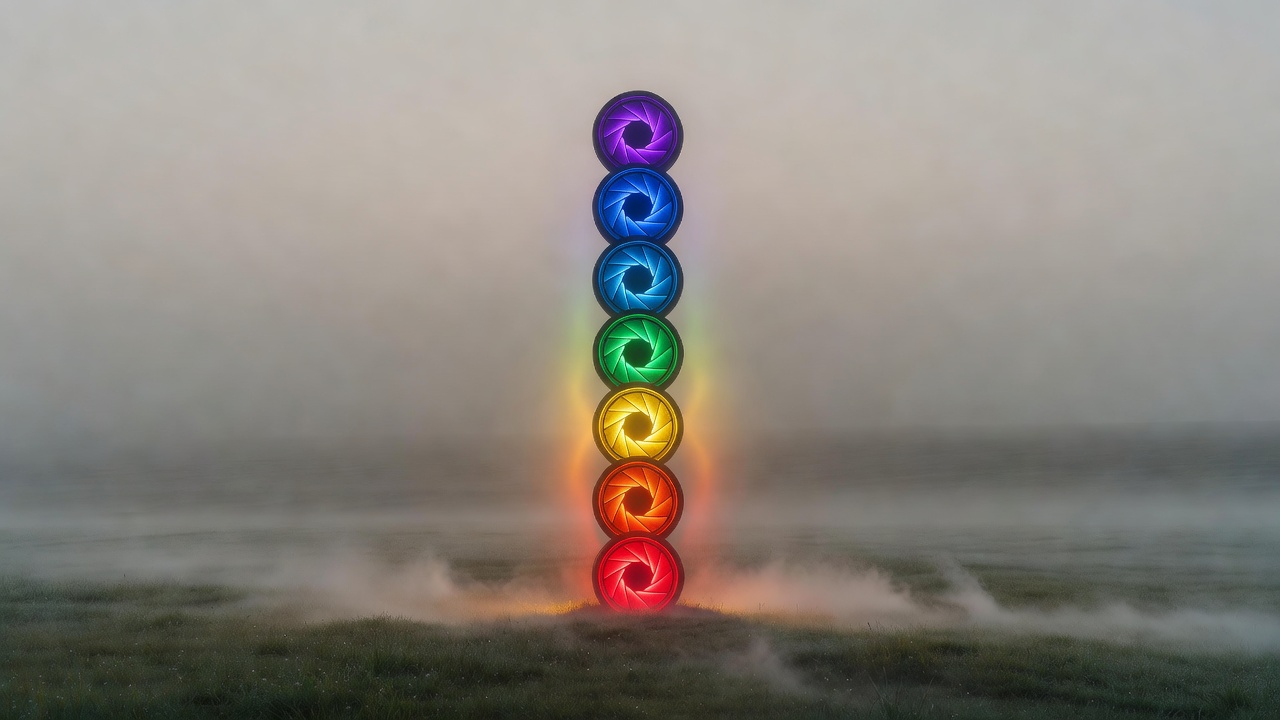
I spend a lot of my life looking for light. I photograph it, I chase it through the fog that rolls off the Bay, and on good days I get to catch it doing something it was not supposed to do. So when I started studying chakras, the old teaching that they are wheels of light made instant sense to me. They are not abstract energy centers. They are lenses. Think of a camera. Light has to pass through a whole series of glass on its way to the sensor, and if one piece is smudged, the entire photograph comes out dull, no matter how bright the morning is. The same thing happens inside us. We have seven of these lenses, running from the base of the spine to the crown of the head, and each one is responsible for a color and a question. Balance them, and the light flows. Ignore one, and everything dims. I am not a doctor, and this is not medical advice. I am a clown and a photographer who learned
the hard way that the fastest way to fix a muddy picture is to clean the lens instead of cursing the sky. So let me show you the seven lenses, how to tell when one is smudged, and the small, joyful ways I bring them back into focus. ## The Seven Lenses The first lens sits at the base of your spine and glows red. Its question is the oldest one any of us asks: am I safe here, in this body, on this ground? When it is clear, you feel rooted, calm, held by the earth. When it is smudged, everything feels urgent and unsteady, like standing on a dock in a storm you cannot see. The second, an orange wheel just below the navel, asks what you want. Not what you should want. What you actually want. The third, a yellow sun at your solar plexus, asks whether you can do the thing, whether you have the nerve. The fourth, green at the center of the chest, asks the bravest question of all: can I love, and
let myself be loved? The fifth is blue, at the throat, and it asks if you can say the true thing out loud. The sixth, indigo, sits between the brows and asks if you can see clearly, not with your eyes but with the quieter sight behind them. The seventh is violet, at the crown, and it does not ask a question at all. It just reminds you that you were never separate from anything. Here is the part nobody warns you about. These seven are not a checklist you clear once. They are a living system, and like any lens they get fogged by ordinary weather: a hard conversation, a month of poor sleep, a grief you have been carrying in your chest like an unpaid bill. The work is not to fix yourself. The work is to keep the glass clean enough to let the light through. ## How to Notice a Smudged Lens In photography you learn to read a bad frame before you try to fix it. Too blue means the white balance
is off. Blown out means too much light hit the sensor. Chakras give off the same kind of clues, and they usually show up first in the body, because the body is honest in a way the mind is not. A cloudy root shows up as tight shoulders, a churning stomach, or the feeling that you cannot fully arrive anywhere. A dim sacral shows up as numbness around your own desires, a sense that you do not know what would even delight you anymore. A weak solar plexus feels like second-guessing every move, the inner critic narrating your life like a heckler at a show. A heavy heart is the one most of us recognize: a literal ache in the chest, trouble forgiving, the instinct to flinch away from tenderness. A blocked throat feels like the words sitting in your chest at the exact moment you need them. A cloudy third eye feels like living in a fog bank, where you can see shapes but nothing with edges. And a
closed crown? That one is quieter. It feels like the absence of wonder, like you have forgotten that anything is holding you. I know all of these from the inside. I have stood on stage in front of a laughing crowd and felt utterly disconnected from it, grinning with my mouth while my chest was a sealed room. The first step is simply to notice. You cannot clean a lens you refuse to look at. ## The Light-Chaser's Way to Rebalance Here is what I love about this work: it does not require a monastery or a special robe or even much time. It asks for attention, which is the one thing we always have and the one thing we are most reluctant to give. The tools are everywhere, and most of them are things I already loved. Color is the simplest. Each chakra has its color, and simply sitting with that color, wearing it, picturing it pooling in the place where the wheel lives, is a real practice. I do
this with light, because light is my first language. When my solar plexus feels dim, I close my eyes and imagine a yellow sun the size of a coin warming the space just below my ribs until it spreads. Sound is another, and it is the one that reaches me fastest. Every chakra has a tone, a seed syllable the old traditions pair with it. You do not have to chant anything fancy. Humming, a single low note held while you breathe out, a singing bowl if you have one, even your own laughter works. Laughter yoga taught me this: vibration does not care whether the sound is pretty. It only cares that you made it. And then there is the simplest one of all, the one my camera taught me. Look for the color you are missing, in the actual world, with your actual eyes. Need grounding? Go stand on real dirt and notice the reds and browns you usually walk past. Need your voice? Go sing badly in the car with
the windows up. The lens cleans itself the moment you stop narrating and start looking. ## A Small Ritual for a Foggy Morning San Francisco taught me fog, and fog taught me patience. Some mornings I wake up and the whole city is a soft grey smear, and I cannot tell where the buildings end and the sky begins. Those are the days the light inside me goes grey too, and I have a tiny ritual for it. I make tea and stand at the window. I start at my feet, because you always start at the ground. I picture red, warm and low, and I breathe into it for a slow count of four. Then orange, then yellow, one slow breath each, moving up through the body the way morning light climbs a wall. Green at the chest, blue at the throat, indigo at the brow, violet spilling over the top of my head like water finding its level. It takes about two minutes. I do not force any of the colors to be vivid; I just invite
them and let them be as faint as they want. The fog does not lift because I asked it to. The point is not to burn the fog away. The point is to remember, on a morning when everything is grey, that the colors are still in there, waiting. You do not have to believe any of it to feel it. That is the joke the jester in me loves most: the practice works whether or not you have the theology sorted out. Do it for a week. Notice what shifts. The body keeps the score even when the mind is still arguing with the referee. ## Closing Reflection We are all walking around with seven lenses, and most of us never clean them because nobody told us they were there. Now you know. You are not broken, and you were never dim. You have just been trying to take a beautiful photograph through a smudged window, and the window was never the problem. The light was always waiting. So this week, pick one lens. Just
one. The one that felt heavy when you read about it. Give it a color, a breath, a sound, a few honest minutes. Then come back and tell me what you saw. I will be here, chasing the light, one frame at a time.