The Golden Ratio of a Punchline
By Aurora Spellweaver
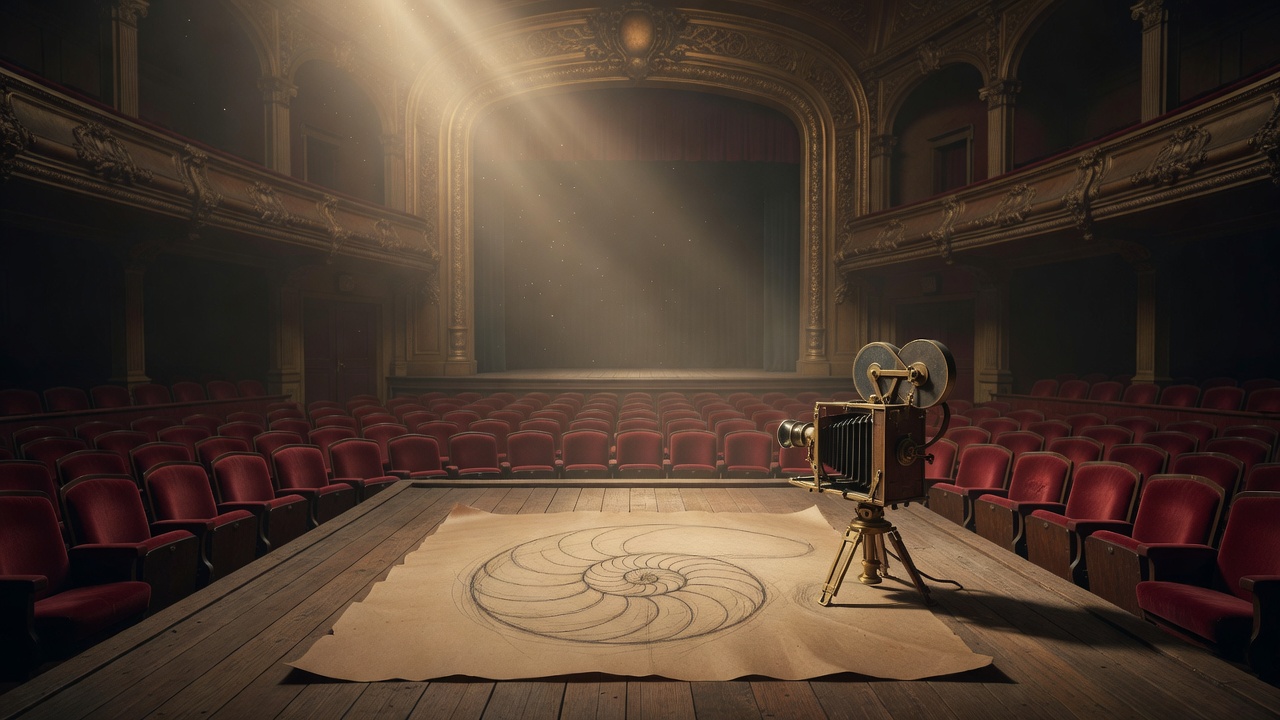
I have been spending my mornings inside a theater that does not yet know it is haunted. I bought it in the spring, a narrow old house in North Beach with a proscenium arch and seats that fold up like polite little ghosts whenever you stand. Most days I sweep. Some days I bring a tape measure, which is how all of this started. The room felt like a held breath, and I wanted to know why. So I measured it. The stage opening is not square. The house fans out from a point somewhere behind the last row. The balcony rail curves in a way my eye kept returning to, the way you keep returning to a face. I traced that curve onto brown paper and set a nautilus shell beside it. The two lines argued for a while and then agreed. I came in a clown with a broom and left with a geometry lesson. Nobody who built this room in 1911 would have used the phrase sacred geometry, and yet there it was, set in
plaster and worn paint, waiting for someone with too much time on his hands. ## The Room Knew Before I Did The builders worked with proportion the way a baker works with flour, by feel and by rule of thumb handed down through a guild. The arch is taller than it is wide by a ratio the eye reads as lift. The sightlines were tilted so a person in the very last row could still see a performer's shoes. Every choice was made so that attention would not have to be argued for. Good architecture is a form of hospitality. It invites your eyes to rest somewhere they did not choose. I have photographed light in fog banks for years, and I know the feeling of a frame that holds you without asking. This room is that feeling, made of wood and dust and one very stubborn popcorn machine. ## The Same Shape in a Joke Then it hit me that I had been studying this geometry my whole life in a different costume.
A joke has a shape. There is the setup, which builds the room, and the punchline, which turns the light on. The space between them is not random. Too short and the joke trips over itself. Too long and the audience starts furnishing the silence with their own doubts. My first mentor, a comic named Walt who never told me his last name, used to say, give them the beat, then give them one turn past comfortable. I never knew what that meant until I measured a theater. A pause has a proportion. So does a bow. So does the moment a clown decides to look directly at one stranger in the third row and quietly make them the whole audience. \*The best laugh is not the loudest one. It is the one that arrives on time.\* ## Where the Pattern Keeps Showing Up Once you notice proportion, you cannot un-notice it. The spiral of my stairwell. The curl of a fiddlehead fern. The way a sunflower sorts its seeds
so that no single seed is crowded out. The rose windows of cathedrals were set by people counting something, and so was the shell I keep on the windowsill beside a chipped mug of cold tea. My camera knows all of it too. The aperture is a small polygon, six blades or eight or nine depending on the lens, and the shape of the light that gets through is the shape of that little metal door. Photographers call the soft circles outside the focus bokeh. Nobody mentions that we are photographing the door as much as the light. I have spent thirty years chasing light and only recently noticed I was also collecting shapes. Maybe that is all a symbol ever was. Not a secret code with a lock on it, but a habit of the world that our eyes learned long before we had words for it. ## What I Am Building Now The venue is still half a building and half a promise. There are permits, a leaking ceiling, and a
popcorn machine from 1974 that I cannot bring myself to throw away. But I have decided to let the geometry do some of the work. We will keep the arch. We will keep the curve of the balcony. We will keep the worn places in the floor where a hundred years of feet already agreed on where to stand. I want a stage where a person can stand inside a circle of light and feel, without being told, that they are held. That is what the room was always for. Not to contain the jokes, but to shape the silence around them so that they land like something passed from a friend's hand. At fifty-seven I am in the second act of a life I did not exactly plan, and some mornings the laughter catches in my throat when I stop long enough to look at it. The jester's trick is to turn that catch into a bit and keep moving. But some mornings I just sit in the last row and let the room be taller than me. ## Closing
Reflection I do not think sacred geometry is a doctrine you have to believe. I think it is a way of paying attention with your body. The builders of this theater never lectured anyone about proportion. They set it into the walls, and a hundred years later a man with a tape measure and a broom finally understood what his own eyes had been telling him the whole time. If you want to find it yourself, you do not need a compass or a temple or anyone's permission. Measure the room you are sitting in right now. Look at the spiral of your staircase. Notice the pause right before the thing that made you laugh. The pattern was never hidden. It was only ever waiting for you to slow down enough to say hello.