The Laughter That Wasn't a Joke: What Teaching Joy Taught a Clown
By Aurora Spellweaver
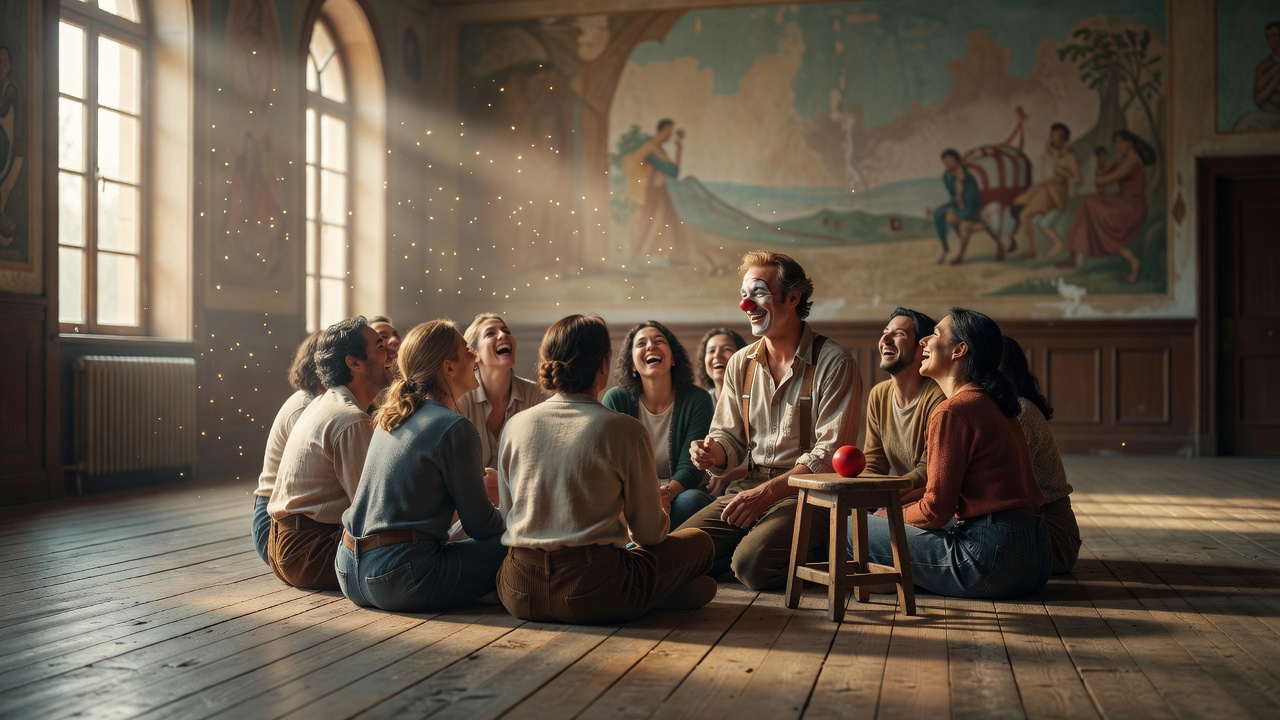
The last time I wrote here, I stood in an empty theater and tried to describe what the silence felt like. That was before the grand opening. Before the night the doors finally opened and a hundred strangers walked in off the street to watch clowns, eat circus snacks, and laugh until the old tilted stage seemed to straighten itself. I expected the opening to be a finish line. It turned out to be a starting gate. Once the theater had a crowd, it needed a heartbeat, and the heartbeat turned out to be a weekly laughter yoga class at nine in the morning, which I volunteered to teach myself. This is the honest report of a clown who agreed to lead joy on purpose, and what the class taught me about the joke I have been telling my whole life. ## The Room That Finally Filled The opening night was everything I hoped and nothing I planned. A mime borrowed my hat. A stranger in the second row juggled
three clementines better than I ever could. The show spilled out onto the sidewalk, the fog rolled in, and nobody left. I have spent years building things I cannot hold, and here was a night I could not hold either, which is exactly what made it work. But the morning after, the theater was quiet again, and I understood something I had avoided for decades. A venue is not a community. A party is not a practice. If I wanted the room to stay alive, I had to give it a rhythm, something that returned every week whether or not anyone was watching. The empty room had taught me to listen. The full room was going to teach me to show up. ## The Class I Almost Didn't Teach Laughter yoga sounds simple. You breathe, you make eye contact, you giggle until the giggle turns real. I am a street clown, so I assumed I had a head start. I was wrong. On stage I control the joke. I know exactly where the
punchline lands. But in that class there is no punchline. The first morning I stood in front of twelve strangers with no red nose and no routine, and for the first time in my adult life I did not know what to do with my hands. So I stole from my own craft. I taught them the clown breathing I use before a show. I had them hold a silent laugh for ten seconds, then twenty, until the silence cracked and the laugh turned real. One woman laughed so hard she cried, and then she kept crying, softly, and I almost stopped the class to fix it. That would have been my oldest mistake. She looked at me and said, this is the first time I have laughed since my mother died, and the first time I have cried since she died too. Same door. Same door. ## The Joke That Wasn't There Here is the confession. I became a clown because I am terrified of my own feelings, and I got very good at making sure nobody
noticed. The jester's gift is finding light in the mundane. The jester's tax is that you never have to sit in the dark with yourself. My whole act has been a beautiful, well-rehearsed deflection, and the laughter yoga class dismantled it without meaning to. You cannot deflect a laugh that has no punchline. You cannot hide behind a joke that was never told. When the class laughs, it is not because I am funny. It is because they gave themselves permission, and I was only the person holding the door. For fifty years I believed my job was to make people laugh. The class taught me my real job is to make it safe for them to feel, and that laughter and grief are the same muscle flexing in different directions. ## The Nose Comes Off So I changed one small thing. When the class begins, I take off the red nose. I set it on the stool where everyone can see it, and I tell them the nose is the
costume and the costume is the mask, and today we practice without masks. Some mornings I do not want to. Some mornings I want the joke more than the truth, which is exactly why the nose has to stay on the stool. The theater is still crooked and the mural is still faded and the van is still waiting for the tour I keep promising myself. But every Tuesday morning, twelve people show up and laugh at nothing, on purpose, until it becomes something. I am learning that joy is not a punchline. It is a practice. You do it badly at first, then you do it again, and somewhere between the second and the twentieth time, it stops being an act and starts being true. ## Closing Reflection If you have ever hidden behind your own cleverness, or laughed to avoid the thing you were actually feeling, the door opens from the inside. You do not need a theater or a class. You need one honest sound, made with no
audience, repeated until it stops being scary. The room is full now. The joke is not. And for the first time in a long career of making people laugh, I am not performing. I am practicing. Come find me in North Beach on a Tuesday morning, bring your honest laugh, and I will leave the nose on the stool for you.