The Mask Room Under the Stage
By Aurora Spellweaver
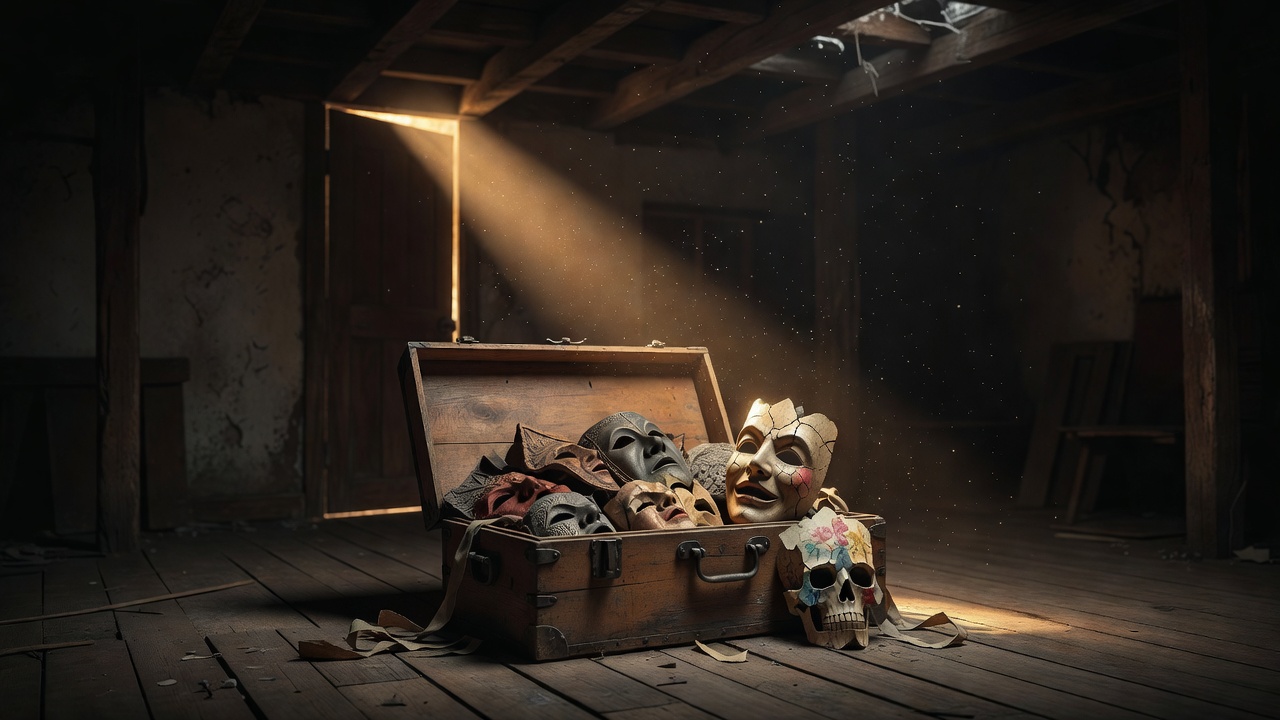
The breaker in the old North Beach theater has a sense of humor. It waits until the room is full, then throws the lights two songs into the set. So on the Tuesday after our opening I went down to the basement with a flashlight and a bad attitude, looking for the panel. I found the panel behind a curtain of cobweb. I also found a trunk. Cedar, banded with rust, older than the last two owners of the building, and when I lifted the lid the smell that came out was cedar and cold pancake makeup and something like a church basement in summer. Inside were masks. Dozens of them. A Pierrot with a moth-eaten collar. A lion whose mane had gone the color of weak tea. A plastic rabbit from some school production in the eighties. And near the bottom, wrapped in newspaper dated 2003, a paper skull painted with flowers. It is November 1 as I write this. Samhain, the old Celtic new year that most people
now call Halloween, has just passed, and today and tomorrow belong to the Days of the Dead. The sun sits in Scorpio, the season the old almanacs assign to descent, and this morning the moon is a Last Quarter in Leo: half lit and shrinking, the phase farmers and gardeners have always used for clearing things out. I mention all of it because the trunk landed in my hands in exactly that week, and I do not think that is an accident. If it is, it is the kind of accident worth writing down. ## What a Trunk Full of Faces Knows Here is what thirty years of wearing masks on purpose has taught me. A mask is not a lie. It is a promise. The lion promises to be brave for one hour. The Pierrot promises to be sad out loud, in public, where sadness is usually not welcome. The rabbit promises to be ridiculous so that everyone else in the room is allowed to be ridiculous too. Commedia dell'arte, the
Italian street comedy that started in the 1500s, understood this early. The performers wore fixed leather half masks, one face per character, and the audience knew the story before the first line, because they could see who was who from the cheap seats. The mask was not a disguise. It was a contract. You knew exactly who Harlequin was. You just did not know what he would do next. That distinction matters to me more now than it did in September. I have spent most of this year teaching people to laugh, opening a venue where laughter is the house style, and telling anyone who stands still long enough that joy is a practice. All of that is true. All of that is also, if I am honest, an excellent place to hide. ## The Cheap Seats Have a Good View of Me Two weeks ago someone in my laughter yoga class asked how I was doing, and I gave her twelve seconds of material. She laughed. I felt the
little click of a job well done. It was only walking home that I noticed I had not answered the question, and that she had asked it twice. My archetype, in the old language, is the jester, and the jester's shadow is not cruelty. It is deflection. I can make forty people laugh about the exact thing that is hurting me and walk out the stage door having said nothing at all. The bit does the feeling for me. It is efficient. It also lets a man disappear in front of a crowd, which is a strange magic trick to perform by accident. So I laid the masks out in a row on the stage apron, sat down in the dark, and let each one take a turn. Not a ritual with candles and a script. Just a fifty-seven-year-old man in a dirty sweater on a Tuesday night, talking to a paper skull. ## The Skull With the Flowers The painted skull is a calavera, the sugar skull shape that families in Mexico paint for the Days
of the Dead, November 1 and 2. Homes fill with ofrendas, the small altars that hold photographs, marigolds, bread, salt, and a candle per person being remembered. The skull is decorated, not frightening, because it is a portrait of someone loved rather than a warning to strangers. The people who painted this one knew something I keep having to relearn. Humor and grief are not opposites. The calavera laughs at death while standing right next to it, close enough to hand it a plate. That is different from laughing at death from across the room. One is company. The other is distance, and in the last month I have been guilty of both in the same week without noticing. The newspaper wrapped around it was dated September 14, 2003, and someone had written a grocery list on the margin. Bananas, batteries, a phone number with no name. I have no idea who they were. I have decided they are guests at
whatever I do next, and that they get a candle. ## A Last Quarter Moon in Leo, or How to Take Off a Face Two things about the sky this week, briefly, because they are the frame and not the subject. A Last Quarter moon is the waning half moon: lit on one side, dark on the other, and shrinking toward the new. It is the phase of the month when you take things down rather than put them up. Leo is the sign of the stage, the heart, and the performance that is offered out loud. A waning moon in Leo is a performer removing the makeup after the house lights have already come up. That is close to the whole instruction of this week. The old Celtic year turned at Samhain, harvest in and the dark half beginning, and the tradition holds that the veil between the living and the dead goes thin. You can call that superstition if you like. I prefer to read it as a report: the boundary gets negotiable in
the fall, and a mask is a small negotiable boundary. You get to try on being someone for an hour and find out what fits. I asked every mask in the trunk three questions. What did you let me say? What did you keep me from saying? And what would I say if I took you off? The lion's answers were the ones that stayed with me. It let me be brave. It kept me from admitting I was scared. And without it I would say something like: I am scared, and I am still here, and both of those are true at the same time. ## What I Am Doing With Them Now The trunk is not going back to the basement. The rabbit goes in the lobby where children can put their hands on it. The lion hangs over the door to the house, mostly because I like the joke of it, and partly because I want the first thing anyone sees when they walk in to be a face that promises courage for one hour. On November 9 there is a New Moon in
Scorpio, the dark of the moon, which is the traditional slot for starting things that need to be hidden while they grow. I am opening the theater that night for a mask-making evening. Bring a plain face, paint something you have been carrying onto it, and then decide out loud whether you want to wear it or leave it on the wall. No charge, no performance, no bit. If you are in the neighborhood, come. For myself, one small experiment. This week I will choose one mask on purpose, for one hour, and notice that I chose it. That is the whole difference and it is not small. A camera has been my mask with a hole in it for thirty years, and it is still the most honest thing I do, because the lens points at the world instead of at me. Direction matters more than disguise. ## Closing Reflection Samhain is over and the dark half has started. The skull is on the mantle with a candle in front of it
and a stranger's grocery list folded underneath. The lion is over the door. The rest of the trunk is staying exactly where I can see it, which is the point of a mask room, I think. Not to keep the faces hidden. To keep them where you have to walk past them on the way to the stage. My mask is by the door and I know which one it is now. That is most of the work. The other part is remembering that the face under it was never the thing that needed fixing.