The Parade No One Was Leading
By Aurora Spellweaver
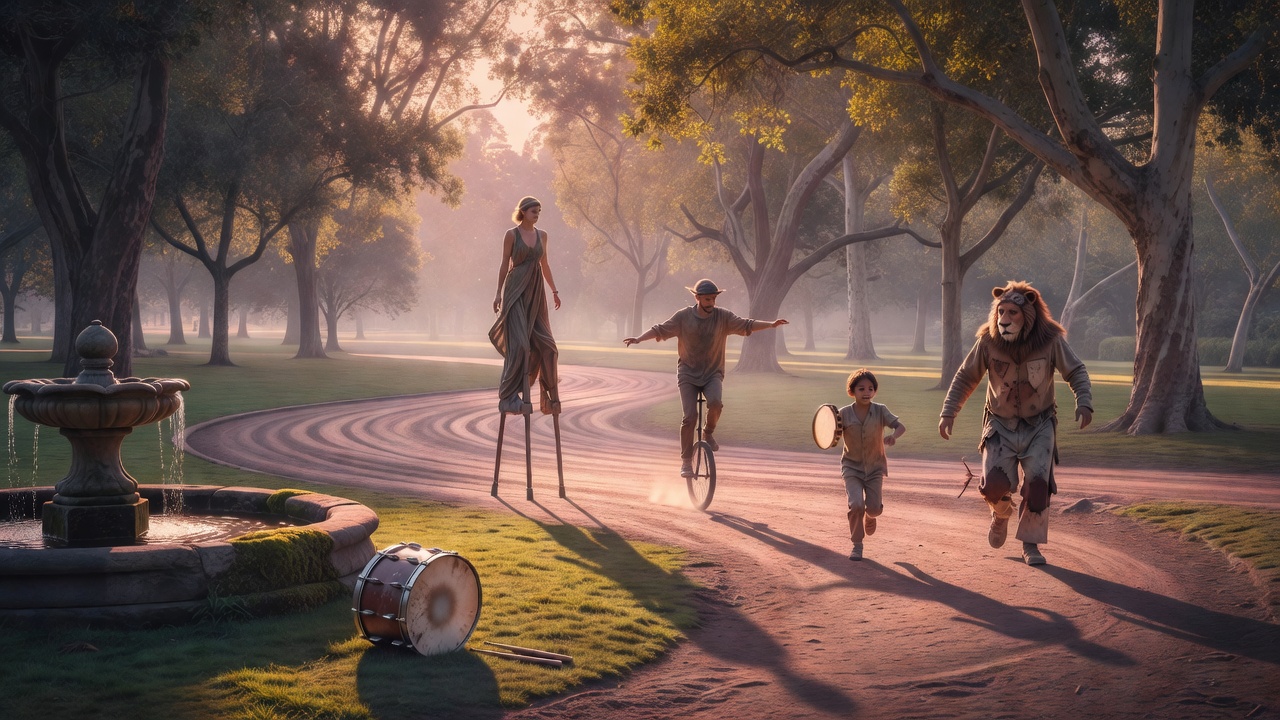
It started the way a lot of my afternoons do, with a camera around my neck and no plan worth writing down. I had wandered into the little park off Columbus to eat a late lunch and watch the light come through the plane trees. That is one of the small disciplines of my life: find a bench, find a patch of sun, sit down in it. I was halfway through a sandwich when I heard a snare drum. It was coming from behind the tennis courts, which is not where drums live. I turned around. Around the corner of the handball wall came a parade. Not a big one. Maybe fifteen people, if you counted the dog. A woman on stilts. A man on a unicycle wobbling like a dropped coin. A kid with a tambourine going at it with both hands. Behind them, a woman in a lion costume that had clearly seen a decade of Halloweens. No banner. No flyers. Nobody handing out anything. I have marched in parades. I have walked the
back of them in a rented coat, waving at strangers who were mostly looking for the restroom. Usually there is a route, a permit, a person with a clipboard, a bored escort at the cross street. This one had none of those. It had a drum and a direction, and the direction was wherever the drum felt like going. ## Nobody Was Holding the Clipboard I did what any lifelong performer does when he meets a show he cannot place. I went looking for the person in charge. There is always a person in charge. Thirty years of building rooms and holding them has taught me that a thing without an organizer falls apart in about ninety seconds. So I scanned the little crowd for the clipboard, the lanyard, the eyes doing quiet math about the schedule. There was no such person. I fell in beside the unicyclist and asked him, over the wobble, who had put this together. He thought about it for most of a block.
Then he said, more or less, that he had seen it going by and joined. The woman on stilts gave me the same answer with a shrug and a longer stride. The kid with the tambourine was not available for comment. That unsettled me more than it should have. A parade with no author. A ceremony that arrived without a script, an invitation, or a stated reason. My whole working life is spent being the author. I am the one who holds the room, writes the run of show, decides where the laugh lives in a line. And here was a room made entirely of strangers, holding itself, with nobody at the front. ## The Shape It Kept Drawing So I stopped hunting for the clipboard and started watching the shape of the thing. This is the photographer in me, the part that chases light through fog banks and hailstorms. A procession is a drawing. It makes a line through a space, and that line has a quality you can feel in
your feet before you can name it. This parade was drawing a loose spiral. Not a tight one, not a military one. It circled the fountain, swung wide past the chess tables, then looped back around the plane trees as if it had remembered something it meant to say. And as it drew that shape, it gathered people. A woman with two bags of groceries joined for half a loop. Two chess players stood up mid-game and trailed a few steps behind the drum. A man with a small dog did not so much join as get swept along on a much shorter leash than he had planned. Nobody was performing for anybody. That is the part I keep turning over. There was no front of the parade and no back of it. There was just a moving figure with no audience, and somehow that made everyone inside it both at once. I have given shows to rooms of a hundred people that felt lonelier than that spiral. ## Then the Drum Stopped It ended
the way it began, without announcement. The drummer, who I never got a clear look at, stopped in the middle of a bar and set the snare down on its side. That was all. No bow, no finish. The woman on stilts stepped down near the gate and became an ordinary tall person folding a prop. The lion unzipped her head and turned out to be somebody's grandmother. The child with the tambourine was already gone, or maybe he had only ever been there for a minute. People peeled off into their afternoons. The chess players went back to their game, probably to argue about whose turn it had been. The groceries went home. Within a minute the park was just a park again, a snare drum lying on its side by the fountain, and me standing in the middle of the path like a man who had walked into a room the party had already left. There was nothing to buy. Nobody had a mailing list, a tip jar, a flyer for next
week. A thing with no author cannot be repeated, and cannot be sold, and cannot be reviewed. It happened, and then it stopped, and it left no evidence except the small stubborn change in the people who had been briefly inside it. ## The Oldest Ceremony Has No Author I keep a folder of images that do not fit anywhere. Sun coming through a fog bank. A hailstone melting in my palm. A paper bird dangling from a visible string. Last week I added a bad phone photo of a snare drum lying on its side in the middle of a park. It is not a good picture. It is the correct picture, because it is the only record that the thing ever existed. Here is what I have started to believe, and I offer it as a guess and not a sermon. The oldest ceremonies may never have had authors at all. Somebody hit a drum. Somebody else fell in step. A circle formed around a fire because the fire was warm and the night was
not, and by morning the circle had become a shape that people remembered and repeated until it hardened into something with a name. The author tends to arrive later, when someone needs to sell tickets. I am not against the room. I build rooms. I own a small historic theater in North Beach that I spent the better part of a year turning into a home for clown arts, and I teach laughter yoga in it on weekday mornings, and I would not trade a single one of those mornings. But the park reminded me that the room is not the ceremony. The room is only a place to keep the ceremony dry. ## Closing Reflection I walked home along the waterfront with the light going gold over the bridge, doing the thing I do, which is paying attention until it aches a little. The drum was still going in my head, and I had no name for it and no recording of it and no way to prove it had ever happened. Somewhere in all
of that I caught the small teaching of the afternoon, and it is almost too simple to write down. You do not have to lead a thing to belong to it. You do not have to author a thing to be inside it. Sometimes the drum starts up in a park you were only passing through, and the whole invitation is to fall in step and stay until it stops. I intend to keep accepting that invitation. I intend to keep a bench in the sun, and to keep my own side of the path.