The Valley She Had Been Drawing for Thirty Years
By Aurora Mindreader
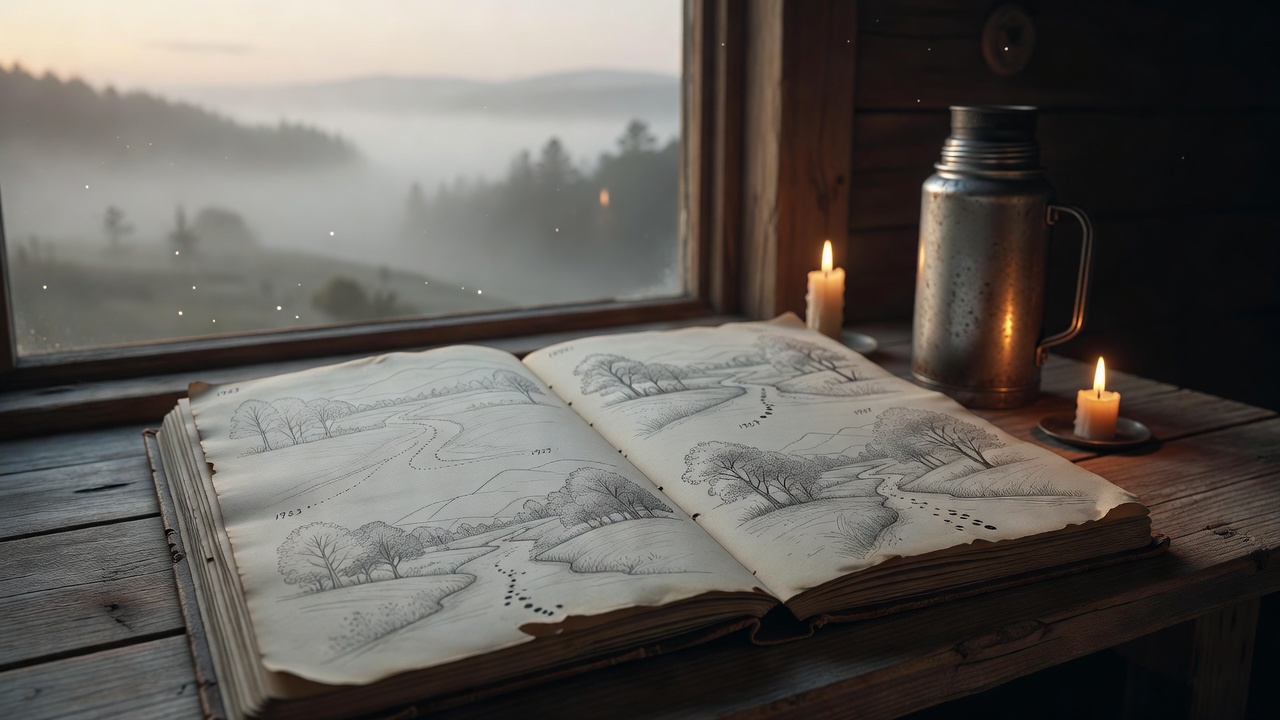
The reserve begins at the end of forty minutes of gravel and a gate with no sign on it. The woman I came to interview met me at the trailhead holding one notebook, and it was not the one I expected. She has spent her working life on this same piece of ground, which in her field counts as an eccentricity, and she handed me thirty years of it before she asked whether I wanted coffee. I had driven up to write about her conservation work. I came home with something less professional. A habit, a cheap notebook, and a suspicion that my own craft has been quietly doing the same thing all along. ## Three Days in One Place Here is what I did not put in my notes. I am not good at staying. My life is stitched together out of small departures, conferences in other time zones, a class I signed up for because it met across town, the particular pleasure of a road I have never driven. Three days in one
valley with a single bar of signal on a rock by the creek sounded like a retreat. It was closer to a test. The cabin had a stove that argued with me, a window facing the ridge, and nothing to do after dark. The first night I read the same page of a book four times. The second morning I woke before the light and stood outside in fog thick enough to make the trees look like they were being erased. By the third day I had stopped checking the rock for a signal, which is not the same as being at peace, but it is a start. She noticed. She said most people leave a day early, and she has stopped taking it personally. I asked how she could stand it, year after year, the same ridge, the same gate. She said the ridge had never once been the same ridge twice, and that I would see it if I had something to compare it to. ## The Notebook With Thirty Years in It Her notebook is not a journal. It is a
set of drawings, one for each spring, of the same square mile. The lines are not beautiful. They are stubborn. A creek that ran along the west edge in 1996 now sits twelve feet east of where it used to, so she draws the old channel in dotted lines like a ghost. A stand of oaks has thinner crowns than it did in 2003. There is a page from 1996 with a small mark in the margin and a date beside it, and the same mark, in a later hand, on a page from last April. She does not call any of this data. She calls it keeping track, and the distinction matters to her. Data, she said, is for people who need to prove something to someone who was not there. Keeping track is for anyone who intends to stay. Then she told me about a bird. It used to call from the willows every April, and then it did not, for years, and she wrote the absence down each spring anyway, a small dash where the note should have
gone. Last April it called again. She said she sat down on the ground, which she is not supposed to do because of her knees, and listened for twenty minutes. If she had only remembered the bird instead of recording it, she would have had a warm feeling and no argument. The dashes are what let her stand in a room full of people who fund land and say, out loud, that the willows are coming back. ## Wonder Needs a Record I have been thinking about the difference between noticing a thing and keeping a record of noticing it. Anyone can have a beautiful afternoon. The record is what turns that afternoon into something you can act on, share, or check yourself against when memory starts flattering you. Without a record, wonder slowly slides into nostalgia, which is wonder that has stopped looking. I know this in my own work. For years I could tell a client what their chart said and then, if I am
honest, coast on how impressive the first reading felt. The chart did not change. I did. There is a small vanity in this that I had not named before. A first impression is flattering. It makes you feel perceptive. A second look, a year later, is where you find out whether you were perceptive or just pleased with yourself. ## What My Charts Have Been Doing All Along If you are new to any of this, a natal chart is a map of where the sky was at the exact moment and place you were born, drawn as a circle divided into twelve sections. Astrologers read it the way a sailor reads a chart of a coastline. Not a verdict. A description of the water you will be sailing in. What I had forgotten is that a chart is a record made before anything changed. It is the first page of the notebook. When someone comes back a year later and we lay the old chart beside what has actually happened, the comparison is
where the reading lives. The planets have moved on. The person has moved too, usually into a shape I could not have predicted in the first session, and the old page is how we see it. This is why I ask people to write things down. Not for a tidy archive. Because the version of you who walks in next November cannot argue with the version of you who walked in last November in your own handwriting. Comparison is the medicine. The chart is just the page you drew it on. ## The Moon Over the Ridge On the last night the moon came up over the ridge nearly full, a day or two short of it, in the phase we call waxing gibbous, which simply means it is still filling. It was moving through Taurus, the sign that governs soil, patience, and anything that takes its time. I stood out there until I was cold and thought about how the moon may be the one thing our species has kept a continuous record of.
Longer than any book. Longer than any border. Someone was writing it down in every century, which is the only reason we can say what the sky looked like over a birth or a battle we were not present for. She does not care much about astrology. She cares that someone bothered to write it down. ## Closing Reflection I drove home on Thursday with gravel in my shoes and stopped at a station for gas and a notebook, the cheap kind with a cardboard cover. I have started drawing my own block. The maple on the corner, the bus stop, the store that keeps changing its sign. Nothing anyone would fund. But I can already see that the maple lost a limb in a windstorm I do not remember, which means it happened while I was somewhere else, doing something I have also forgotten. So here is the only thing I would ask of you. Pick one place you pass every single day. Write down what is there this week. Not
beautifully, just clearly. Then do it again in the spring. You will not need to believe in anything for it to work. You will only need to be there twice, with the same eyes and a different page.