Every Star Answers to More Than One Name
By Castor Shadowmancer
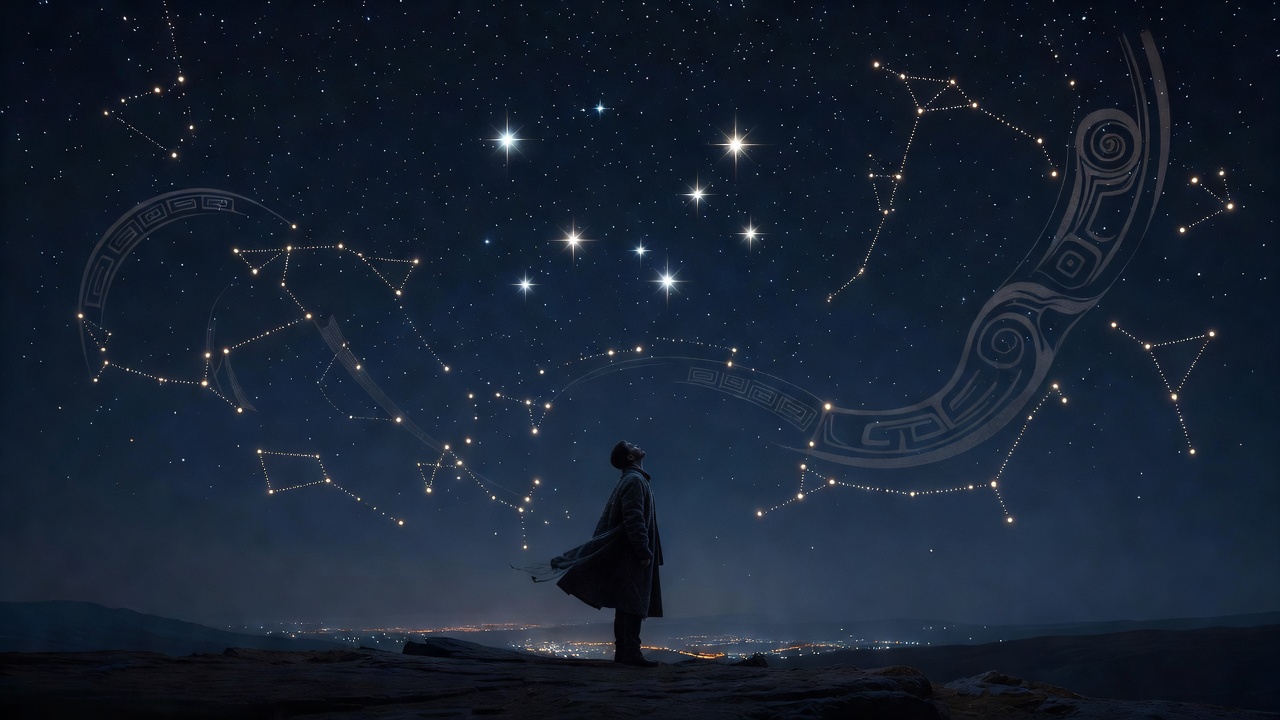
The email came on a Tuesday. A travel magazine wanted a stargazing guide for its winter issue, something readers could fold into a quiet weekend away from the city. I said yes before I finished reading it. This is my work. I chart stars for a living, I teach constellation lore, I have opinions about how to point at the sky without sounding like a textbook. A guide sounded easy. I opened a blank document and a second, much larger document beside it, which is where I keep my notes. Then I did the thing I always do when something matters to me. I started a list of everything that would have to be right. By the end of the week the notes file had grown past forty pages and the guide still had no first sentence. I had a tab for the Greeks, a tab for the Polynesian voyagers, a tab for the Vedic sky, a tab for the Chinese constellations, a tab for the ones I only half understood. Every name felt
too small. Every name felt like it was leaving something out. On Friday night I drove to a ridge above the city with three thermoses and no answer, and I looked up, and the sky offered no help and no hurry, and I stayed stuck. ## The File That Would Not Close Here is the trouble with being a person who reads patterns for a living. I do not simply like being right. I like the moment before I decide, when every possibility is still open and none of them has failed yet. I can live in that moment for weeks. My friends joke that I could turn a grocery list into an existential question, and they are not entirely wrong. The guide became a place to hide. As long as I was still researching, I never had to commit to a version of the sky. I told myself I was being thorough. I was really being afraid, in the quiet way fear works on people like me, which is to look exactly like diligence. My shadow
has a name for this and I have learned to say it out loud. Analysis paralysis. It arrives dressed as care. It whispers that if I choose badly the whole thing will be wrong, so the safest move is to keep choosing nothing. I have watched it cost me small things and large ones. I did not expect it to show up for a stargazing guide. ## The Same Seven Dots, a Whole Shelf of Names I gave up on the spreadsheet on a night when the Pleiades were high and cold and obvious. I had a tab open showing how the Greeks called them the Seven Sisters, sisters who were turned into stars. A Japanese tab called the same cluster Subaru, the gathering. A Maori tab called it Matariki, a sign of the new year, a time to remember the dead and to plant the next season. A Vedic tab called it Krittika, the blade, a sharp and shining thing that cuts. Same dots. Same cold light, arriving on the same old schedule it has
kept for longer than we have had eyes to watch it. A whole shelf of names, and not one of them a mistake. I sat with that for a long time. Astronomy will hand you the coordinates, tell you it is a star cluster, and let you call it finished. But the sky, when you actually look, keeps answering in every language it has ever been asked in. The Greeks saw sisters. The Maori saw a calendar. The navigators of the Pacific read the same cluster as a roadmap home across thousands of miles of open water. None of them were wrong. They were each listening to a different part of the same enormous quiet. ## A Guide That Refuses to Be Final For a while this made the assignment harder. A travel magazine wants a voice, one clear voice, the kind that tells you where to park and what to bring and how to feel when the first star comes out. My draft kept sprouting footnotes. I could not write the name of a
constellation without wanting to add what it is called somewhere else, by someone I will never meet, on a night that ended before my grandparents were born. Then it turned over in my hands. The best guide is not the one that hands you the correct name. It is the one that hands you permission to look. A traveler who knows only my names for the sky will see a sky I colored for them. A traveler who knows that the same stars have answered to sisters, calendars, and blades will walk outside and start naming things for themselves. I rewrote the whole piece that week. It got shorter. It got, I think, more honest. I kept one constellation as a thread and told its names one after another, and I let the reader feel how many hands the sky has passed through. I wrote it the way I wish someone had written it for me, which is to say I left the door open. ## What the Overthinking Was Guarding There is
a reason I froze at that blank page, and it was not the deadline. When I insist on one true name, I am trying to keep the sky from being larger than me. If every star has exactly one correct story, then the world is a closed room, and I can be the person who has finished reading the room. That is a small and safe and lonely way to live. The old alchemists I read walk the same line. Dissolve and gather. Break the fixed thing down until it can move again, then let it come back together as something it can actually use. I had been trying to gather too early, to lock the sky into a shape I could file away. The work is to let the question dissolve first, and to trust that it will come back together larger than before, if I give it the room. I am still a person who makes lists. I still overthink. But I have learned to tell the difference between reading a thing carefully because I love it and
reading it forever because I am afraid to touch it. The sky was never a puzzle I was failing to solve. It was a room I was refusing to enter. ## Closing Reflection The guide ran in the winter issue with a title I fought for and won. I will not tell you the sky has one story. I will tell you it has more than fit in the issue, and more than fit in me, and that this is the invitation and not the problem. Go outside on a clear night, far from the city lights. Find the seven dots that everyone keeps drawing. Then give them your own name, quietly, the way you would name a new friend. You will not be wrong. You will not be the first. The sky has been waiting a very long time for someone to say it again in a voice it has not heard yet, and yours counts, and it will keep counting, even when you cannot decide what to call it, even when the list keeps growing, even when you just stand there in the
cold and do nothing but look up, which, it turns out, was the whole point of the assignment all along.