The Dolphin I'd Forgotten How to See
By Castor Shadowmancer
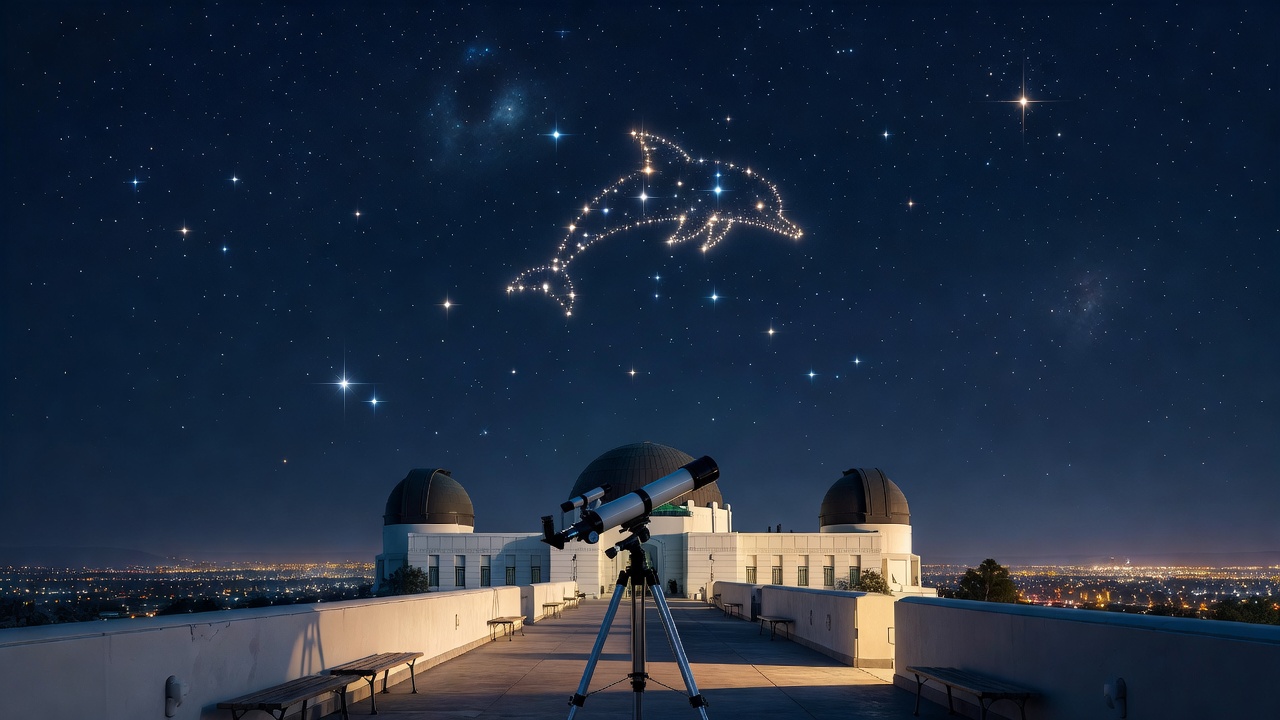
A travel magazine sent me a question I spent three weeks not answering: what does a stargazing guide actually give a person? I had coordinates, catalogue numbers, and a folder of notes on spectral classes. What I did not have was an answer. The magazine wanted a guide that would sit in the glove compartments of rented cars, something a person could read at a trailhead before the light failed. I wanted to give them something true, and I had begun to suspect that truth and coordinates were not the same thing. So on a warm evening in late summer, I left the laptop open on the kitchen table and walked up to Griffith Observatory to clear my head, in exactly the way a man who has spent too long indoors convinces himself he is being productive. Near the railing on the east terrace, a young astronomer I had never met was setting up a small telescope. He could not have been more than seventeen.
He was adjusting the eyepiece with the careful, patient hands of someone who had done this a thousand times, and when he saw me watching, he nodded toward the sky like I was an old friend he had been waiting for. ## The Constellation You Can Miss 'Have you ever really seen Delphinus?' he asked. I laughed a little, because I write about Delphinus. I knew it was a small constellation in the northern sky, four main stars forming a compact diamond with a tail trailing east. I knew the myth: the Greek poet Arion, thrown from a ship and carried safely to shore by dolphins, the grateful Apollo setting the dolphin among the stars. I knew its neighbors, its best viewing months, its history in the old star atlases. I could have recited all of it from memory, and I had, in fact, typed most of it into a draft that very afternoon. He stepped aside and gestured at the eyepiece. 'Look,' he said. So I
looked. And there it was, not as a diamond on a chart but as a creature: a small, bright dolphin mid-leap, frozen in the dark, trailing a tail of light behind it. I had looked at Delphinus a hundred times over the years. I had never once seen it. ## What Knowing Had Cost Me That is the quiet hazard of my work. I read the sky for a living, and somewhere along the way I began to mistake the map for the territory. Every star became a coordinate, a magnitude, a paragraph I owed the guide. The sky became a library I was reorganizing, and the wonder that had made me pick up my first telescope at nine years old had gone somewhere I could not find. I had written, once, that the stars were my first teachers. Somewhere I had become the kind of student who takes notes during the lesson and misses the lesson entirely. My friends would say I overthink, and they would be right. The shadow side of a
seeker is the analyst who cannot stop: the one who must name, categorize, and file every experience before he is allowed to feel it. I could lecture for an hour about Delphinus and never once notice the dolphin. I could write a guide that taught people to identify stars and, in the same pages, teach them never to actually look. ## First Light The young astronomer did not lecture me. He simply waited while I looked, and then he asked the question that undid me: what do you see? Not what is it called. Not what magnitude is it. What do you see. And because he asked with his eyes instead of his charts, I answered with mine. A dolphin, I said. Leaping. He smiled like I had passed a test I did not know I was taking. We stood there a while, watching it climb. He told me his grandfather had shown him Delphinus when he was six, pointing up from a beach in San Diego, telling him the dolphins carry
people who fall overboard, and that some of them are still out there, leaping. He had come to the observatory that night, he said, to show the constellation to anyone who looked lonely. I was the lonely one. ## Closing Reflection I finished the guide, but I rewrote the opening. It no longer begins with coordinates. It begins with a single instruction: put the book down, go outside, and let the sky find you. A guide is only honest if it sends people out to look, not back to the index. I wrote the chapter on Delphinus last, and I wrote it the way that boy taught me: from the eyes, not from the files. These days I give myself five minutes of first light before I open anything: five minutes of looking without naming, letting the small, faint things leap. The dolphin is still there, small and bright, mid-jump over the city's glow. It was always there. I had simply stopped seeing it, and I
needed a stranger with a little telescope to hand me back my eyes.