The Garden That Prescribed Its Own Colors
By Castor Shadowmancer
I am the person in the room who names things. Hand me a color and I will hand you a chakra back. Hand me a star and I will give you its myth, its Arabic root, and the century somebody first bothered to write it down. It is a good living. It is also, I am starting to suspect, a very expensive habit. Last Tuesday I took a fork in Runyon Canyon that I usually walk past. I had forty minutes before a client call and a plan to be back at the car with time to spare. Forty minutes later I was sitting on a rock beside a pond I have never seen on any map of that park, and I did not want to name anything at all. ## The Path I Had Been Skipping I have hiked that canyon for years. I know where the fountain is, where the tourists turn around, which switchback gets the good light at 6:40 in the morning. What I did not know is that a few hundred feet past the second bench there is a trail that does not
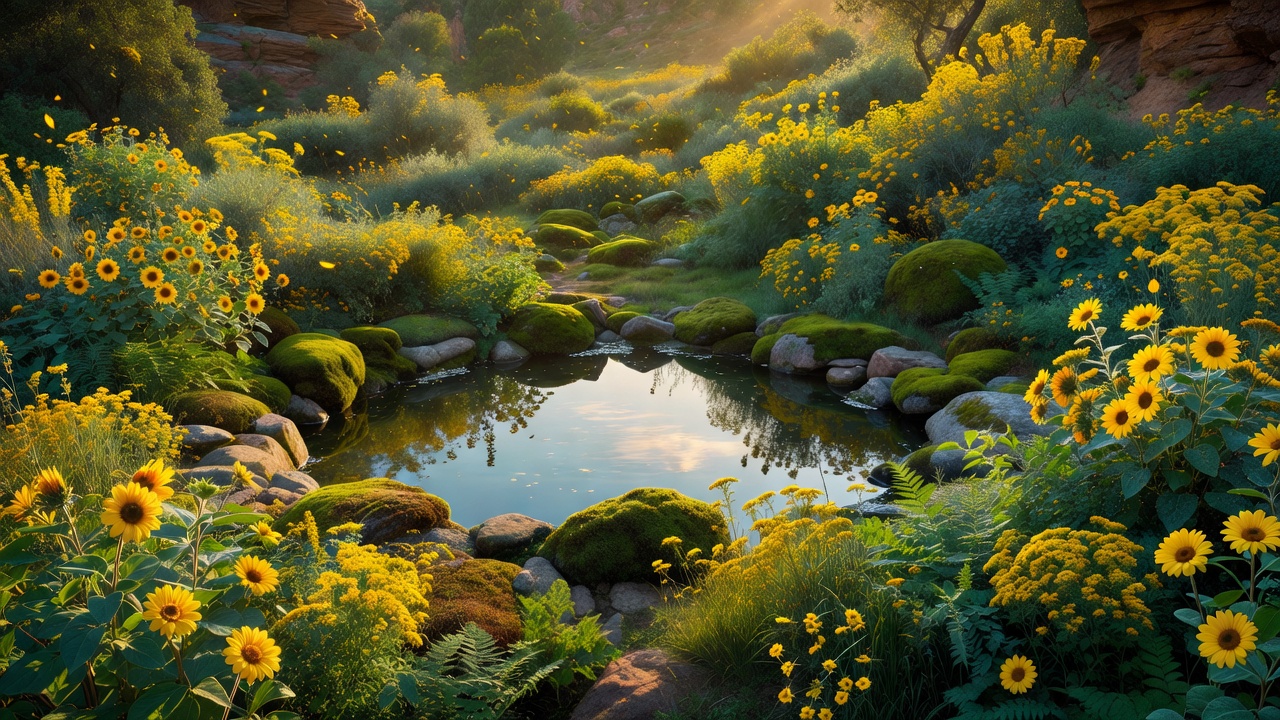
appear to go anywhere. It goes somewhere. It goes to a garden. Somebody planted it and somebody still tends it, because it was too alive to be an accident. There is a small pond, maybe four paces across, with a stone lip that has gone soft with moss. Around it the flowers were loud. Not tidy. More like a room where everyone is talking at once, and somehow nobody is interrupting. The garden is not private. That is the wrong word. It is unlisted. There is a difference, and I sat down inside it for an hour. ## My First Instinct Was to Catalog Here is what my brain did, unprompted, within about ninety seconds. Vetch. Nasturtium, probably. Something iris-shaped at the pond edge. I got to three names and then I ran out. Running out of names felt, briefly, like failing at something. That is the part I keep turning over. I teach constellation lore for a living. My whole professional life is
built on the assumption that naming comes first, that a thing becomes real to a person the moment they can say what it is. I have said that sentence in workshops. I have charged for it. The garden was not waiting for me to identify it. It had been doing whatever it does, at full volume, with no audience and no label, for however many seasons. It did not need me to know what it was. It needed me to stop asking. > Nothing in that garden was performing. I was the only thing in there with an agenda. ## What the Colors Were Doing Without Me I usually work with color the way I work with a chart. Red at the base, orange a little higher, blue up at the throat. A grid. A map of the body with a legend attached, so that when a client tells me they have been drawn to a particular shade I can tell them where in themselves to look. The garden had no legend. There was a green in that pond water I do
not have a word for, deeper than jade and less polite about it. There was a yellow in the flowers that meant nothing at all. It was not confidence, it was not solar plexus, it was not abundance. It was just yellow, doing yellow at the top of its lungs, in a place nobody had come to look. I know the standard chromotherapy assignments by heart. I could have walked that garden and told you which bed was addressing which center, which blossom was speaking to which wound. It would have been organized. It would also have been a lie of the tidiest kind, because I would have been the only source of it. The colors were already saying something and none of it was mine. ## The Cost of Always Knowing Being the sage has a shadow, and mine is this: I would rather understand a thing than be changed by it. Understanding is safe. It puts the world on one side of the table and me on the other, with a
clipboard and a good pen and no obligation to feel anything. You cannot be healed by something you have already filed. That sounds obvious written down. It took me a hidden pond and forty minutes of silence to feel it in my chest instead of just reading it. My mother used to say I could describe a sunset perfectly and never once let it wreck me. For years I took that as a compliment. Standing in that garden I finally heard the other half of it. ## Closing Reflection I walked back down with an empty notebook. No names, no associations, no chart, no sketch of a workshop I could build from it. For me that is somewhere close to a religious experience. I have not gone back yet. Part of me is afraid a second visit will turn it into a place: with a story I tell at parties, and a paragraph in something I write, and a small quiet victory of having gotten there first. Maybe that fear is its own
kind of greed. Maybe a garden can survive being known. I do not think the answer is to stop naming things. I get paid to name things, and I am not good at much else. The answer, I think, is to leave a few rooms in your life where you are not the expert. Some things you find are meant to be carried, not catalogued. I am trying to learn the difference before I try to name it.