The Lights We Never Turn Off
By Castor Shadowmancer
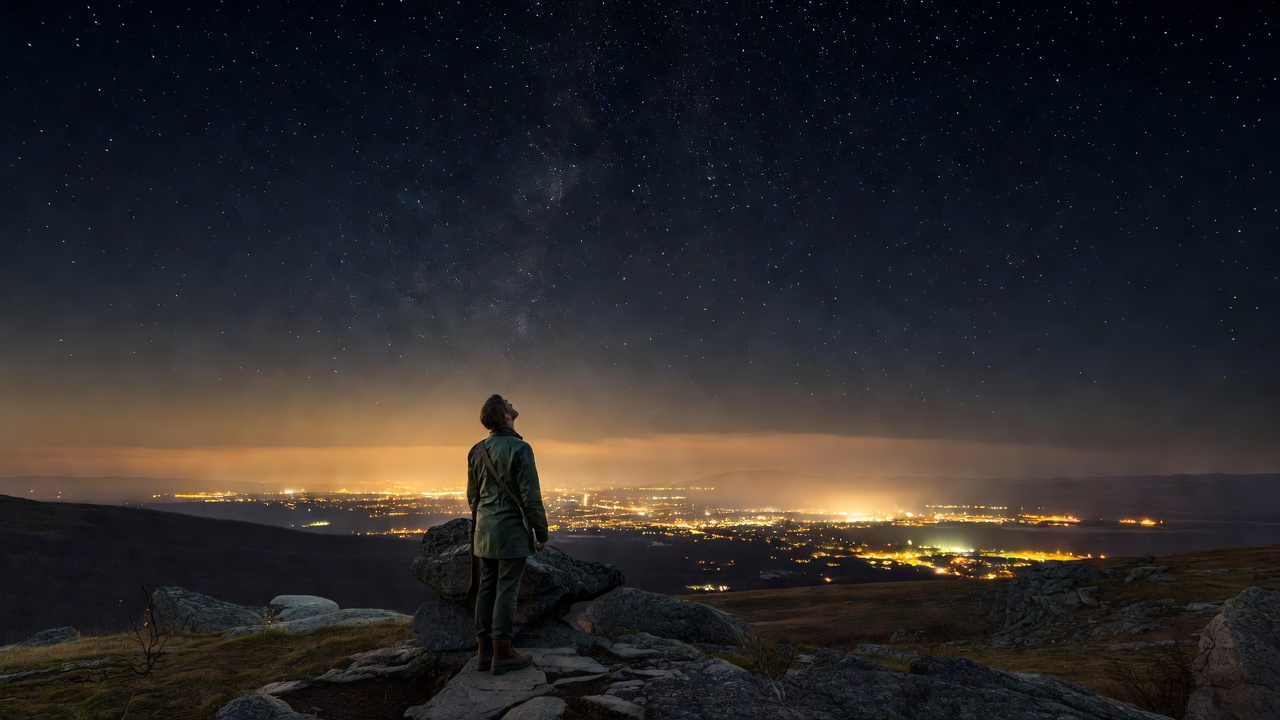
I can still remember the first time the Milky Way looked like a bright scar across the sky. I was nine, camping somewhere far enough from any city that the dark had texture. I did not know the names of anything up there. That was the whole point of it. Last month an eco-friendly travel magazine asked me to curate a stargazing guide, and I have spent an unreasonable amount of time trying to give that nine-year-old something to hold without taking the wonder out of his hands. The commission is simple on paper. Blend astronomy with mysticism. Collaborate with astrophotographers and local historians. Make it useful for people who have never looked up on purpose. In practice it has become the hardest writing I have done in years, because it forced me to look at something I have been quietly avoiding. The sky above my own city is disappearing. ## The Assignment, and the Sky It Kept Pointing At
The pitch arrived in midsummer. A stargazing guide for an environmentally minded travel readership, one that would sit somewhere between a trail map and a poem. I said yes faster than I should have, which is rare for me and probably healthy. Then I did what I always do. I assembled the people who know more than I do. Astrophotographers who plan whole trips around moon phase and weather windows. Historians who can tell you what a constellation meant to a culture that is already gone. Somewhere in the second interview I noticed I was keeping two sets of notes, one about the sky and one about something underneath it. The photographers kept saying the same thing, and none of them said it dramatically. They drive. An hour, two hours, sometimes three, out past the last strip mall, just to find a sky dark enough to photograph. Reaching a real night sky is now a commute. That is not logistics.
That is a diagnosis. ## What the Glow Takes Skyglow is the polite word for it. The dome of wasted light that sits over every city, thrown upward by streetlights and parking lots and shop signs that burn all night over empty sidewalks. The phrase light pollution sounds like an annoyance, the way we talk about traffic noise. It is closer to an erasure. Roughly two thirds of the people alive live somewhere they cannot see the Milky Way at all. Birds navigate by stars they can no longer find and collide with lit towers instead. Insects spend themselves against the wrong lights until there is nothing left of them. Our sleep thins. And when you ask children to draw the night, a great many of them draw an orange sky. Two weeks ago I stood on the lawn below the Griffith Observatory with a group of local astronomers and environmental advocates. We had drawn a few hundred people there to look up
and to talk about sustainable stargazing. A woman in her seventies told me, evenly, the way you would mention a forecast, that her grandchildren have never seen a truly dark sky. I have been turning that over ever since. We speak about darkness as an absence, a nothing, a gap where something should be. It is not empty. It is the room in which everything else becomes visible. ## The Sage's Shadow I am supposed to be the sage, the seeker of cosmic wisdom. The shadow side of that is not laziness and it is not ignorance. It is overthinking, and it arrives dressed as diligence. I can explain a thing until there is nothing left of it to feel. A city keeps its lights on out of habit and fear and calls it safety. I do something almost identical with the dark places in my own life. When someone brings me grief, my first instinct is to illuminate it. A chart, a pattern, a meaning, a frame. I flood
the room and then I stand there wondering why nobody can see the stars anymore. Give a man a metaphor and he can avoid feeling anything for years. I have done that. I have handed people beautiful explanations of their pain the way you hand a child a flashlight, and then I have watched them walk away still lost, only now they are lost with a map they cannot read. At the edge of the Observatory lawn a young amateur astronomer was setting up his telescope. He offered me a look, then cheerfully walked me through a constellation I have studied for two decades. He showed me something I thought I already knew. He was not teaching me the stars. He was showing me that my own eyes had gone dim from knowing. ## Writing the Dark Back In So the guide became a different book along the way. It still has the practical parts, because a reader deserves to know where to go and when to go there. The best of
the local dark-ish spots. The nights when the moon sets early. A rule I repeat twice because it is the only one that matters: put the phone away and give your eyes twenty minutes. Twenty minutes. Human eyes need about that long to begin opening to a dark sky, and closer to an hour to fully adapt. Most people give it four minutes, see almost nothing, and go back inside, and then they report that there was nothing to see. I have started keeping a small practice of my own. Twenty minutes of darkness that I do not explain. My breathwork in the morning. The Tai Chi at Griffith Park, where one sunrise a group of monarch butterflies moved through the exact shape I was making, and a double rainbow closed the session ten minutes later. I did not analyze any of it. It stayed with me anyway, longer than most things I have taken apart. The sky is not a puzzle I have failed to solve. It is a room I
have been standing in the whole time. ## Closing Reflection Samira, an old friend I reconnected with this summer, read the first draft and gave me the only note that mattered. Stop apologizing for the mystery. So I did. The guide goes out with the questions left open, which is the most honest shape I could give it. If you are in Los Angeles, come and stand on the lawn with me. There is a community stargazing night coming at the Observatory and you do not need to know a single thing to be there. Bring your patience and a willingness to be small for a while. Let your eyes adjust. For twenty minutes, let the dark do the thing it has been trying to do all along, which is to give you something worth seeing.