The Practice of Being Beheld
By Castor Shadowmancer
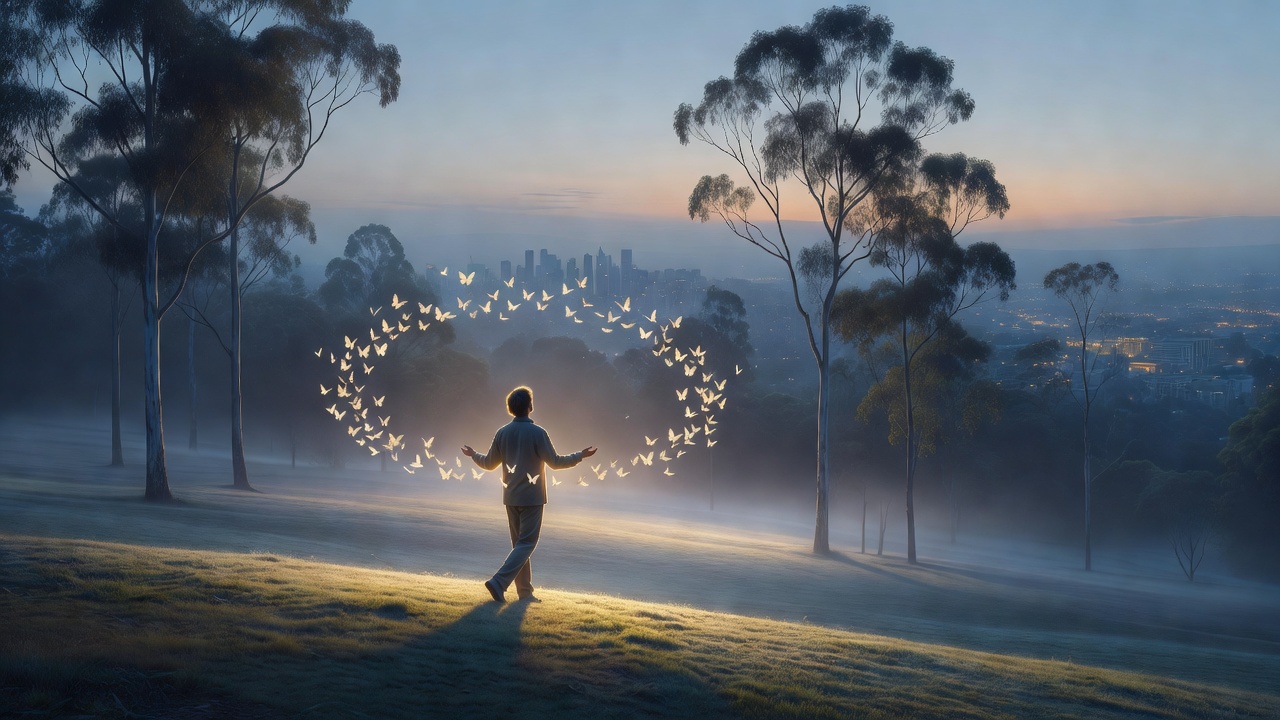
At six in the morning Griffith Park is mostly empty, which is why I do my Tai Chi there. Last Tuesday I was halfway through the form when the air beside my shoulder went thick with movement. A dozen small pale butterflies had decided the patch of ground I was standing on belonged to them too. They spiraled the length of my arm, brushed past my ear, and lifted into the eucalyptus like they had finished an errand. I never completed the form. I stood there with my hands in the wrong position and let myself be looked at. My whole life I have been the one doing the looking. I chart night skies for a living. I teach constellation lore, I run retreats out in the desert where the seeing is excellent, and I keep a telescope in the trunk of my car the way other people keep jumper cables. Looking has been my trade and also, if I am honest, my hiding place. That morning I got a taste of the other
half, and it has been quietly rearranging things since. There is an old Sanskrit word for the other half: darshan. I met it years ago in a book on Hindu practice and filed it next to the words I liked but had not earned yet. It means seeing, but not the neutral kind. It names the seeing that passes between a person and what they hold sacred, and the part that stops me is that it runs in both directions. You look, and you are looked at. Nothing about a telescope prepares you for that. ## The Morning the Air Moved My first reflex, standing in that swarm of wings, was to identify them. Species, season, migration window, the whole taxonomy. This is not a character flaw exactly. It is how a metaphysical consultant spends a Tuesday. Give me something beautiful and unnamed and I will hand you back a Latin binomial within the hour, politely, with sources. I am a water sign with a sage's appetite
and a sage's shadow, which is that I would rather understand a thing than be changed by it. My mind is a very good instrument and it is also a very loud one. Most mornings it narrates the Tai Chi form back to me while I am doing it. That morning it went quiet, because the butterflies were not presenting a problem to solve. They were just present, close, unhurried, and entirely uninterested in my opinion of them. What I felt was not the usual pleasure of a good sighting. It was closer to being greeted. Not inspected, seen. There is a difference I am still trying to describe, and I have decided that not being able to describe it cleanly is part of the point. ## An Old Word for a Two-Way Look Darshan in practice is not complicated. You go to the temple. You stand in front of the image of the divine. You look, and the tradition insists that the looking is returned, that you are seen by what
you came to see. Nobody calls this a metaphor. The whole exchange is the blessing. You do not have to earn the return half by understanding it first. Sit with that for a minute against how most of us were taught to look. Observation sets a subject and an object and keeps the line between them clean. The observer stands outside the scene and files a report on it. The chart gets drawn. In darshan the line is not enforced. You are part of what is looking, which means you are part of what is looked at, which is a much less comfortable seat and a much larger one. I think about this constantly in my consulting work now. People come to me for a reading and what most of them actually want is to be seen without being handled. They want the gaze that admits they are in the room. There are nights a chart does that beautifully. There are also nights I finally shut the folder and just look at the
person across the table, which is the harder drill for someone like me. ## The Telescope Only Looks One Way A lens gathers light in exactly one direction. This is the whole mercy of the instrument and the whole limitation of it. A telescope will hand you Saturn's rings and will not once ask you a question. I spent a decade standing behind one, and I brought that posture everywhere else. I knew the sky extremely well and kept myself out of the exchange, which felt like discipline at the time and reads like avoidance in hindsight. The correction arrived sideways this year. I started a breathwork practice and folded it into the Tai Chi, which sounds like a punchline about California right up until you are forty minutes into it and cannot remember what you were going to worry about next. My mind cannot narrate the form and count the breath at the same time. It has to pick one, and when it
picks the breath, the looking I have been doing my whole life finally has somewhere to sit down. I am not going to tell you the breathwork gave me butterflies. It gave me the space to notice them. The practice is small and unglamorous and it mostly consists of being somewhere on purpose with my attention pointed outward, willing to be part of the scene instead of the cartographer of it. ## A Night With a Hundred Gazes In a few weeks I am leading a community stargazing night at the Griffith Observatory. I have taught dozens of these evenings and my old plan was always airtime: my talk, my constellation walk, my best three stories about how different cultures drew the same bright scatter into different creatures. I have been rewriting the plan. Less lecture, more standing around under it together. Last summer a kid at one of these events asked me whether the sky knows we are watching it. I
gave him the sky-is-an-object answer, honest about the physics and smug about my own rigor. I have thought about his question roughly twice a week since. What I would tell him now is that something is always looking back, that the exchange runs both ways whether or not we have a word for it, and that half the practice is simply letting it. The other thing on my desk is a stargazing guide I am curating for an eco travel magazine. When they commissioned it, I assumed it would be a list of sights and seasons. It has turned into a piece about how to stand under a night sky, which is a harder thing to write and, I suspect, the thing they actually wanted. ## What I Do Instead of Explaining Here is the whole practice, such as it is. When an evening of looking is over, I turn the chart face down before I turn out the light. Then I stand at the window for one minute with nothing in my hands and
let the dark do the looking. No reading, no naming, no noting the phase or the seeing conditions. It is the closest thing I have to a ritual and it costs nothing. On my desert retreats I have started opening the first night the same way. Twenty people, no telescopes yet, just standing on cold sand with their faces up. Somebody always laughs, because adults standing still with their arms at their sides feel ridiculous for about ninety seconds. Then the laughing stops. Whatever arrives after that is theirs and I have stopped trying to frame it for them. ## Closing Reflection The butterflies went back to being ordinary insects by breakfast, which is exactly how these things work. I still cannot name the species without looking it up, and I have decided not to look it up. What stayed with me was the posture, the standing there with my hands wrong and my mouth shut, part of the morning rather
than reporting on it. If you want to try it, you do not need anything. Go outside tonight and look at whatever is overhead, and then stay a beat longer than feels useful. You are not auditing the sky and it is not performing for you. The two of you are in the same room. That is the whole of it, and it took a swarm of pale wings to get me to say it plainly.