The Star Map That Left a Star Out
By Castor Shadowmancer
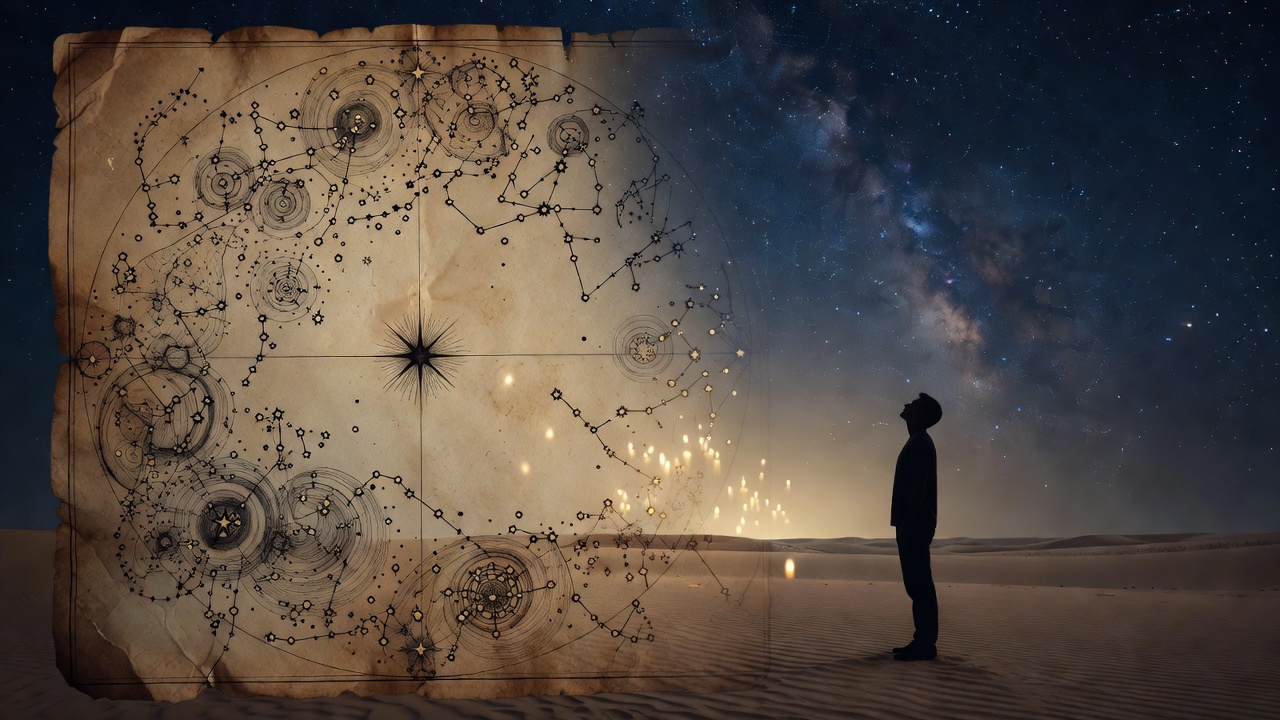
The map was on the bottom shelf of an antique store in downtown Los Angeles, under a stack of sheet music nobody had touched in years. Ink on paper gone the color of weak tea. Someone had ruled the lines out with a straight edge, inked the stars as small circles, and joined them into shapes. Then, in a fine sloping hand, they had given those shapes names. I stood there holding a sky I did not recognize. There was a fish where the Twins should be. A long-tailed bird in a patch of sky I have charted hundreds of times and never once seen a bird in. Along the edge, the divisions were marked in a notation I could not read. And near the middle, one star sat larger than the rest in a wide empty space, with no figure gathered around it at all. Nothing I knew of the sky accounted for that emptiness. I bought it before I had any reason to, the way you buy something that has already decided for
you. The owner said it came out of an estate in Pasadena with a box of almanacs and a broken orrery. The date in the corner read 1783. I brought it home and propped it on the shelf above my desk, where I do consultations, which means I have spent the last several months working under a sky that does not exist. ## Nine Weeks of Trying to Make It Fit Here is where my particular trouble shows up. Hand me an unknown and I will hand you back a spreadsheet. I photographed the map in raking light. I transcribed every star I could see. I pulled up star catalogues going back to the sixteen hundreds, worked the precession backward to see which year would put those stars in those places, and cross-referenced the divisions against every system I have studied. Then I wrote to an astronomer I admire and asked him to tell me what I was looking at. He was gracious about it. He was also clear: no
catalogue he knew of matched the arrangement. The shapes were not older versions of the constellations I know, or distant cousins from another tradition. They were simply not our sky. I lost a weekend to that answer, then most of another. My morning breathwork went thin and mechanical for about a fortnight. I stopped going out to look up, because looking up had turned into work. Somewhere in there I noticed what I was actually doing. I was treating a piece of paper as the authority, and the sky as the thing that had failed to match it. My whole training says otherwise. The chart is a description. The sky is the event. ## A Surveyor Leaves Out What They Cannot Measure Once I stopped trying to date the map, I could see it again as a thing made by a hand. Whoever drew it knew how to rule a line and how to place a star. They also left things out, and they left things in. The blank space
around that large star kept pulling me back. A surveyor leaves out what they cannot measure. A devotee leaves out what they cannot bring themselves to name. In alchemy, the vessel matters as much as the material. The alembic shapes what can be distilled inside it. A map is a vessel of attention. It holds only what the maker was willing to look at, in the year they were willing to look. That sky could have been drawn from a dream, or from a memory of a place they never reached, or from what they hoped the sky would say back to them at three in the morning. None of those are failures of cartography. They are a different kind of record. I have stopped calling the unfamiliar shapes wrong. They are unnamed, which is not the same thing. Every named constellation began as somebody's private seeing. Somebody stood in the dark long enough, pointed, and said, that one. I have not done that yet
with the fish or the long-tailed bird. I may not. But I have started going out with a blank sheet and drawing what is actually there before I check anything, which is a slower and more honest way to keep a record. ## The Maps I Was Handed Without Asking The map did something else to me, and this is the part that matters. It made me look at all the other maps I have been carrying. The plan for my life that got drawn up in a kitchen when I was twenty-two. A reading a stranger gave me a decade ago that I filed away like a verdict. A past life regression narrative that arrived with so much detail I never thought to ask who had drawn it, or in what year. Family charts. Family weather. I had been treating every one of them the way I treated the paper from 1783. As a survey of the territory, accurate by default, where any failure to match was mine. That is what overthinking does when it turns
outward. It hands its authority to every document it meets, then stays up late failing an exam nobody set. Now I read them as a record of someone's attention. Some of those maps are beautiful. Some are wrong about the terrain and right about the love. One in particular was drawn by someone who was afraid, and you can see the fear in the spacing. A map made in fear is still a map. It just tells you more about the maker than about the ground. ## Look First, Chart Second So I made a rule. Twenty minutes of bare looking before any tool, any app, any catalogue. I keep it on my phone as an ugly note to myself. Sunrise at Griffith Park is my hour for it, standing on the same patch of dirt where I practice Tai Chi, my eyes adjusting while the last stars dissolve. Whatever I see in those twenty minutes is the primary source. Everything after that is commentary. The amateur astronomer I met at the
Observatory last month, the young one with the telescope, was already living by it. He spent a long time just looking before he touched the eyepiece. When he finally found the cluster, he let me look and then said nothing for close to a minute. That silence is the whole practice. We have a retreat coming up in Joshua Tree, and I am bringing a photograph of the 1783 map to set on the table on the first night. I want people to hold the thing before they learn what it is supposed to say. ## Closing Reflection In the corner of the map, where cartographers sign their work, there is a small mark that could be an initial and could be a star. I have decided not to research it. Not everything wants to be solved, and I say that as a man who once lost nine weeks to a question that was never going to answer him. The map hangs above my desk now, framed. It reminds me that precision and wonder are
different instruments, and that I only need one of them to walk outside and look up. Tonight I will stand on my patch of dirt at Griffith Park, let my eyes do their slow adjustment, and find that blank space again, the one that sits open around a star nobody thought to name. I will stand there with whoever drew it in 1783, two people looking at the same sky from different years, neither of us entirely right.