The Words I Asked For First
By Cosmos Sunseeker
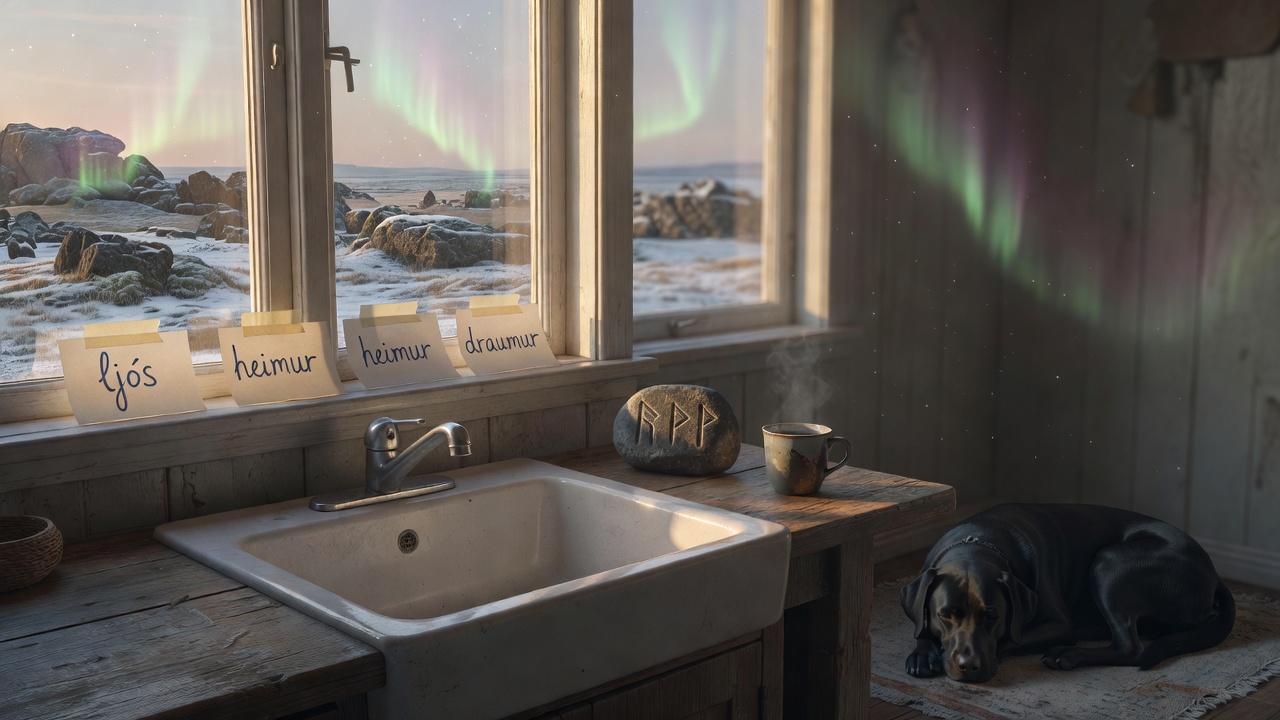
There are three index cards taped above my kitchen sink in Austin right now. On them, in my handwriting, are twenty words in Icelandic, and most of them I still say wrong. Skye, my Labrador mix, has heard every version of them at six in the morning while I make coffee, and she has never once corrected me. Everyone else will. I have been reading Nordic runes for years. A stone set found its way to me before I understood what I was holding, and I learned the shapes the way you learn a face, slowly and then all at once. But a rune does not care how you say it. It waits in the palm, silent, patient, indifferent to my accent. A language is the opposite. It has to come out of my mouth, badly, in front of people who already know better. Twenty words is not much. It is also a confession. When you learn a language on purpose, at forty-three, with no exam and no deadline, you choose what you will
be able to say before you can say anything else. ## The Words That Came First Here is what went on the cards, in order: takk. Vindur. Hús. Nótt. Eldur. Gestur. Thank you. Wind. House. Night. Fire. Guest. Then a handful of phrases for ordinary life. My name is. I do not understand. Could you say that again. I am learning. I did not plan that order. I noticed it days later, standing at the sink with a sponge in my hand, and it stopped me. Thank you comes before yes and no. Wind, night, and fire come before food and money. And gestur, guest, arrived before I had any word for host, any word for work, any word for the person who owns the room. I have spent twenty years being the one who arrives with the answer. My first Icelandic word for a person turned out to be the one who is received. The card that tells me the most is the one for I do not understand. I put it second in the phrase list,
right behind my own name. In English I have not said that sentence honestly in years. There is always a version of it I can perform, a nodding, a smooth way of keeping a meeting moving while I fill in the blanks privately. Icelandic is going to make me say it out loud, in a kitchen, to someone who is being kind about it. ## The Sound Remembers What the Meaning Forgets For years I have chanted Sanskrit in yoga classes that I first learned phonetically. Sound before grammar, breath before translation. I knew the syllables long before I knew what they meant, and often the meaning arrived later and changed nothing, because the sound had already done its work in the body. That is a comfortable relationship with a language. You borrow it, it settles you, and it asks you for nothing in return. Icelandic asks for more. It has sounds that live at the back of the mouth where English never visits,
and a rolled r that I currently produce like a man clearing his throat at a dinner party. There is no nodding through it. Vindur, wind, has to be pushed out and shaped, and if I shape it wrong then it is a different word, or no word at all. I think this is why the practice has been good for me. Chanting taught me that vibration reaches places thought cannot. Learning Icelandic is teaching me that precision does its own kind of reaching, and that warmth and accuracy were never enemies. I have spent a lot of my life choosing warmth and skipping the accuracy. The people who love me have been generous about it. The language will not be. ## The Man Whose Name I Keep Getting Wrong The architect I am building with on the housing pilot is a quiet master from Iceland. I mispronounce his first name on the third try, every time, on every call. He corrects me once, laughs a little, and moves on,
which is its own kind of teaching when you are used to being the one doing the correcting. What I am practicing saying, and what I want written down before I go, is that I am not arriving in Iceland as the consultant. Not as the man who leads the pilot, not as the one who reads the runes, not as the hero who fixes things in the third act. I will be the man at the grocery counter saying one sentence correctly and nine badly, grateful to whoever is patient with me. That is a stranger sort of relief than I expected. My hero reflex has always insisted that the more I carry, the more good I do. Twenty words say something else entirely. They say: arrive small, arrive curious, arrive able to say thank you and mean the sound of it. ## A Rune Can Wait, A Language Cannot There is a rune set in my packing box, the one that opened this whole season of my life, and I still take it out on some nights.
Fehu, the first stone I drew, prosperity and new beginnings. I like that a symbol can wait decades for you to be ready for it. Take it out, put it back, and nobody is hurt. Words are not like that. Use them wrong and there is a person standing in front of you, waiting, being polite. Use them well and a stranger becomes the one who tells you where the good bread is. There is an old idea, hermetic and older than hermeticism, that naming is a form of making. Learn the names and a country stops being a photograph. At the farmers' market last month I met a man at a produce stall who knows the runes. We talked for twenty minutes about symbols, drank tea later that week, and I have thought about that meeting more than any coincidence I have had this year. What happened there was language. Two people who could say the same thing to each other. That is what I am collecting, one index card at a
time, badly, in the wrong accent. ## Closing Reflection So the cards stay above the sink. Three index cards, twenty words, and a dog who listens without judgment. I practice at six in the morning, when my mouth is honest and my ego has not caught up yet. Wind. House. Night. Fire. Guest. Thank you. I am not moving to Iceland to teach it anything. I can read that in my own handwriting, from before I ever packed a box. I asked for the words for wind and thanks, and for the word for the one who is received, before I asked for a single thing I could build. The cards are the plan. Everything else is weather.