I Accidentally Joined a Meditation in the Park
By Dawn Visionary
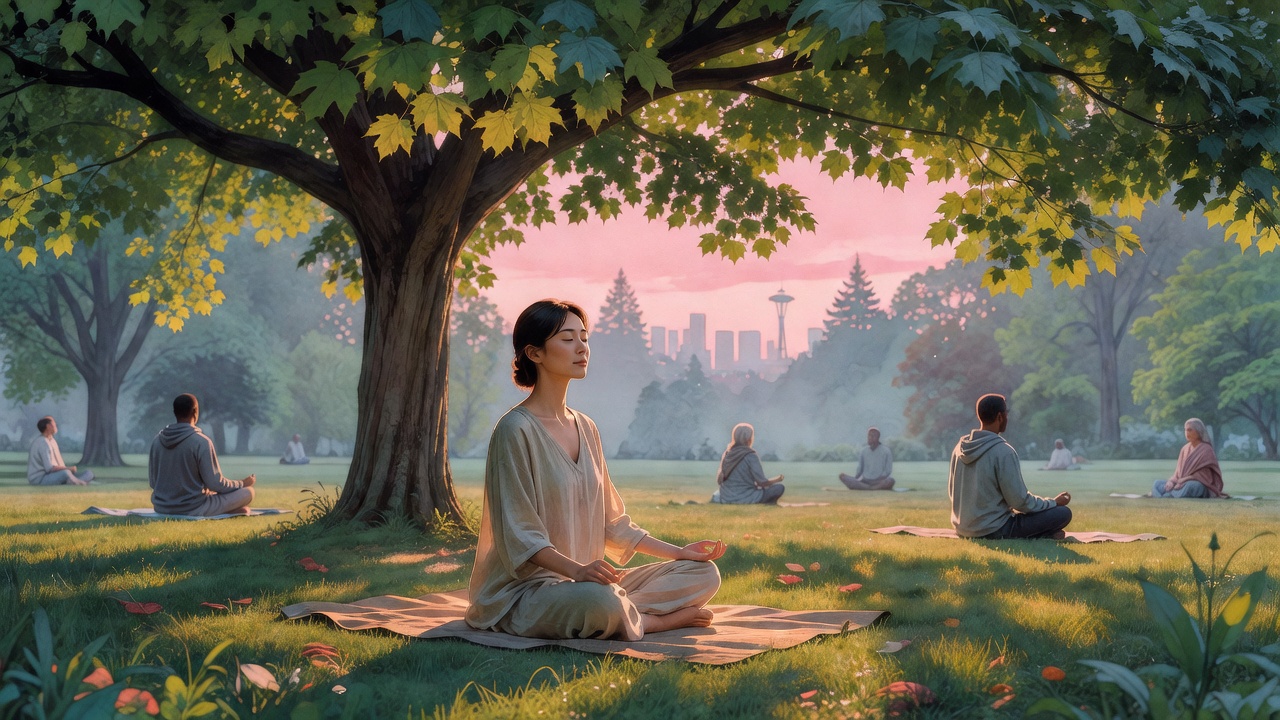
I did not go to the park to meditate. I went to the park to think, which for me usually means walking in circles with a poem half stuck in my head, muttering lines out loud until the people on the bench start to edge away. I am a poet and I am a dancer and I am, according to everyone who has ever shared a kitchen with me, not a person who sits still. So when the woman under the maple tree waved me over and held up a spare mat, I almost laughed. Then I sat down anyway. I want to tell you what happened, because I think a lot of people carry the same idea I did: that meditation is for calm people, for people who wake up early and own a cushion, for people whose minds are quiet places. Mine is not a quiet place. It is more like Pike Place Market at noon on a Saturday. If I can sit with that for forty minutes and walk away changed, then maybe you can too. ## What I Thought Meditation Asked of
Me Here is what I believed, honestly. I believed meditation meant emptying the mind, and I know exactly how full my mind is, so I believed I had already failed before I sat down. I believed you had to be good at it, and I have never been good at anything that asks me to hold still. I believed it would be boring, and boredom, for a dancer, feels a little like an insult. These are not original fears. They are the same fears half the people I know carry around. But there is a deeper reason I avoided it, and it took sitting on a borrowed mat to admit it. A still body leaves you alone with whatever you have been running from. I am very good at staying busy, at filling the hours with rehearsal and open mics and a Europe trip I am planning down to the train times. Busy is how I keep the hard feelings quiet. Meditation sounded like a room with no music in it, and I was not sure I wanted to hear
what was left. ## What the Woman Actually Told Us Her name was Mara, and she did not say anything mystical. She said the things that, later, made me want to write them down. \*You are not trying to empty the mind. You are learning to notice it and come back.\* She said the breath is just an anchor, a place to return to when you drift, and that drifting is not failure. Drifting is the whole point. You drift, you notice, you come back. That is the practice. She told us five minutes counts. Ten counts. Nobody grades you. The goal is not to reach some blank state but to catch yourself in the act of thinking and gently, without scolding, steer back to the breath. I had spent years assuming meditation was a performance, something you could win or lose, because I had turned everything else in my life into a performance. This was the first thing anyone had ever told me to do that I could not
fail. ## The Thoughts That Would Not Leave So I closed my eyes, and the thoughts came exactly the way she said they would. The anthology deadline. Whether my grandmother's old travel journal really did line up with my itinerary the way it seemed to, or whether I was only seeing patterns because I wanted to. A line from a poem I cannot finish. The hard thing I keep putting down and picking back up again. My mind was a market. I kept opening my eyes to check that everyone else was doing it right. Then I tried what Mara said. I stopped fighting the thoughts and just named them, quietly, like guests walking through. There is the deadline. There is the worry. There is the grief. And each time, I came back to the breath. It was not peace exactly. It was more like finally letting the crowd move through instead of standing in the doorway arguing with every single one. For a person whose shadow
is pretending the hard things are not hard, that small act of noticing, without fixing, was enormous. ## Under the Tree, in the Body And then there was the tree. I had watched the sunrise from my window that morning, that rare pink Seattle light, and now I was sitting under a maple with the same light breaking through the leaves. Meditation, for me, has always had to live in the body, because that is where I live. A dancer learns early that the body keeps a different kind of memory. So I let my attention drop out of my head and into the ground beneath me, into my hands on my knees, into the slow rise and fall of my ribs. That is when it stopped being a chore and started being a place. You do not have to sit under a tree. But I think it helps to put your body somewhere it wants to be. The breath is the anchor, but the body is the door. If the thought loop is too loud, drop down into your
feet, into the air on your skin, into one small physical thing that is actually happening. That is a beginner trick nobody puts in the instructions, and it is the one that saved my first session. ## Closing Reflection I am not going to tell you I meditate every day now. I am a poet, so I will tell you the truth instead: some days I do five minutes by the window and some days I forget, and I have stopped grading myself on either. What changed is that I no longer believe meditation belongs to someone else. It is not a quiet room you have to earn. It is a mat under a tree, a stranger waving you over, and forty minutes where your busy mind was allowed to be a busy mind without shame. If you have been waiting to feel calm enough to start, stop waiting. The practice is not about being calm. It is about coming back, again and again, and noticing you can. And if you ever find yourself in a park
and someone holds up a spare mat, sit down. Under the tree, with the light coming through, is as good a place to begin as any.