The City-Wide Stage: What Organizing a Poetry Slam Taught Me About Holding a Crowd
By Dawn Visionary
The message came from the Seattle Arts Council, and at first I read it twice to make sure it was meant for me. They had heard about the open-mic nights at the little Capitol Hill bookstore, the ones that started with a borrowed corner and a nervous sign-up sheet. Now they were asking whether I would organize a city-wide poetry slam, with poets from every neighborhood, a real stage, a real budget, and a crowd that would not fit in any bookstore I knew. I said yes before I had finished the sentence, which is how I say most brave things. Then I sat with the weight of it. The open mics had always been small enough that I could carry every voice in my head: who had read, who had wanted to read, who needed a quiet word afterward. A city-wide slam would be too big for that kind of care, and I had no idea how to hold a crowd I could not see. This is the story of what happened between that yes
and the night itself. It is not a story about poetry, exactly. It is about what a small person does when a city hands her a stage, and about the strange discovery that a container does not limit wonder. It gives wonder walls to bounce off. ## The Cozy Night That Grew Teeth The bookstore open mics began by accident, the way most of my best nights have begun. I had discovered the shop on an aimless Capitol Hill afternoon, tucked between two busy cafes with the warm smell of old paper and fresh coffee. When I asked the owner whether we could host a reading, she said yes with the same hopeful speed I had just used on the Arts Council. The first night, nine people came. By the third, the chairs ran out and people sat on the stairs. What I loved about those nights was not the size. It was the feeling that every person who stood at the little microphone was being held. The nervous readers, the
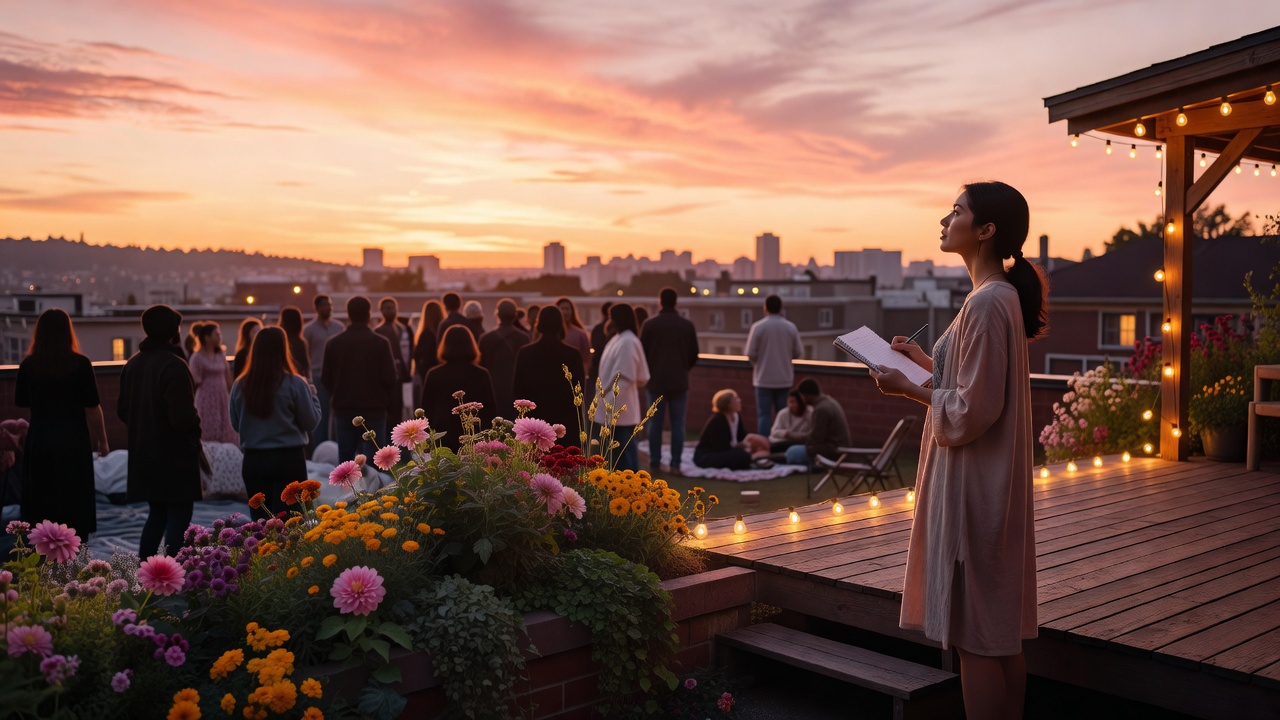
poets who had never read aloud before, the woman who cried at her own line: they all got the same unhurried space. I kept a mental list of everyone who wanted to read, and I made sure the list emptied before the night ended. That was the promise I carried into the city-wide planning meetings. And it was the first thing the city asked me to break. ## The Rooftop Garden Where I Learned to Say No I did my planning on a rooftop garden in downtown Seattle, a small hidden square of flowers above the noise. I would sit among the blossoms with my notebook and try to design a night that would hold three hundred people the way nine had once been held. The garden was patient with me. It did not judge the lists I crossed out. The crossing out was the hard part. A city-wide slam cannot give everyone a spot. There are time limits and intermissions and a running order, and every poet I turned away was
a real person with a real poem about a real loss. I hated it. I had built my whole small practice on never being the one who said no. Here is what the garden taught me, slowly, over weeks: saying no to a slot is not saying no to a person. The night could hold a hundred voices well, or it could hold three hundred voices badly. Choosing well for the room was a form of care, the same care I had once poured into a sign-up sheet. The kind thing and the caring thing are not always the same thing, and I learned to tell them apart. The night before the slam, I walked the empty venue and put a chair where the water would live and checked that the microphone reached the shortest reader. Small acts, all of them. But I understood then that this was how love scales: one careful detail at a time, until the whole room is full of them. ## A Stage Is a Container, Not a Promise The night itself arrived on
a warm September evening, and the sky went pink at the edges like the sunrise that had once painted my apartment walls. We hung string lights across the outdoor stage, and for a moment it looked exactly like the Green Lake reading where I had first scribbled a poem on a napkin. The same lights. A hundred times the people. I stood at the side of the stage for the whole show, not to perform, but to hold. To make sure the water pitcher was full. To nod at the poet who had practiced in front of her bathroom mirror. To catch the reader whose hands were shaking and whisper that the first line was the hardest. Holding a crowd, I learned, is not about being seen. It is about seeing everyone else. And the crowd held itself. That was the surprise I had been too afraid to imagine. Strangers passed tissues to strangers. A man in the back row laughed at a poem and then cried at the next one. When the
final reader finished, the applause rolled up the hill and out into the street, and I understood that a stage is a container, not a promise. It does not have to hold everything. It only has to be shaped well enough that people can hold each other. I did not read my own poem that night, and I do not regret it. Some nights are for holding space and some are for filling it, and I have finally stopped confusing the two. My poem waited in my pocket like a warm stone, and it came home with me, which is its own kind of reading. ## Closing Reflection I still believe in the small nights. The bookstore is booked for three months of open mics, and I still keep a mental list of every reader. But I no longer believe that bigger means colder. The innocent part of me, the part that wanted to promise every poet a spot, has learned to live beside the part that builds edges on purpose. Wonder does not
have to shrink to survive a crowd. It can grow a stage instead. The council has already asked about next year. I said yes again, faster this time. But the yes comes with something it did not have before: a plan, a running order, and the quiet certainty that the city does not need me to hold it. The city needs me to hand it the microphone and step back. That is the bravest thing I have learned to do, and it begins with letting go.