The Grief I Was Told to Brighten
By Dawn Visionary
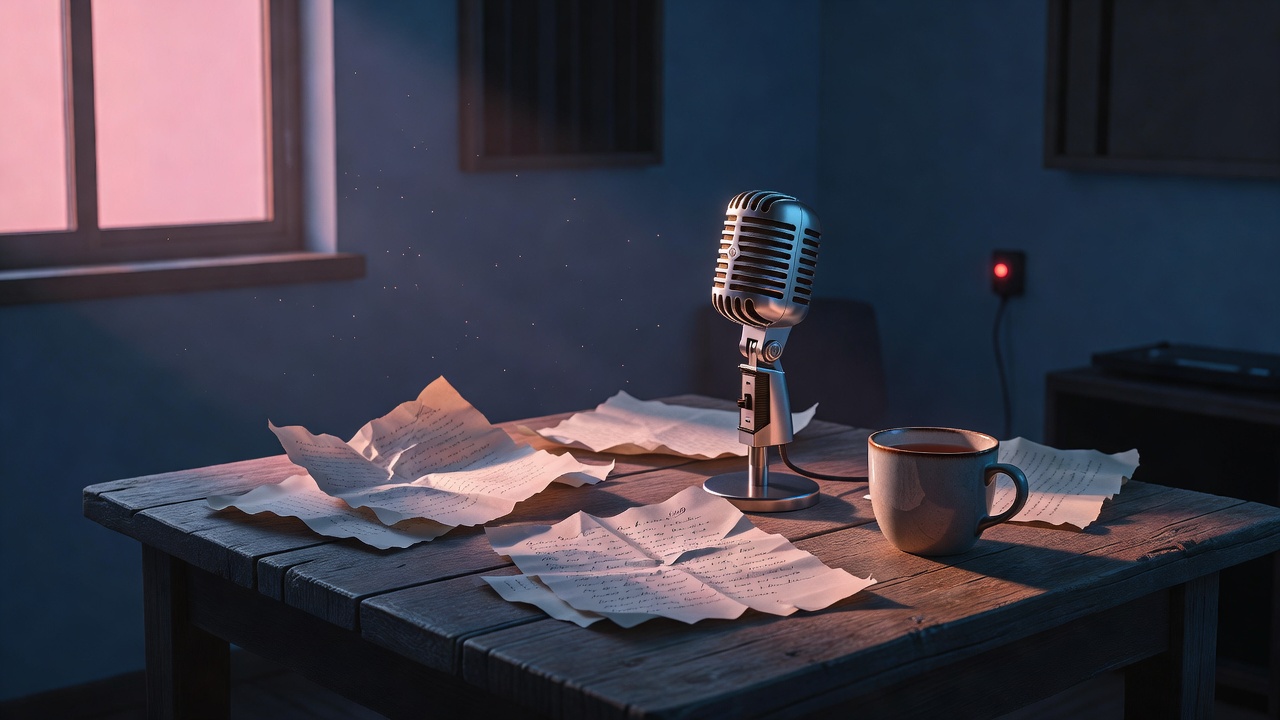
The message arrived on a Tuesday, wedged between a natal chart reading and my third cup of tea. A Seattle literary podcast I had been listening to since before I moved here asked if I would co-host a short series on emerging Pacific Northwest authors. I read it twice, set the phone down, picked it back up and read it a third time, then carried it to the window as if the gray light might make the offer more real. It did not. It stayed exactly as large as it was. I said yes in about four minutes. That is my pattern. The yes shows up long before the questions do, and I have mostly made peace with the fact that this is how I move through the world. What I did not expect was the third episode, or the guest who walked in carrying a poem I could not fix. ## The Studio Above the Bakery The studio is one room above a bakery on a side street in Ballard, and it smells like bread until about eleven
in the morning. There is a table that is too small for the three of us, a tangle of cables that I was warned not to trip over and did anyway, and a red light on the wall that means we are recording. That light is the whole job. It is a small honest star, and it does not care how you feel about what you just said. I nearly turned the whole thing down, which I want to admit because everyone keeps telling me how brave it was to say yes. It was not brave. It nearly was not a yes at all. The taping days landed on my Friday dance class, the one hour a week where I stop narrating my own life and just move. I sat with the calendar for a day and a half before I understood that the collision was the point. I could keep the hour that belongs to me and still show up for the work. I moved the class to Thursday and Luna, my cat and resident chaos consultant, supervised the whole reshuffling from the
top of my notes. The first two episodes were easy in the way that good conversation is easy. We talked about chapbooks and small presses and whether the Pacific Northwest has a mood. It does. We agreed it is rain that is polite about it. ## The Poem Nadia Brought Then came Nadia, a poet from Tacoma who is thirty-four and writes like someone who has stopped performing. She brought a poem about her brother. He died four winters ago, and the poem does not lift at the end. There is no turn toward gratitude in it. It finishes in the middle of a sentence about a parking lot where she used to wait for him, and the sentence just stops, the way a person stops when there is nothing left to add. She finished reading and the room went quiet in a way I have only felt a few times in my life. I could feel the silence pressing against my chest. And I heard myself begin to do the thing I always do. "And
yet..." I said. That is it. Two words. That is the whole instinct, laid out on the table between us, and I got to hear it back three days later through headphones. My mouth was already reaching for the sunrise, for the meaning, for the soft landing. My body had decided that the poem needed to be carried somewhere warmer before it was even finished being read. ## The Instinct That Reaches for the Light Here is the part I am still turning over. I believe, genuinely and without apology, that everything is woven together, that the sky keeps a record, that grief and dawn are the same conversation held at different hours. That belief is not a costume I put on for clients. It is how I actually live. But a belief can become a reflex, and a reflex can become a small erasure. If every hard story gets gently steered toward its consolation, then the hard part never gets to be the point. It only ever
gets to be the tunnel. I sat in that studio having spent a decade learning to read the most difficult transits in a stranger's chart, and my first instinct in front of a wounded poem was to hurry it into morning. My own shadow has a name for this. It is the tendency to deny what is harsh because I want so badly for the world to be kind. I have been told it is a gift, that I hold a room in the light. Some days it is. Some days it is me refusing to sit down in the dark with someone who is already there. So I did the only thing I could do, which was ask a real question instead of offering a soft one. Where were you standing when you wrote that, I asked. Not what does it mean. Not how are you now. Where were you standing. Nadia was standing at her kitchen sink at two in the morning, she said, because that was the only place in the apartment where the streetlight did not reach. And then she
talked for eleven unbroken minutes. That was the episode. That was the whole episode, and it was the best thing we have recorded. ## What the Record Taught Me I listened back the next morning with tea and the sunrise doing its pink thing over the water, which is my favorite hour and also the hour that makes me most likely to sand the edges off something true. Luna was asleep on the arm of the couch. My own recorded voice came through the headphones, and I could hear the exact second my mouth changed direction and reached for the light. It is not a loud moment. It is barely a breath. But it is there, and I do not get to unhear it now. So I have made myself a small rule for the record and for everything else that holds another person's words. I can love the dawn without arguing with midnight. I can hold the whole woven sky and still let a poet end her sentence in a parking lot. The two are
not in conflict. I was treating them like they were, and the poem was the one paying for it. This has changed things outside the studio too. When a client sits across from me and the chart shows a genuinely difficult transit, I used to make sure the brightness was waiting at the end of the reading. I still want to. I am learning, slowly, that naming the hard weather and then sitting in it with someone is a different kind of gift than handing them an umbrella before they have even said they are cold. ## Closing Reflection Nadia's collection comes out in the spring. I have already told her that I want to do a live episode at the open-mic night, and I have already started working out which Thursday that will land on so it does not eat the dance class. I am trying to be someone who keeps both. The hour that is mine, and the room where the hard poems get to stay hard. If you write, I would
love to know which of your pieces you keep sanding down. Not the ones you are hiding, the ones you keep quietly rescuing before anyone else can feel them. There is a version of every true thing that is smaller than the thing itself, and I am learning to notice when I am reaching for it. Catch you under the stars.