The Pattern I Was Putting on Someone Else's Paint
By Orion Moonwhisper
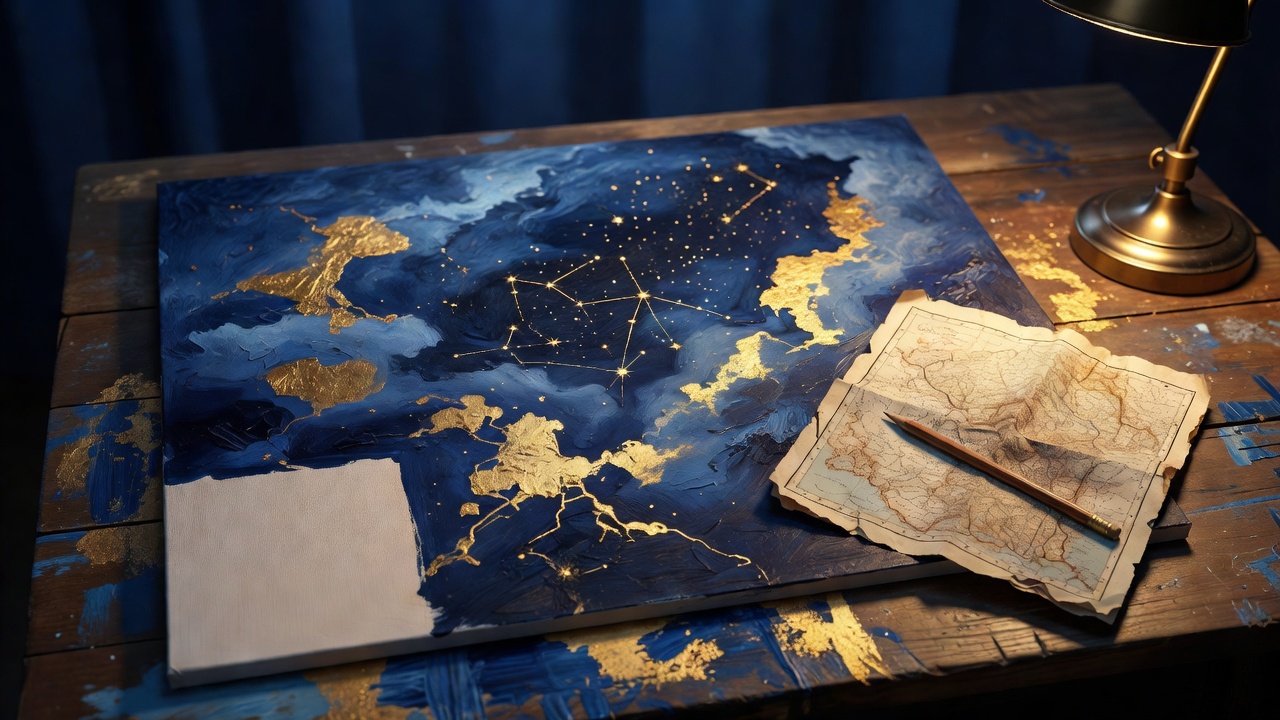
For thirty years I have made my living by finding patterns. Give me a birth time, a place and a date, and I will hand you back a shape: the way you argue, the way you rest, the reason you keep choosing the same difficult person and calling it fate. I am good at it. That is the trouble with being good at something. You start to believe the shape is the thing itself. Three months from now, an exhibit I helped imagine opens in a New York gallery. A painter whose work I have admired for a decade agreed to pair his canvases with my astrology, and I have been carrying that project around like a warm stone in my pocket. This is the story of how I almost ruined it on the first studio visit, and what an empty corner of his canvas taught me about the shadow side of my own craft. The eclipse has been sitting in the back of my mind all month. In my tradition we call these windows shadow work, which
sounds dramatic until you notice how unglamorous the actual work is. Most of it is catching yourself in the middle of a familiar move and choosing, for once, not to make it. ## The Napkin, the Blossoms and the Map It started under a cherry tree. I was practicing tai chi in the park before the city had fully woken up, and somewhere between one slow turn of the arms and the next, the shape of a new column arrived whole: astrology braided with ancient wisdom and modern art, three strands that had never sat together on my desk before. I finished the set, walked to my cafe, and sketched the whole thing on a napkin while the espresso cooled. I still have that napkin. It is taped above my desk now. Two days later, the call came. A painter I have admired since I was a young woman in Saratoga Springs wanted to build a show with me, his canvases and my charts, opening in a gallery downtown in
three months. I said yes before he finished the sentence. Asking me to pair the sky with paint is like asking a hawk to describe thermals. Of course I said yes. And then I noticed what I did next. Within an hour of hanging up, I was reaching for birth data. I wanted his date, his time, his place. I wanted the chart for the gallery's opening night. I wanted to know what the show was going to mean before a single canvas had been hung. That was the first click of the trap closing, and I did not hear it at the time. ## What He Would Not Let Me Name His studio is on the fourth floor of a building with a freight elevator, and the light in there is the kind you cannot buy. The canvases are large. He paints weather, mostly: layers of it, scraped and repainted until the surface looks like a sky that has been arguing with itself for weeks. No figures. No titles he will commit to. He walked me past
six of them and said almost nothing. I asked for his birth time. He smiled and said no, thank you, not yet. He said he did not want to know what his own work meant, because the moment he knew, he would start painting toward the answer instead of into the question. I did not take that gracefully, at least not inwardly. I stood in front of one canvas and offered three readings of it. Three, in five minutes. I told him the lower half read as Saturn, the break in the middle as a progressed moon, the gold thread as a fire sign rising through water. He listened the way you listen to a friend describing a dream that is not yours. Then he said, gently, that maybe I did not need to read the painting. Maybe I was allowed to just look at it. Here is the part I would rather not write down. I was not reading his painting. I was furnishing it. I was filling an empty room with my own furniture and then
complimenting the room for how well it matched my taste. My codex calls this the shadow of the magician: the willingness to arrange a situation until it fits the story I already want to tell. It is a small sin and a common one, and I have committed it far more often than I have ever admitted in a column. ## The Magician's Honest Toolkit I want to be fair to the magician, because the archetype is not a mistake. Transformation is real. Symbols do work. When I sit with someone and name the pattern they have been living inside for twenty years, something in the room actually shifts. That is not a trick. Naming a thing changes your relationship to it, and that change is the whole point of the work I do. The trouble arrives when the map gets promoted to the country. A chart is a description of tension and timing. It is not a verdict, and it is certainly not a leash. My grandmother taught me
natal charts at her kitchen table in upstate New York, and she ended every single reading the same way. She would close the folder and say: and here is where I could be wrong. At fifteen I thought that was modesty. At fifty-five I understand it was technique. The eclipse season has me thinking about that a lot. Shadow work gets advertised as deep and dramatic, but most of it looks like this: sitting in a bright studio, feeling the pull to explain something beautiful, and not doing it. Not once. Not even helpfully. ## Leaving a Few Stars Unmapped The project changed after that visit. We scheduled the install around the actual light, which means the show will be hung to catch the late afternoon, when the room goes amber. He is painting two new pieces for the far wall. I am writing wall text that offers instead of asserts, short passages that hand a viewer a question rather than a meaning.
The gallery is fine with it. Nobody has asked me for a single birth chart. I am still an astrologer. I still believe the sky is talking. But I am practicing a smaller, harder version of my craft these days, one where I hold a pattern loosely enough that reality can disagree with it. The tai chi has been teaching me the same lesson for months. You do not win by pushing. You win by yielding at exactly the right moment and letting the energy come through you instead of from you. If you want to try it, here is the whole method. The next time you feel the meaning of something arrive too fast, wait one breath before you say it out loud. Then ask yourself the grandmother question: what would this be if I were wrong? You do not have to believe the answer. You just have to leave the door open long enough for the truth to walk in on its own. ## Closing Reflection The show opens in three months. I
do not know what it will mean yet, and for the first time in my working life I am not trying to find out early. The napkin map is still taped above my desk, folded and soft at the creases, full of arrows and circles and my own confident handwriting. Last week I took a pencil and added one line at the bottom, under all of it, in letters small enough that I have to lean in to read them: leave room for the paint. It is the best piece of astrology I have written in years.