The Sky, Unannotated: Watching Strangers Read an Exhibit I Helped Build
By Orion Moonwhisper
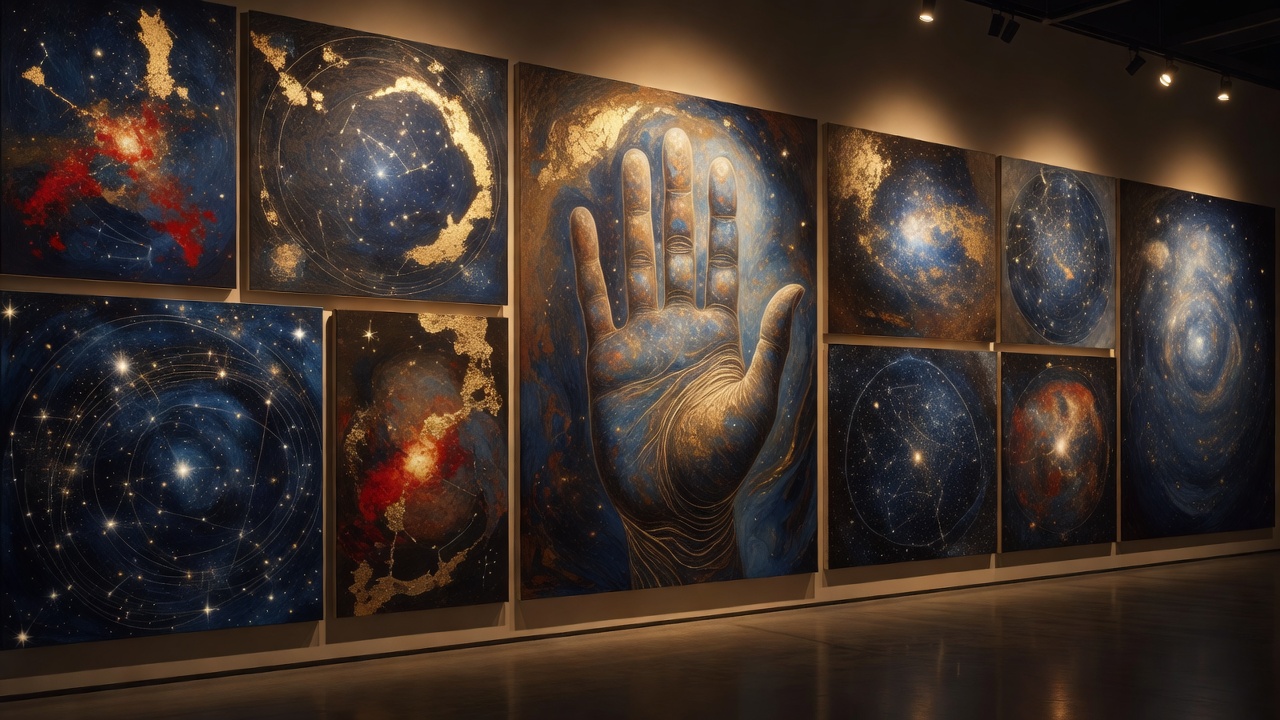
The night before the gallery opened, I stood in the empty room with the artist and did the thing I do for a living. I walked the wall and explained every symbol. This is Venus retrograde in the third house, I said, pointing at a coil of silver thread. This is the north node. That tangle of gold is Mars squaring Neptune. The artist listened, nodded, and then said the sentence that undid me: That is lovely, Eleanor. Now let them find it themselves. I have spent thirty years learning to read the sky, and the lines of a hand, and the quiet architecture of a birth chart. I am good at it. I turn a messy, contradictory chart into a story someone can carry, and people leave my table lighter than they arrived. The magician's instinct, I have learned, is not so different from the astrologer's. We both want to know what things mean, and we both want to be the one who says it out loud. The exhibit
asked me to do the opposite. It asked me to build a room full of meaning and then stand aside while strangers made their own. This is the story of that room, and of the month I spent learning that a reading is a doorway, not a verdict. The artist gave my charts back to me with the annotations removed. I am still a little shaken by what I saw. ## The Chart as a Painting It began with a reading. The artist came to me through a friend, wanting to understand a birth chart before a new series of paintings. I laid out the chart and talked for an hour. At the end she was quiet for a long time, and then she said something no client had ever said. You know, she told me, this is already a composition. The aspects are lines. The houses are rooms. The planets are colors. You have been describing paintings your whole life and calling them predictions. I laughed, because it was funny, and because it
was true. She asked if she could paint a few of my clients' charts, anonymized, as a private experiment. I said yes, expecting decorative star maps. What came back were not star maps. Mars arrived as a slash of vermilion. The moon was a silver coin dropped into a dark well. One client's empty third house became a wide blue field with nothing in it, which made no sense to me until the client cried the moment she saw it. The collaboration grew from there. The artist wanted to know how the charts worked, not so she could copy them, but so she could trust her eye. I wanted to know how a person who cannot read a single glyph could make a chart feel more true than my most careful interpretation. We argued about the color of Mercury for a week. We agreed on the color of Saturn in an afternoon. Somewhere in those arguments, the exhibit was born. The hardest moment came early. She painted my own
chart, and I stood in front of it for a long time. It was mine and it was not mine. She had found something in it I had never said aloud, and she had painted it anyway: the quiet third house, my own blue field, the room I never let anyone visit. She did not know what it meant. That was the point. She did not need to know. ## A Room Without a Legend The argument about labels was the last one we had. I wanted small plaques, one line per painting, so visitors would not get it wrong. The artist wanted nothing. No titles, no legend, no QR codes, no me standing by the door handing out interpretations. Misreading is reading, she said. I said people would walk away confused. She said confusion was a room they would have to furnish themselves. I lost the argument, and I am grateful I did. On opening night I stood by the door like a nervous host, watching. A couple argued about the gold thread for
ten minutes. She said it was a river. He said it was a scar. A child tugged her mother's sleeve and pointed at the blue field and announced, very seriously, that this was where the sky sleeps. Someone cried in front of the silver moon, and I never learned why. Every time someone landed on a meaning I would not have chosen, my whole body leaned forward to correct them. I stopped myself again and again, and standing there doing nothing was the hardest work I have done in years. The magician's shadow is not laziness. It is the urge to fix the meaning, to make the story tidy, to be the one who says what things mean. I had sworn I would never fit people into my narratives. The gallery showed me how often I still tried. By the second night I had stopped leaning. I had started listening. A woman who knew nothing about astrology stood in front of the Mars square Neptune painting and said it
looked like a promise someone kept breaking. I did not tell her what it meant. I did not have to. I had lived with that aspect for a decade, and she had described it better than I ever had in print. ## What the Strangers Saw I began asking visitors what they saw, and I stopped telling them what it meant. The experiment changed my column. The epiphany that had been circling me for weeks finally landed: people do not need more interpretation. They need permission to look. My next column is not about what the planets mean. It is about how to look at a chart the way you would look at a painting, with your own eyes first. The misreadings were the best part. The child's blue field became the title of the show's most loved piece. The couple who argued about the river and the scar came back the next week holding hands. A man told me the whole room felt like a letter he had never been brave
enough to send. None of that was in my notes. All of it was true. I learned to tell the difference between explaining and witnessing. Explaining is what I do at a reading table, and it has its place. Witnessing is standing with someone while they make their own sense, and it is rarer and harder. The gallery taught me that a reading is a conversation, and that I had been giving monologues. The stars do not need me to be their spokesperson. They have been getting along without one for a very long time. Some nights I still hovered. Some paintings I still wanted to annotate in my head, paragraph by paragraph. But I kept the annotations inside, and the room kept teaching me the same lesson from a hundred different angles. The meaning of the show was never in the paintings. It was in the space between the paintings and the people looking at them. ## Giving the Sky Back The same lesson was
waiting for me at dawn in Central Park. I began tai chi this summer, and for the first two weeks I was terrible at it for a very specific reason: I was trying to control it. I wanted my arms in exactly the right position, my breath on exactly the right count. The instructor finally took my hands and said, gently, that the form works when you stop forcing it. You are not performing the river. You are the river. It took the gallery to make me hear it. Control is the magician's crutch. I learned the sky by memorizing it, and somewhere along the way I confused mastery with possession. The artist did not need to master the stars to paint them truly. The tai chi instructor did not need to command the river to move through it. And the strangers in the gallery did not need my legend to find what they were looking for. My grandmother taught me to read charts, and she had a saying I quoted for
years without understanding: you do not argue with a map, you walk with it. I thought I knew what she meant. I pointed at maps for a living. The exhibit taught me the difference between pointing at the map and walking it. Pointing keeps the map yours. Walking gives the road back to the road. The artist's last piece was a portrait of my palm, painted enormous, the lines running across the canvas like rivers and roads and the cracks in old stone. She hung it without a title and without my caption. It was the most exposed I have ever felt in a public room. It was also the most free. The sky is unannotated now, and it is enough. ## Closing Reflection The show runs through the end of the month, and I still do not know how many of the meanings people found were correct. I know that I stood in that room night after night and heard more true things about the stars than I have heard in a decade
of conferences, and almost none of them were mine. I am still an astrologer. I still read charts, and I still believe the sky speaks. But I have stopped believing I am the only one who can hear it. The magician's real trick was never making meaning appear. It was learning to let it belong to everyone in the room. If you come to the gallery, find the blue field, the one the child said is where the sky sleeps. Stand in front of it for a minute, and do not let anyone tell you what it means. Not even me. You already know. That was the whole lesson of the exhibit: you already know.