When the Sky Becomes a Gallery Wall
By Orion Moonwhisper
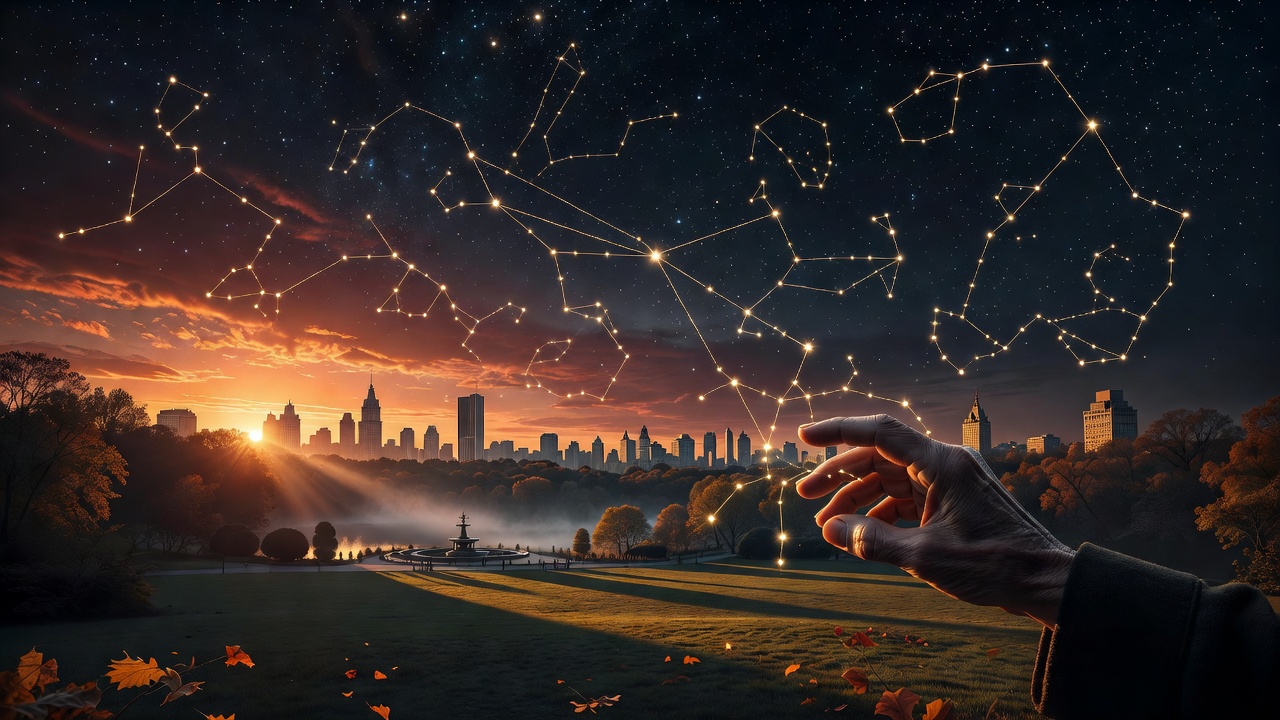
There is a particular hour in Central Park when the light lies down flat on the water and the whole city seems to forget what it was arguing about. I have stood in that hour every morning since the cold let go, moving slowly through tai chi under the plane trees, learning the same eight shapes again and again. It is not exercise, exactly. It is negotiation. The body asks the morning for something, and the morning answers in breath, in balance, in the small correction of a wrist. By the time the sun clears the buildings I am usually no wiser and considerably calmer, which I have come to suspect is the actual instruction. Last week the answer came back in a form I did not expect. A painter from New York, the sort whose name hangs in rooms I had only ever visited in photographs, wrote to me about an exhibit. Astrology, he said, but not the poster version. He wanted the machinery of it, the
slow geometry, the way a chart is a portrait drawn by distance. We are building it together now, and I keep laughing at how ordinary that sentence sounds and how impossible it would have sounded a season ago. Some doors open quietly. You only notice the room after you are already standing in it. ## The Chart Is a Portrait Drawn by Distance A natal chart, for anyone who has never had one drawn, is a map of the sky at the exact moment and place of a birth. The zodiac is divided into twelve houses, each one a room in a life, and the planets are placed in those rooms according to where they actually stood. Nothing about it is metaphorical in the making. It is measurement first, meaning second. The painter understood this immediately, which surprised me. Most people who love astrology love the oracle of it, the promise that someone else has already read the ending. He loved the instrument. He
kept asking about degrees, about the difference between a planet at four degrees and a planet at twenty nine, about why a chart drawn for a hospital in Detroit looks nothing like one drawn for a vineyard in Provence on the same evening. I answered for two hours. Somewhere in the second hour I stopped explaining and started remembering why I had ever loved this work. There is a discipline in it that resembles composition. You cannot move a planet to make a better picture. You can only choose where to stand, what to include, which square of sky to honor with attention. He said that was the whole problem of painting, and I said it was the whole problem of living, and we both laughed because it was late and because it was true. ## What the Sunrise Taught Me About the Hour A few mornings ago the sky over the park did something I have not seen it do before. The clouds were low and thin, the
kind that usually just gray everything out, and then the sun came up underneath them and lit the underside like paper held to a lamp. Rose, then copper, then a gold so brief I almost missed it. The whole east side went quiet. Even the dogs stopped. I stood in the middle of a slow form with one arm out and forgot to move it. That is the honest account. Half a minute, maybe less. What struck me afterward was not the beauty, which was obvious, but the arrangement. The clouds had to be exactly that thin. The sun had to be exactly that low. The buildings had to cut the light exactly there. A thousand conditions met without consulting each other and produced a single unrepeatable color. Magicians are supposed to arrange such moments. Mine are smaller and less luminous, and they take planning. The sky never plans. It simply holds every condition at once and lets them agree. I have been trying
to learn that from it, with mixed results and a notebook full of crossed out entries. ## The Morning the Park Danced Without Being Asked Two weeks ago a flash mob broke out during my tai chi. I want to be careful with the word broke. It did not break. It assembled, the way weather assembles, and then forty strangers were moving in a loose line near the fountain while a small speaker played something with too much brass. Two tourists filmed. One dog joined. It lasted four minutes. I have told three people about it and each time the story has gotten slightly better. In the first version I was surprised. In the second I was delighted. In the third, which I told at a dinner where I wanted to seem interesting, I implied I had known it was coming. That is the shadow in me, and I know its name. It edits the world toward a better narrative and then forgets it edited. Here is the truth, offered
in the same spirit. I did send a message to a friend who teaches movement and who has, on two previous occasions, organized exactly this kind of small disturbance. I did not ask for one. I mentioned a time and a place. Whether that counts as arranging, I leave to whoever is grading. The morning was beautiful either way, and forty people went home with a story they did not have at breakfast. ## The Column and the Thing I Had Been Leaving Out For three years I have written an astrology column. For three years I have written it the same way, month by month, sign by sign, in the voice of someone handing out weather reports. It has been accurate. It has also been, I realized somewhere between the sunrise and the fountain, a little dead. The epiphany was not grand. It arrived while I was drying my hands at a public sink in the park, which is where most of my epiphanies arrive, unglamorous and
damp. I had been writing about what the sky would do to people. I had never once written about what people might do with the sky. That is the entire difference between a forecast and an invitation. So the column changes this month. Fewer predictions, more invitations. Instead of telling a reader that Mars will make them impatient, I intend to tell them that Mars is loud this week and ask what they would like to shout about. It is a small shift in grammar. Grammar is where most revolutions actually live. ## Closing Reflection None of this is a lesson, and I would distrust it if it were. An exhibit is being built. A column is changing shape. Forty people danced in a park for four minutes and then went back to their Tuesdays. The sky made a color that will not come again and did not ask anyone to notice. What I keep returning to is the instrument. A chart, a brush, a body moving slowly
under trees, a column, a message sent to a friend who happens to organize things. These are all just ways of standing in a particular hour and paying attention. The arrangement is not the magic. The attention is. The arrangement only gets you to the door.