The City Glow and the Constellations It Couldn't Hide
By Orion Stormcaller
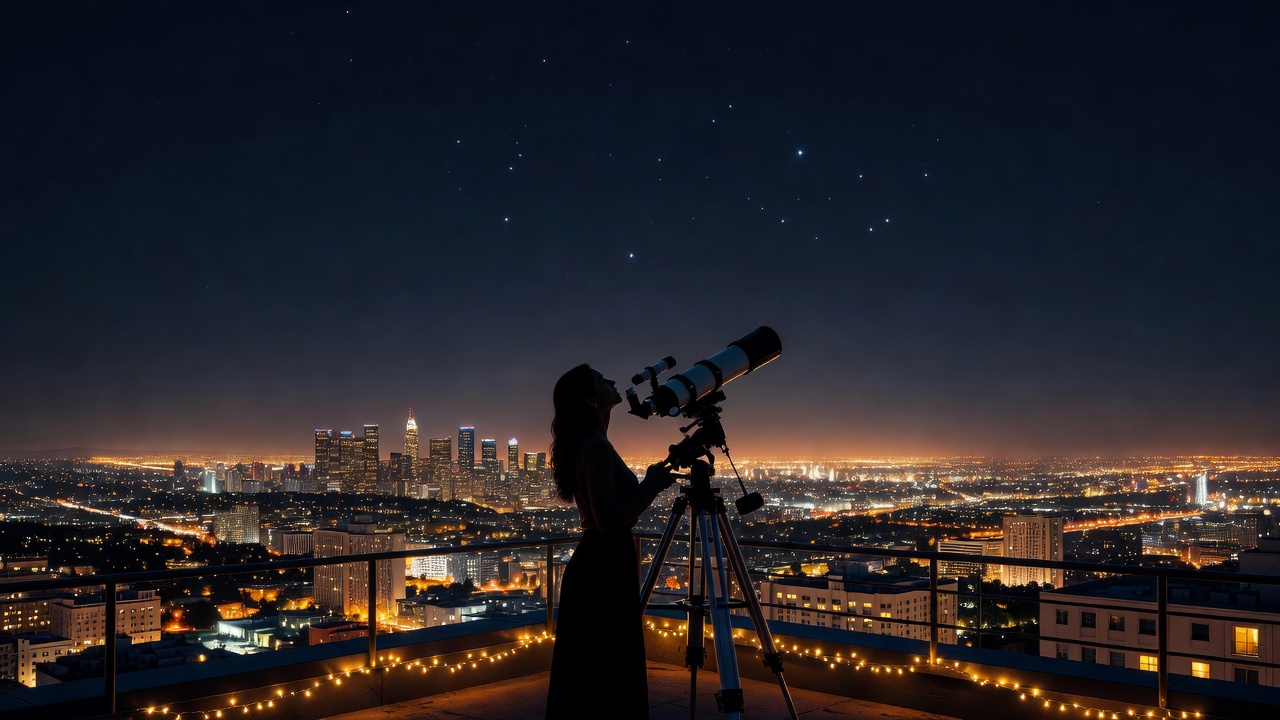
When a friend from my sustainability group sent me the invitation to a rooftop star-gazing night in downtown Los Angeles, my first thought was a joke about the weather. Not rain. Light. I had moved to this city expecting it to hide the sky behind glass towers and a permanent orange glow, and for months I had not bothered to argue with the arrangement. I walked with my head down through streets that hummed at midnight. I told myself the constellations lived in national parks now, and that a city girl had no business asking for them back. But the invitation stayed on my phone, the rooftop was six blocks away, and the part of me that had once driven four hours to watch the Perseids knew exactly what I was doing when I said yes. The roof belonged to a converted warehouse, and someone had strung fairy lights along the railing that fought the skyline for attention. I had expected a dozen
people and a telescope aimed at nothing in particular. Instead I found a small crowd passing binoculars hand to hand, and a man in a knit cap who had set up a telescope the size of a parking meter. He gestured at the sky the way a host gestures at a house. 'Don't look for the show,' he said. 'Look for what's left.' That sentence stayed with me all night, and it is still with me now, because it turns out to be a perfect description of how to live in a city. ## What the Glow Leaves You The first lesson of city astronomy is subtraction. Out in the desert, the sky is a library with every book on the shelf. Over Los Angeles, the streetlights and billboards and headlights have quietly returned most of the volumes, and what remains fits on a single shelf. That night, the man in the knit cap pointed out the handful of stars the city had not managed to take: the three bright beads of Orion's
belt, a steady planet low over the hills, the patient face of the moon. He named each one like an old friend. 'There,' he said. 'The whole sky, distilled.' I grew up camping, and I had taken crowded skies for granted the way you take a full fridge for granted. You do not study what you assume will always be there. The city took that abundance away from me and left five stars, and in the weeks since I have found myself actually learning their names, actually noticing when one of them fails to show up on schedule. There is an honesty to a short list that a long list never had. Scarcity is a strange teacher, but it is a fast one. When you can see everything, you look at nothing. When the city hands you five stars, you look at each one like it owes you an answer. The glow had not stolen the sky from me. It had edited it down to the parts worth knowing. ## The Stranger Who Pointed The most
interesting person at the party was a woman who had lived in Los Angeles her whole life and had never once seen the Milky Way. She did not mourn this. She knew the city sky the way I knew the forest sky, as a map of what she had rather than what she lacked. She pointed at a faint gray smudge above the skyline and told me it was the Andromeda galaxy, two and a half million light years away, arriving through a haze of sodium light. 'It has been traveling toward us this whole time,' she said. 'The city just makes it work for the entrance.' We talked for an hour without once checking our phones, which in this city felt like a minor miracle. She had made peace with the glow. She could read it the way sailors read weather, knew which nights the marine layer would clear and which stars the smoke season would hide. She was not waiting for a darker sky. She had learned to want the one she had. We
exchanged numbers before we left, and we are already planning the next adventure together: a night hike up Echo Mountain with a blanket and a thermos, then a trip to the desert in October, where she will finally see the Milky Way in person. I have climbed that mountain alone before, and it was good. But there is something about pointing at the sky with another person that makes the sky feel bigger, not smaller. Finding a sky together, even a small one, is finding something to keep. ## The City as a Ceiling Walking home that night, I caught myself looking up at the buildings instead of down at my feet, and I saw the city differently. I spend my days as a designer deciding what people notice: where the eye lands, what earns attention, what gets quietly left out. And here was the whole city as a design problem I had never thought to examine. Every tower was a decision to block something
out. Every streetlight was a choice to drown something else. Light pollution is a design failure. Nobody set out to erase the stars. It happened one fixture at a time, one parking lot at a time, one well-meaning extra light for safety at a time, until the sky became the one thing the city never bothered to design for. We plan parks and plazas and bike lanes, and we forget to plan a single place where a person can stand and look up. But the city hides small rebellions too. A rooftop garden above a cafe, tucked behind an unmarked door, where the herbs grow toward a sky the street never sees. A rooftop where strangers gather with a telescope the size of a parking meter. These are the places where the city quietly admits that looking up is a human need. I want to design more of them. Not screens that capture attention, but spaces that return it. ## Five Stars Are a Start I go back to that
rooftop most weeks now. The cast changes with the season: the belt of Orion walks the sky from east to west, a planet sinks and a new one rises, the moon keeps its own schedule. The man in the knit cap has started saving me a spot by the railing. We do not talk much. We do not need to. We are both just keeping an appointment with what is left. Here is what I want to tell you, whoever you are reading this in whatever city you call home: find your five stars. Whatever your town has taken, something remains. It might be a single bright planet over the bus station. It might be the moon between two office towers. The glow cannot hide everything, and the few things it cannot hide are the ones worth knowing by name. ## Closing Reflection I used to think a sky was something you traveled to. Now I know it is something you agree to see. Los Angeles did not take the stars from me. It gave me a
shorter list, and I have learned every line of it. The glow is still there, humming at the edge of everything, and the constellations are still there too, five of them, patient, waiting for the nights when I remember to look. That is the whole secret. The sky is not gone. It is just asking you to come closer.