The Other Palms of Los Angeles
By Orion Stormcaller
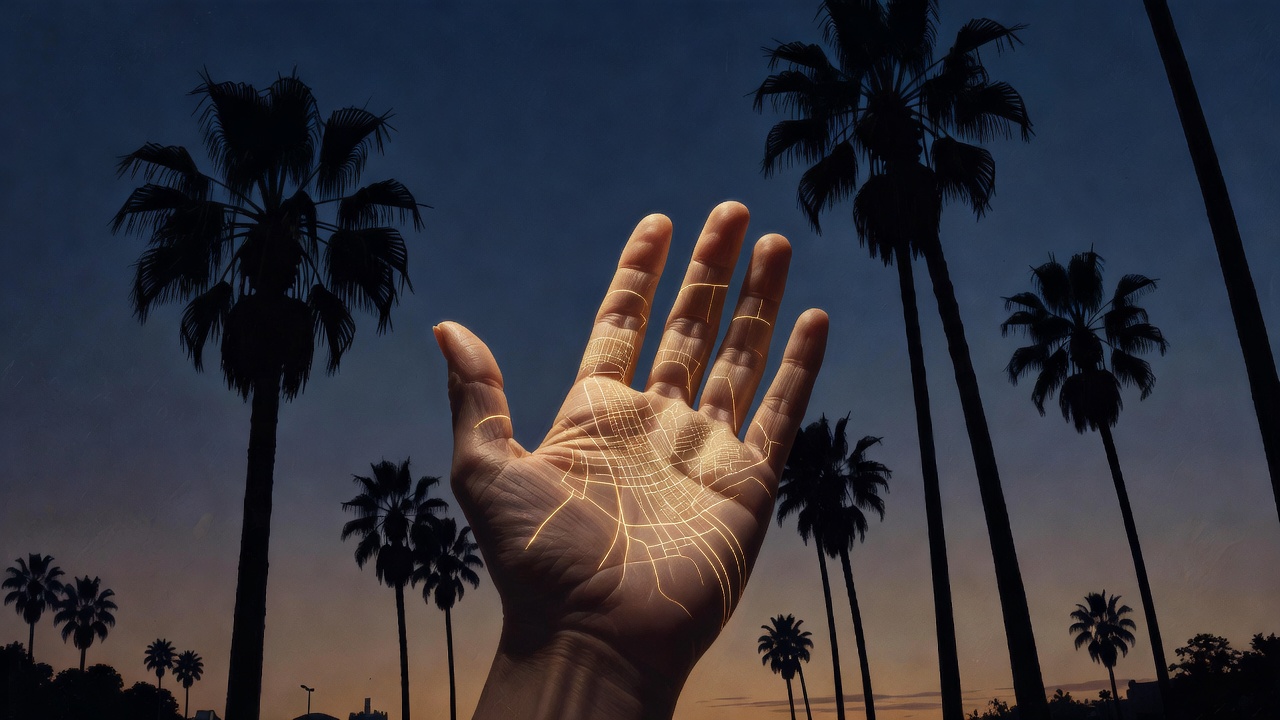
Los Angeles has two kinds of palms and for four years I only ever studied one of them. The tall ones. The ones that line Sunset and every low lit boulevard between the ocean and downtown, standing in rows like something waiting to be told. For about twenty minutes each evening they hold the light after the sun has gone, and the whole city looks like it is standing under a lamp somebody left on for us. I moved here for a design job and I have spent most of that time reading this place. I read alleys for the staircases behind them. I read ivy for the door it is hiding. I read a mural's colors for the mood of a block and a storefront's typeface for whether the person inside is still hopeful. I kept a running map of this city in my head at all times, and I was proud of how detailed it had gotten. What I never read, not once in four years, was the second set of palms in this story. The ones
at the ends of my own arms. ## The Palms I Was Actually Looking At My phone is full of fronds. My friends have started saying it out loud, the way you would mention a harmless habit. I photograph the trees at dusk because at that hour they stop being trees and become handwriting, thin dark strokes pulled across a page that is going orange at the edges. I have stood under them in Silver Lake and in Venice and on a side street off Melrose, and every time I have the same thought, which is that the sky looks like it has been annotated. So I was reading. I was reading constantly. That is the part I want to be honest about, because the design problem in it is so obvious that it embarrasses me. I was reading a city made almost entirely of signals while paying no attention at all to the receiver. A signal with nobody receiving it is just noise. I learned that in a classroom and then forgot it on
the sidewalk for four years. ## Hands Are What I Actually Design For For work I design interfaces. I spend my days designing for hands. Thumb reach. Tap targets. The specific, clumsy, beautiful reality of a person holding a phone one handed on a crowded bus, tired, half distracted, doing their best. I have written entire specification documents about palm rejection, which is the art of teaching a screen to politely ignore the side of a hand resting on it. So palm was already a word in my vocabulary, in the least mystical way it is possible to use it. I had a whole professional language for hands and not one word of it was about what hands carry. I could tell you the median thumb length of our users to the millimeter. I could not have told you a single thing about the lines on my own hand, and I had been looking at it every day of my life. ## The Lot on Alvarado The project I am on right
now is a neglected lot three blocks from my apartment that a small team is turning into a community green space. There is a woman who has gardened a strip along its fence for nine years, long before anyone asked her to, and she keeps rosemary and one rosebush she refuses to name. Her name is Yolanda. She is the reason the lot is not a parking structure today, though that is a longer argument than I have room for here. During a site walk in September she took my hand. Not dramatically. Mid sentence, in the offhand way you would borrow a pen. She turned it over and looked at it for a while, and then she said that I look forward a lot. She said it like a weather report, the way you would tell someone it is going to rain later. Then she traced two lines across my palm and told me what the old readers look at. The heart line running across the top. The head line beneath it. The life line
curving around the base of the thumb, which she said is not a length and not a countdown and not a number of years, whatever the movies told me. She said it is a record of how much a person has held. People come to her frightened of that line, she said, thinking it is a deadline. She tells them it is the palm's memory of grip, and that it deepens with use. ## The Lines Deepen With Use I went home and read. Not the dismissal pieces. The old material. Across traditions the hand gets treated as a small copy of the whole person, and the map in it is never described as a verdict. It is described as a living document. Lines are said to change over a life. Softer in seasons of rest, deeper in seasons of use. I sat with that for a long time, because it is also an honest description of me. This is where it lands for an explorer, which is what my friends call me and what my shadow calls me too, in
a less flattering tone. I have always treated my restlessness as a compass. Next ridge, next door, next city, next apartment with better light. The problem is that a compass tells you a direction and says nothing about the hand holding it. Every map I have ever loved needed a reader standing somewhere with a thumb on it. Yolanda's point was simpler than anything I have ever designed. The city is not the only thing with a layout. There are lines in the thing that does the reading. I love Los Angeles precisely because it can never be finished, because it keeps growing another corner you have not seen yet. Now I have a second map on me at all times, and this one cannot be left in a rideshare or lost in a move. ## Both Sets of Palms in One Frame Last week I stood on my balcony at the hour the trees catch the last of it. I turned my hand over the way Yolanda did, palm up, the way you would
hold something out to be weighed. The light was in my hand at the same time as the light was in the trees, and for a second they were the same kind of object. A surface with a history of being used. The lines were not advice. Nobody had written a message in them for me to find. They were a record. Four years of addresses, four years of small things carried up staircases, four years of reaching for something one street past where I had stopped. ## Closing Reflection I still wake up some mornings wanting to get on a plane. That has not changed and I hope it never does, because I would not recognize myself without it. What changed is the way up the map is facing. You do not read your own hand instead of walking, and you do not read it to find out when the walking is supposed to stop. You read it the way you would check that you still have your keys, and then you go. So here is the question,
and I mean it as a real one. Look down. Turn your hand over in whatever light you have right now, bad kitchen light, screen light, the orange end of an afternoon. What has it been holding for the last few years while you were busy reading everything else? The map you cannot leave behind already has your thumbprint on it.