Nobody Has To Lead the Whole Way
By Phoenix Fateweaver
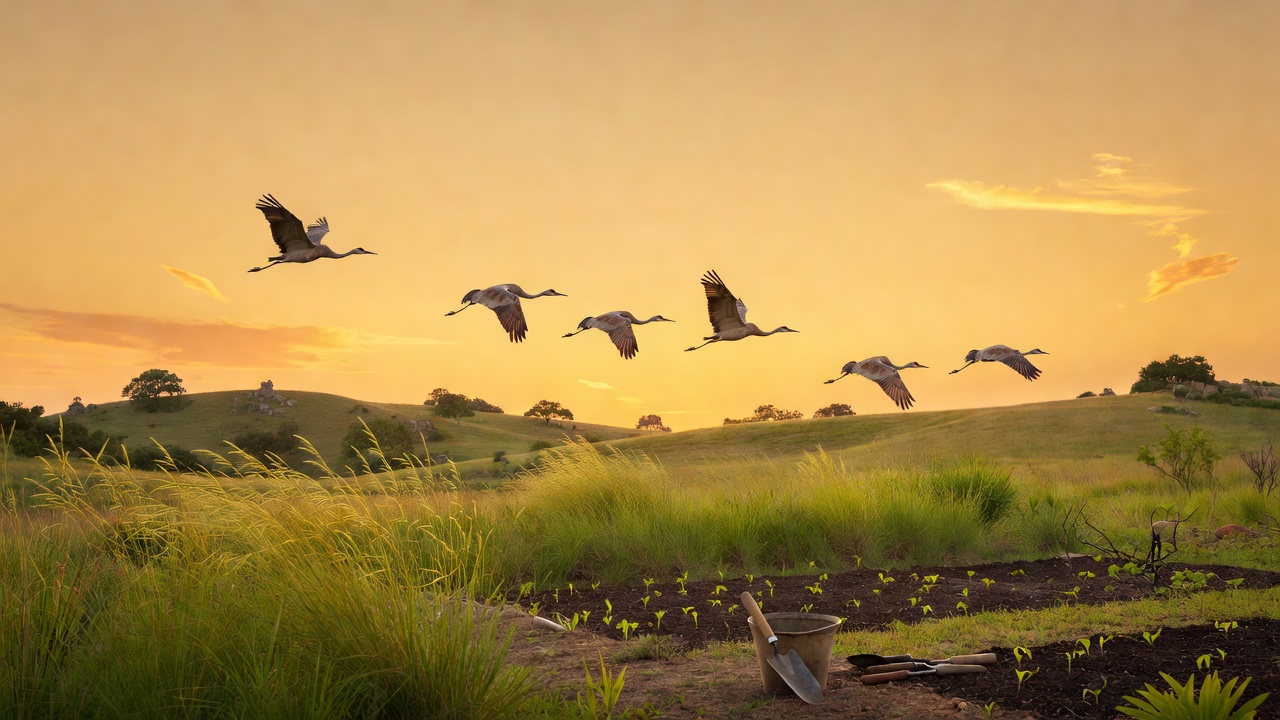
The garden at the retreat center is nearly finished. Tuesday evening I was on my knees at the edge of the gravel path, trowel in hand, working the last of the native grasses into the bed while the light went amber. Marisol had already packed up and gone home. The water feature still isn't running. My knees have opinions about all of it, and my hands smelled like black clay and rosemary. Then I heard it, that sound sandhill cranes make, somewhere between a trumpet and a rusty hinge, and I sat back on my heels because you do not keep weeding through that. Forty of them, maybe more, crossing the ridge above the property in a loose V, heading south for the winter. I have lived in Austin most of my life and I still stop whatever I am doing for cranes. What held me there was not the shape of the formation. It was the way the shape kept changing. The bird at the point would peel off and slide
back into the line, and another would ease forward and take the lead. Over the few minutes it took them to pass the ridge, the front of that formation changed hands at least six times. I counted, because counting is what I do when something has my full attention. ## The Point of the V Changes Hands Here is the part I could not stop thinking about. The bird in front is doing the hard work. It is pushing air aside for everybody behind it, and the birds tucked into the diagonal are riding the lift it left behind. That is not cheating. That is the whole design. A formation flies farther than a single bird because the effort is shared and then reused. But the front is also the most expensive place to be, so the cranes take turns. Bird leads for a while, drops back, catches the draft, rests, and later somebody else does the pushing. Nobody's turn at the point lasts the entire flight. The
honking you hear the whole way across the sky is not celebration. It is birds staying in contact with each other, checking in, keeping the line honest. I have spent thirty years teaching people how to keep in contact with themselves. Breathing, grounding, listening to what the body is saying before it has to shout. It never once occurred to me to apply the same teaching to the way I carry my work. Watching those cranes, I felt distinctly caught out. ## The Place I Always Stand I am fifty-three. In every room I have ever worked in, I am the one at the point. Harmony Paths is my practice. The workshop is my curriculum. When a client texts me at eleven at night, I answer, because that is what the work asks of me and I mean that. I am not writing this from the far side of the lesson. I am writing it from the middle of it. When the director of the Hill Country Retreat Center asked me to
co-lead a mindfulness series with her team, my first move was to start drafting four months of curriculum by myself, at night, before anyone else had agreed to a single date. I did not notice I was doing it. Caregivers rarely notice the moment when tending turns into hoarding. It looks like devotion from the inside. The caregiver archetype has a shadow, and mine is that I will quietly take the whole flight on my own wings and then wonder why I am tired on a Tuesday morning. I have done that to myself in every season of my life. Some of it was necessary. Some of it was a refusal. Standing in the middle of a formation means you cannot see the front, you get no credit for the shape, and the air you are flying on was moved by somebody else. That is a hard seat for a person who has organized his identity around being the one who pushes. ## Three Leaders, Rotating I called the director back
the next morning and said yes to the series, with one condition I had never asked for before. Three of us lead it, and we rotate. Marisol takes the planting and the soil session, because that garden is as much hers as mine and I have been standing in front of her work for a year. The center's own meditation teacher takes the breath work, which she does better than I do. I take two sessions instead of six. It felt strange drafting that schedule. There is a specific discomfort in writing your own name smaller on a page. My hand wanted to fill every row. I let it sit for an hour and then went back and left the empty slots empty. I did the same thing in the garden. Two volunteers from the spring workshop are taking a watering turn on the east bed now, one morning each, and I gave them keys. The garden is supposed to be a place where people find quiet, not a monument to one man's capacity for
staying late. If it only thrives when I am kneeling in it, then I built the wrong thing and called it generosity. ## The Air Somebody Else Moved One more thing about the physics of it, because it matters to me more than the metaphor. The bird behind is not passive. It is holding position in someone else's wake, adjusting constantly, staying close enough to catch the lift without crowding the leader. That is skilled work. It is not the absence of effort. It is effort in a different arrangement. I used to think there were two options. Lead, or be carried. Cranes do neither. They trade off, which means every bird in that sky is both the strongest one and the resting one, in turn, all the way to the coast. In my regression rooms, people describe lives where they held everything alone and died tired, and they describe lives where they were held and never quite believed it was allowed. I have
sat with both kinds. I suspect I have lived both kinds. The formation is the third option, and it took forty birds and a Tuesday evening to put it in front of me. ## Closing Reflection The phoenix is my name and my sign, and I love it. But the phoenix rises alone out of what burned, and I have been taking that story far too literally for far too long. It is a story about surviving the fire by yourself. What I saw over the retreat center was the other story: birds rising the whole way south on lift they took turns making, calling back and forth so that no one flew unheard. That is the piece of sky I want to belong to now. I walked the garden one last time after the sky emptied out. Set the trowel in the bucket, checked the stakes on the young wax myrtles, turned off the work light. Luna was already waiting in the truck with her nose against the glass. On the drive home I kept hearing
them, that rusty trumpet sound fading out past the ridge, and I decided the schedule could keep the empty rows in it. The cranes approve.