The Lead Changes Hands
By Phoenix Fateweaver
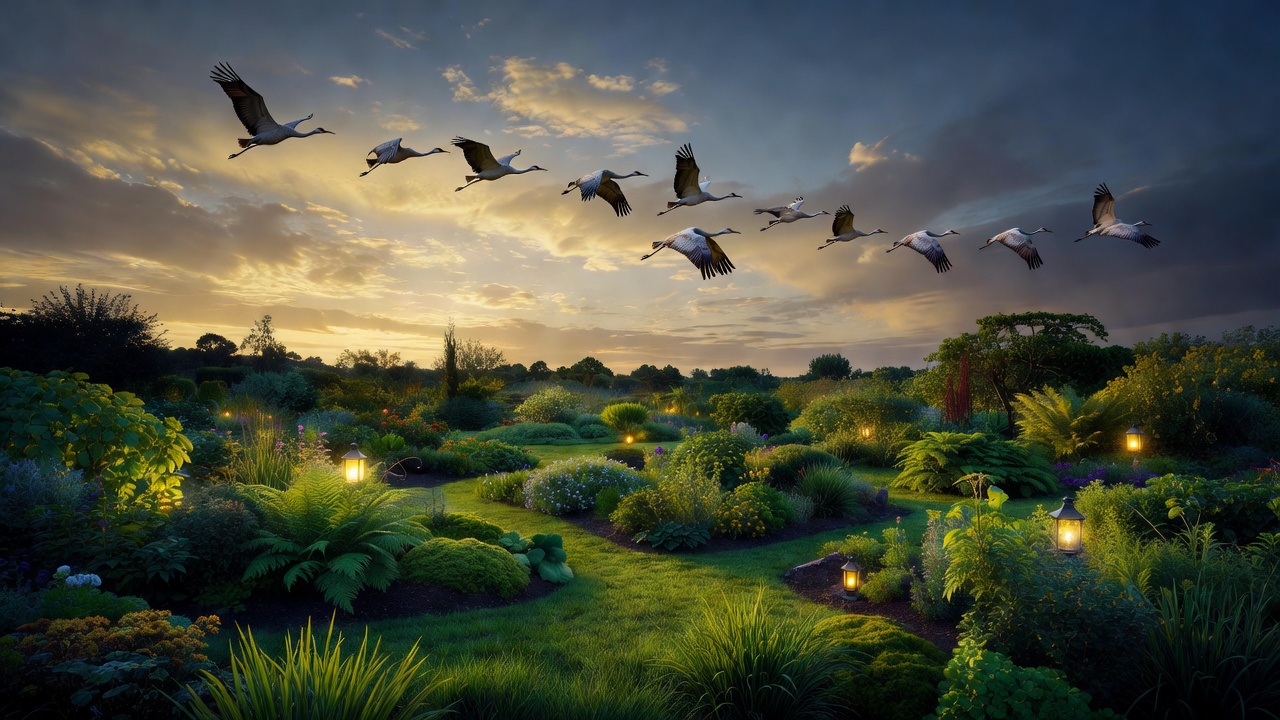
On Thursday evening I was kneeling in the beds of the healing garden with a trowel in one hand when the sound arrived before the birds did, a low rolling conversation of voices I could not see yet. I looked up and there they were, a loose line of sandhill cranes crossing the last of the light on their way to the water. I stayed on my knees with dirt on my hands and watched until they were gone. What held me was not their size, though they are big birds, or the color of the sky, which was doing its usual Hill Country performance. It was the shape. They were flying in a V, and the V was not still. It opened and closed like a slow breath, and the bird at the point of it kept changing. One would hold the front for a while, then drift back a wingbeat and settle into the line, and another would move up and take the work. I have been at this long enough to notice when a thing is trying to teach
me something, so I let it. I stayed in the garden until the sky went grey and the garden lights came on, thinking about who carries the front in the rooms I work in, and who gets to fall back when they are tired. ## The Bird at the Point Is Doing the Hardest Work There is a reason the shape keeps changing. The bird at the front gets no lift from anybody. Its wings are pushing air down, and off the tips of those wings two long spirals of air roll backward, one on each side. The birds flying behind it ride the upwash coming off those spirals, and they burn less energy for the same distance. A bird tucked into the line can go a long way on what the bird ahead of it has already stirred into the air. Which means the front is the one place in the formation where nobody is being helped. And it also means the flock can only keep going if the front is passed around. The lead drops back, another
takes it, and the whole line stays in the air longer than any single crane could manage alone. I recognized the arrangement immediately, because I have lived it. For most of my adult life I have been the first one up the stairs, the one who remembers the birthdays, the one who notices when somebody in the room has gone quiet. Caregiving is a beautiful thing to be good at and it comes with a blind spot the size of a barn door. I would ask any client in the world who takes the point when they are tired. I never turned the question around. ## Lift Is Something Two Birds Make Together The part of this I keep turning over is that lift is not stored inside a wing. It is not a personal possession. It is created in the space between two birds, in the relationship between one wing and the air that another wing just moved. Neither bird can make it alone. Both of them are borrowing from each other
continuously, and neither one has to be aware of it for it to work. I have watched the same thing happen in a workshop room. Two people who arrived as strangers get paired for a breathing exercise and something moves between them that neither of them brought in the door. Attention travels like that. Care travels like that. You cannot hold it in your own chest and call it yours. The moment you hand it forward, it comes back to you as lift. The cranes did not choose each other for the flight. They simply fly with whoever is there, in whatever order the air suggests, and the arrangement holds. I have started thinking about my groups the same way, less like a set of individuals I need to lift and more like a formation that holds itself up once the shape is right. ## The Sanctuary I Did Not Find Myself There is a second thing the cranes taught me last week, and it came from a person instead
of a bird. On Tuesday I was at a cafe with green tea going cold beside me, watching something small and yellow move in the branches outside the window. The man at the next table noticed me noticing, and we ended up talking for twenty minutes about birds around Austin. Before he left he told me about a hidden sanctuary on the south side of the city, a place I had never heard of in twenty years of walking these trails. I make my living helping people draw maps of their lives. So it landed hard that the best place I have been handed in years was handed to me by a stranger whose name I did not get. You do not walk into a place like that by planning it. It reaches you through somebody else's mouth, and all you can do is be findable when it does. The cranes know this in their bodies. A young crane does not inherit the route south in full. It learns the way from the older birds, flying the line
behind them and remembering the turns. The knowledge of the road is carried in the flock, not in the individual, and it only travels if somebody is willing to fly in the back of the line and pay attention. ## Taking the Back Position On Purpose So here is what I am actually doing with it. The director at the Hill Country Retreat Center and I are building the winter series, and one of the modules is changing because of a flock of birds. Instead of me holding the room for the whole session, we are going to pass the point on purpose. Each person gets the front for ten minutes, with a real piece of the work in their hands, and then hands it off out loud, saying who is taking it next and why. Personally, the harder practice is smaller. There is a man in the Tuesday Tai Chi group at Zilker, the quietest one in the circle, who always stands at the edge and follows. I asked him if he would take
the first ten minutes next week. He said yes, and then he asked me twice more whether I was sure. I understood the feeling exactly. Being handed the front is its own kind of exposure. And the garden is getting one more thing before the weather turns. There is a stone bench going in at the far end of the path, past the water feature, in the one spot where the sound of the water covers most of the noise in your head and nothing is asked of you. It faces back down the path toward everyone else. Every garden needs a place at the back of the formation, and every one of us needs to know where ours is. ## Closing Reflection The cranes were long gone before I stood up, and the trowel was still in my hand, and I finished the row of plantings in the dark with the garden lights humming. What I took inside with me was not a lesson about birds. It was the plain arithmetic of that line in the sky. I
have been the point bird out of love, and love is a good reason but it is not a design. The formation is the design. The lead changes hands, and the flock gets where it is going because of that and not in spite of it. If you have been out front for a long stretch, this is the only suggestion I have. Not to stop, and not to hand over everything at once. Just to fall back a wingbeat and let the next one carry the front for a while. Nothing in that shape asks you to stop flying. It only asks you to stop being the only one who does.