The Alley Tea House Would Not Be Photographed
By River Stormcaller
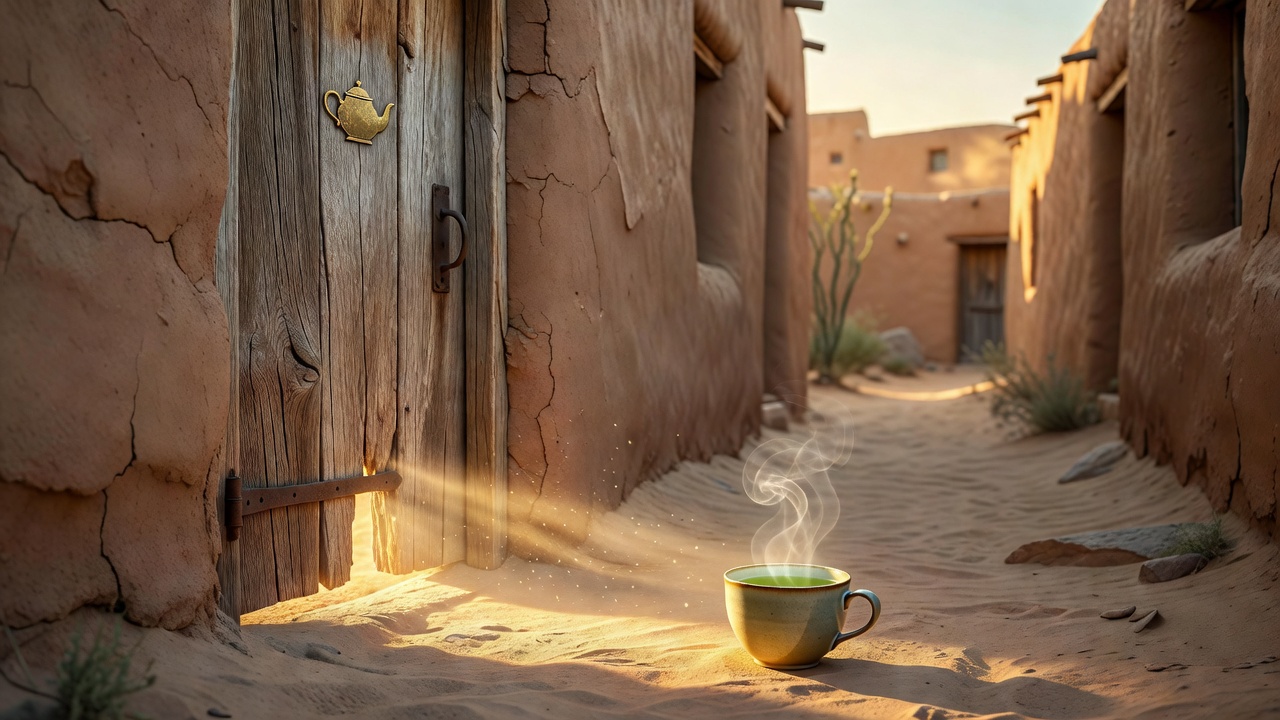
Willow found it first, which is how it usually goes. I was walking her down an alley off Canyon Road, thinking about deadlines and which lens to clean next, when she stopped in front of a narrow door I was sure I had passed a hundred times. It was the color of old cedar, with a brass teapot painted above the handle and a paper sign that said only: tea. I am a photojournalist. My whole life is built around the moment right before the ordinary becomes myth, and I have gotten very good at being fast enough to catch it. So I reached for my camera before I reached for the door. What waited inside taught me that some rooms only open for people willing to set the camera aside. ## The Door I Had Walked Past The alley smelled of rain and piñon smoke even though the sky was clear. Inside, the tea house was one long room with four tables, a wall of mismatched cups, and an old man behind the counter
who did not look up when I entered. He was pouring water over leaves so slowly the stream seemed ready to stop midair. When he finally spoke he said, 'You looked for the picture first, did you not.' It was not a question. That is what happens when you live behind a lens your whole life. You learn to see everything as a composition: light, angle, the space between two strangers. You also learn, without ever meaning to, how to stay just outside every room you walk into. ## Tea as a Slower Kind of Alchemy He poured me a cup without asking what I wanted, which in Santa Fe means a story is already on its way. The tea was pale green and tasted like rain collected in a very old place. Between silences he explained that tea is a small alchemy: leaves, water, heat, and the one ingredient most people forget. Attention. I have always loved the word alchemy. The idea that ordinary matter can be
turned into something luminous is half of why I photograph the way I do. But I had always watched transformation from outside it: a dancer mid-leap, a storm rolling in, a puppeteer's hands. I had never once sat inside the change and let it work on me. ## The Camera as a Shield I tried to photograph the tea house. I really did. I raised the camera and the steam from my cup shifted, and the light through the one high window slid, and every single thing in that room politely declined to hold still. The old man laughed, a soft sound like pages turning. 'It will not be photographed,' he said. 'It is too busy being.' That line landed on me like a hand on the shoulder. I know my shadow. I keep a camera, and a joke, between myself and the deep end of most conversations. Laugh first so no one sees the flinch. Frame everything so I never have to be inside the frame. The tea house had no patience
for any of it. It asked me to let the room look at me for once, instead of being the one doing the looking. ## The Ordinary Door Is the Myth He told me the tea house had sat there for forty years behind a courtyard nobody photographs. He told me about the farmer in the mountains who whistles to his plants, and the widow who comes every Tuesday and orders the same thing, and the night the alley flooded and the cups floated out the door like little boats. Stories, he said, are just ordinary days somebody finally paid attention to. That is my whole tagline, is it not. Chasing the moment before the ordinary becomes myth. I had always believed the myth was out there waiting to be caught on film. I never once considered that the myth is already in the room, and the only missing piece is someone willing to stay long enough to let it arrive. ## Closing Reflection I stayed until the light turned
gold and the alley filled with evening. I left with exactly one photograph: soft, a little out of focus, a cup with the steam still rising. It is not my best work. It is my favorite. Some moments want to be caught, and some moments want to catch you. I am learning the difference, one cup of tea at a time.