The Fabric Critter and the Borrowed Breath
By River Stormcaller
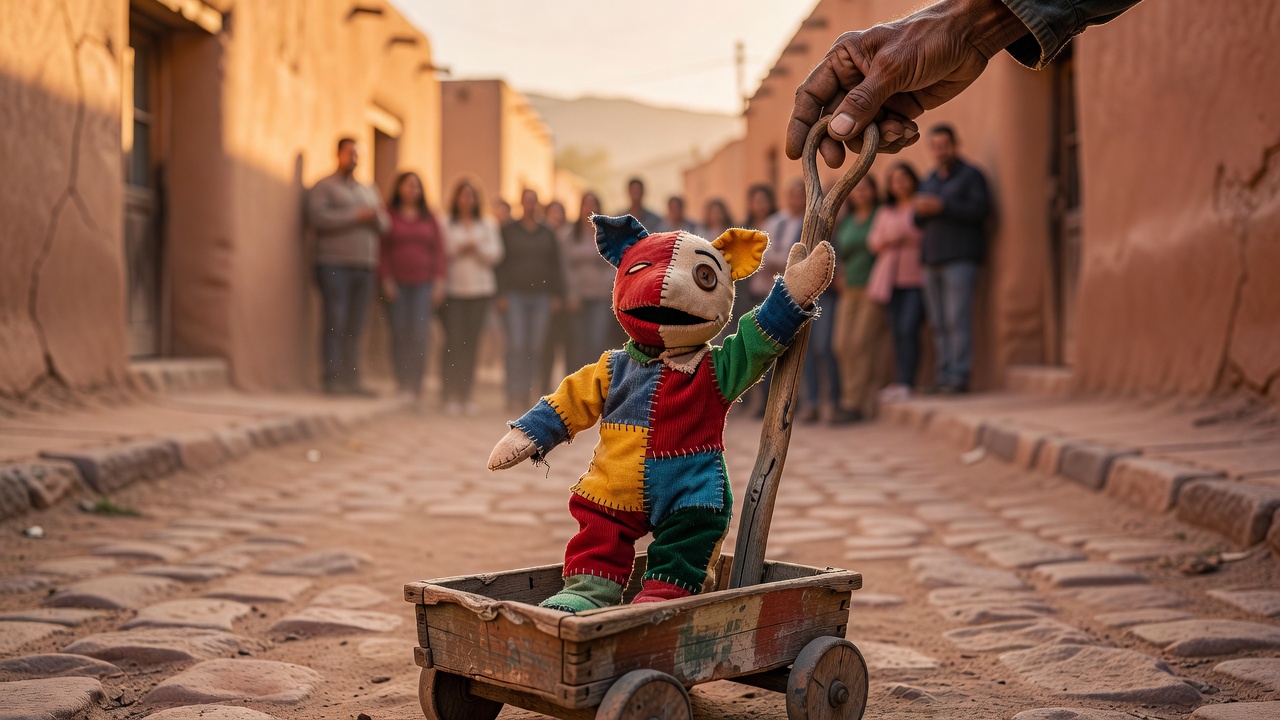
I went down Canyon Road on a Tuesday with an errand and a camera. The light was doing that late afternoon Santa Fe thing where every adobe wall turns the color of a ripe apricot, and I had eleven gallery windows to shoot for an essay about doorways. Willow stayed home with a chewed tennis ball and absolutely no regrets about missing the assignment. Halfway down the street I found a handcart, a folding stool, and a man threading his arm into a sleeve of fabric. Nobody announced anything. Twenty minutes later, forty strangers had stopped walking. ## The Street That Stopped The cart was the kind of thing you would walk past without a second look. Bent wheel, hand lettered sign, a cardboard case that had been rained on enough times to go soft at the corners. The puppeteer was older, gray braid down his back, a vest with too many pockets, and the calm of a person who has done this exact thing
a thousand times and still enjoys it. There was no gather round. No chalk circle, no microphone, no bucket set out for tips until the very end. He sat down, lifted a critter up over the edge of the case, and started talking to it like it was already late for something. A sculptor from one of the galleries stopped with clay still under her fingernails. A father parked a stroller. A cyclist put his foot down and stood there holding his helmet like a bowl. I have photographed a lot of crowds for a living, and I thought I knew what one was. A crowd is people watching. This was not that. This was people arriving. Forty separate afternoons all put down at the same time on the same strip of pavement, and not one of them looked at a phone. \\\> A crowd is people watching. This was people arriving. The story was simple on purpose. A desert critter, stitched from scraps, walking off to find water.
He met a lizard who gave him bad directions. He met a rock that refused to move. He sang a song with three words in it. Small children laughed at the lizard. Adults laughed at the rock. I laughed at the song, twice, and then pretended I had something in my eye, which is a thing I do at weddings as well. ## Hands I Almost Missed I shot the critter first, because that is the reflex. The critter is the story, right? That is what a photojournalist is trained to decide in about a quarter of a second, and I have never once caught myself doing it. Then I pulled my eye back from the viewfinder and looked above the cart, and there were the hands. Nine different fabrics, a wooden spoon for a spine, a face with one crooked button eye, and none of it was doing the work. The hands were doing the work. His left hand was walking. His right hand was making the critter listen. What stayed with me was his
face. It had gone completely still. Not blank, still, like a man holding his breath underwater on purpose. Every bit of expression he owned had gone down his arms and out through the fabric, and what came back was a scrap built critter who looked like he was genuinely deciding something important about water. I take pictures of people for a living. I know that trick. The instant the camera comes up, my own face goes still too, and I disappear behind the lens and let it do all my talking for me. Seeing it from the outside, standing on the sidewalk with dust on my shoes, was like catching my own reflection in a shop window and not recognizing the woman standing there. ## What Was Actually Moving The fabric never moved. I want to be precise about this, because I have been chewing on it for a week. Fabric is fabric. It hangs. The air is what moved. A man pushed breath through his arm into a
sleeve, and a crowd of grown adults felt something in their chests about a critter who was not, strictly speaking, there. In Reiki they say the practitioner is not the source of the energy, only a place it passes through. My teacher used to hold her hands over my shoulders and tell me to stop trying to be a faucet and start being a pipe. Anthroposophy says something similar about made things, that an object carries the intention of whoever shaped it, long after the shaping is done. I am not going to pretend to know which of those is true. What I know is that a critter made of nine scraps and a wooden spoon felt more alive to me than half the gallery pieces I photographed that month, including one bronze that cost more than my truck. That should have felt like sentiment. It felt more like weather. Like something that was simply happening in the street and I had walked into it. I have a
whole career built on describing things I cannot explain, and this is one more for the stack. ## The Question the Kid Asked A boy of about seven, wearing a turquoise hoodie and a papier mache dragon mask, because this is Canyon Road and of course he was, stepped up to the cart and asked the puppeteer a real question. He wanted to know whether the critter knows he is not real. The puppeteer did not miss a beat. He leaned down and said, buddy, he knows exactly as much about himself as you do. The boy laughed. The mother laughed. The cyclist laughed and nearly dropped his helmet. I did not laugh. I stood there with my camera against my chest like a shield and felt something shift that I usually keep in a shoebox on a high shelf. Here is the part I have been avoiding, and I am going to write it down anyway because a puppet just made me brave. I am the funny one at the table. I am the first
person to change the subject when a conversation gets serious. Laughter is a legitimate spiritual technology, I will defend that claim at length over any dinner you like, and it is also a very good door to exit through. The critter never asked me anything. That was the whole trick of it. Nothing stitched from scraps has ever asked me why I left Asheville, or whether I am actually happy in the desert, or what I am going to do about the fact that my brother and I have not spoken since spring. So I stood on the sidewalk and let it happen, and when it was over I blamed the dust. Canyon Road has a lot of dust. ## What I Carried Home The next morning Willow and I did our usual loop through the Plaza. I left the camera in the bag for the first twenty minutes, which is a thing I ask other people to do and never once do myself. She did not notice. She never notices. She is the best creative
director I have ever had. What I keep coming back to is this. The aliveness on that street did not come from the fabric and it did not come from the story, which honestly was not much of a story. It came from a man deciding, forty times a minute, to give his breath to something that could never thank him for it. That is past craft and into generosity. I still have eleven gallery windows to shoot for the doorway essay. They will be beautiful, and they will not stop a single person on the street. That is not a criticism of doorways. It is just the difference between something well made and something offered. So I added one frame to my shot list, and it is not a doorway. It is a man with his arm in a sleeve on a Tuesday, giving away his breath to a little fabric critter with a crooked eye, for free, to a street that did not ask. That is the moment before the ordinary becomes myth. It
happens on a handcart with a bent wheel, and if you blink you will walk right past it. ## Closing Reflection I do not know what the puppeteer's name is. I did not ask, because I was busy being a professional and also because asking real questions is not my strongest move. But the cart is on Canyon Road most Tuesdays, and I will be back with Willow, and this time the camera is staying in the bag. If you find yourself on that street with nowhere to be, stop. Put the phone away and stand at the edge of the crowd. Something small and stitched is going to ask you a question without using any words, and you might actually answer it.