The One Never in the Frame
By River Stormcaller
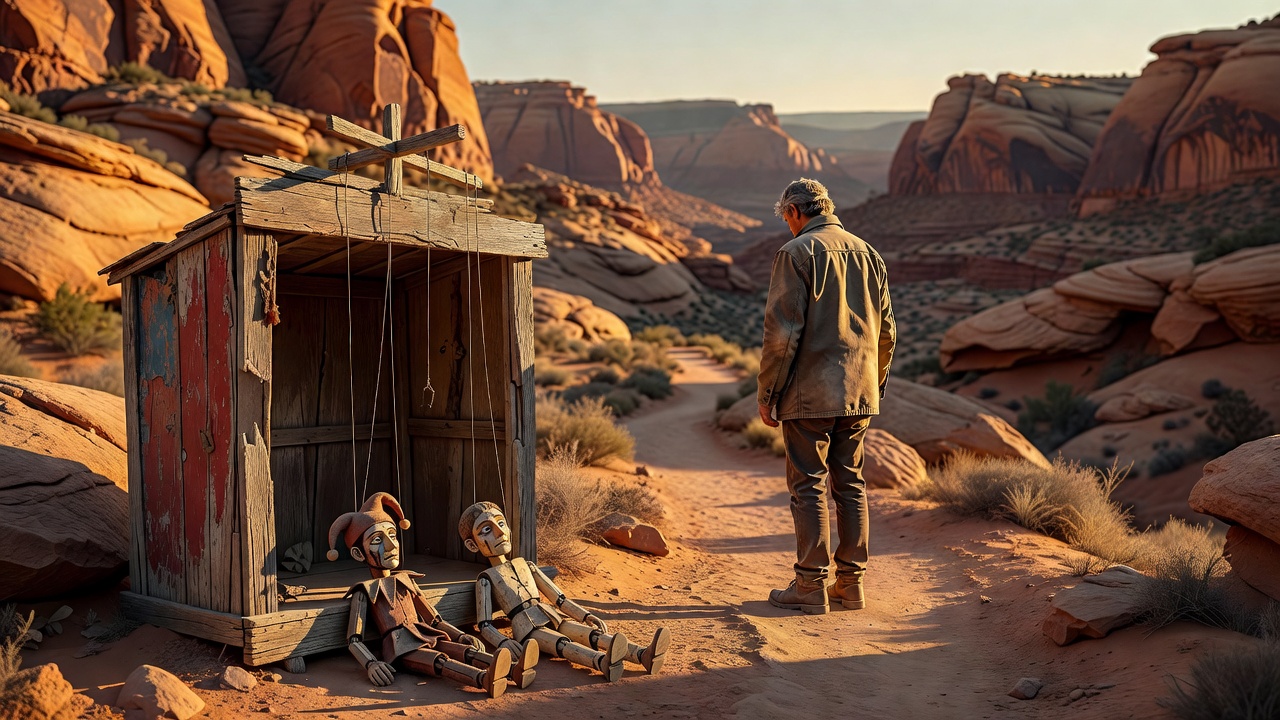
Canyon Road was doing what it always does on a Saturday morning. Gallery doors open to the heat, tourists moving slow, a dog tied to a post outside the tea house while its owner negotiated over a bracelet. I had my camera up, half working and half just walking. Then a crowd gathered at the corner, the way a crowd gathers when something small and alive is happening. It was a puppet show. A woman in a linen jacket had set up a folding screen no taller than my knee, and behind it she worked three puppets with the kind of hands that make you forget about the hands. Children sat cross-legged on the warm stone. Parents stood behind them holding coffee they had stopped drinking. I photographed it the way I photograph most things. The little faces wide open. A grandmother laughing with her whole throat. A toddler who was completely unimpressed and eating a cracker. Ten years of this work and I
still love that exact frame, the one right before a person forgets they are being watched. ## The Corner Where the Crowd Stopped The puppets were not beautiful. That was the first thing I noticed, and it is probably why I stayed. One was a coyote with a crooked jaw, one was a girl with a paper moon for a head, and the last was an old woman with a plain cloth face and no paint at all. No smile stitched on. No eyes drawn in. Just a soft grey oval that turned wherever the puppeteer's wrist decided to turn it. The coyote was the funny one. He stole the moon, he tripped over his own feet, he tried to sell the girl a map to somewhere he had clearly never been. The kids laughed so hard that one of them fell sideways into his mother's knee. I got the shot. Crooked jaw mid-argument with a paper moon, four small heads tipped back in the same direction. Then the puppeteer put the coyote down and
brought the old woman up, and the whole corner got quiet in the way a corner gets quiet when the funny part is over and nobody wants to be the one to say it. The old woman did not do anything. She just turned. First toward the girl, then toward the coyote, and then slowly, all the way out past the edge of the screen, until that blank grey face was pointed at the people watching. At the row of us. At me. ## The Question That Made It to My Side of the Lens The puppeteer spoke in the old woman's voice. Low and unhurried, the way someone talks when they have the whole afternoon and no reason to rush it. She asked the children a question. Something simple and enormous at the same time, the kind of thing you cannot answer with a fact. The kids answered immediately, because children are brave. One said the ocean. One said her grandmother's kitchen. One said a place where you can hear yourself
think. Nobody was wrong. That is the whole trick of a good question, and I know it well because it is the same trick I use with a camera. Then the old woman kept turning, and the puppeteer's next line was aimed past the children, at the standing row, at the adults holding cold coffee. Same question. And I heard myself laugh. Out loud, quick, that familiar little noise I make when something gets too close. I turned to the woman beside me and said something clever about how I should probably ask my dog. She laughed. I had moved the moment along. Moving moments along is one of my actual skills. I got my shot of the blank face and I walked on. Or I want to say I walked on. I got about half a block before I noticed I had stopped taking pictures. ## The Joke I Have Been Telling for Years Here is what I know about myself after thirty-four years. I am good in a room. I can take a heavy
conversation and put a little air under it so it becomes carryable. People tell me I make things easier to hold, and I believe them, and I like being that person. Ask anyone on Canyon Road. The other half is not as charming. When a question turns and points at me, my first instinct is the joke. Not a cruel one. Just a fast one. Something warm and funny that opens a door for everybody else and quietly closes the one I was standing in. A photographer spends a whole career on the unguarded moment. That is literally what I sell. I wait outside people's defenses until they forget I am there, and then I take the picture. In ten years I have never once found it strange that I do that to everyone and no one does it to me. The old woman had no expression because the puppeteer wanted me to put one there. What I put there was a joke. It was faster, and it worked, and I did not notice it happening
until fifty feet down the road. ## Going Back Without the Camera I went back the next morning. No camera, no notebook, no plan. I told myself I was going to interview the puppeteer for a piece I keep meaning to pitch, and that was maybe forty percent true. Her name is Inez. She taught fourth grade for twenty-six years, retired, and now she does Canyon Road on Saturdays because she missed being asked questions by people who do not already know the answers. She let me hold the old woman. Cloth and a wooden crossbar, warmer than you would expect. I asked her why that puppet has no face. She said the children give her one every time. Then she said adults usually do too, and that the adults who laugh first are the easiest to spot. She said it plainly, with no cruelty in it at all. Then she asked me the question again. This time I did not have a joke ready. I stood on Canyon Road holding a
faceless cloth grandmother and I gave the honest answer, out loud, to a stranger, in daylight. It was about six words long. It took ten seconds. I have been carrying it around since, and it is lighter than it has any right to be. ## Closing Reflection My dog Willow is patient with me. She gets the version of me that has run out of material, which in my experience is the true one. We walked home along the acequia and I did not take a single picture, and nothing bad happened. The part I keep coming back to is the frame. I have spent years collecting the second before people forget they are being watched. I thought that was empathy. This week I understood it is also an excellent place to hide, and a very comfortable one, and that I have been hiding there for a long while. Inez still does the show. Same corner, same three puppets, same grey face turning out toward the row of adults with cold
coffee. If you are on Canyon Road on a Saturday and the question comes around to you, you do not have to answer. But if you laugh first, she will know. So will I. We will be gentle about it.