Teaching the Sand to Breathe
By Sol Runemaster
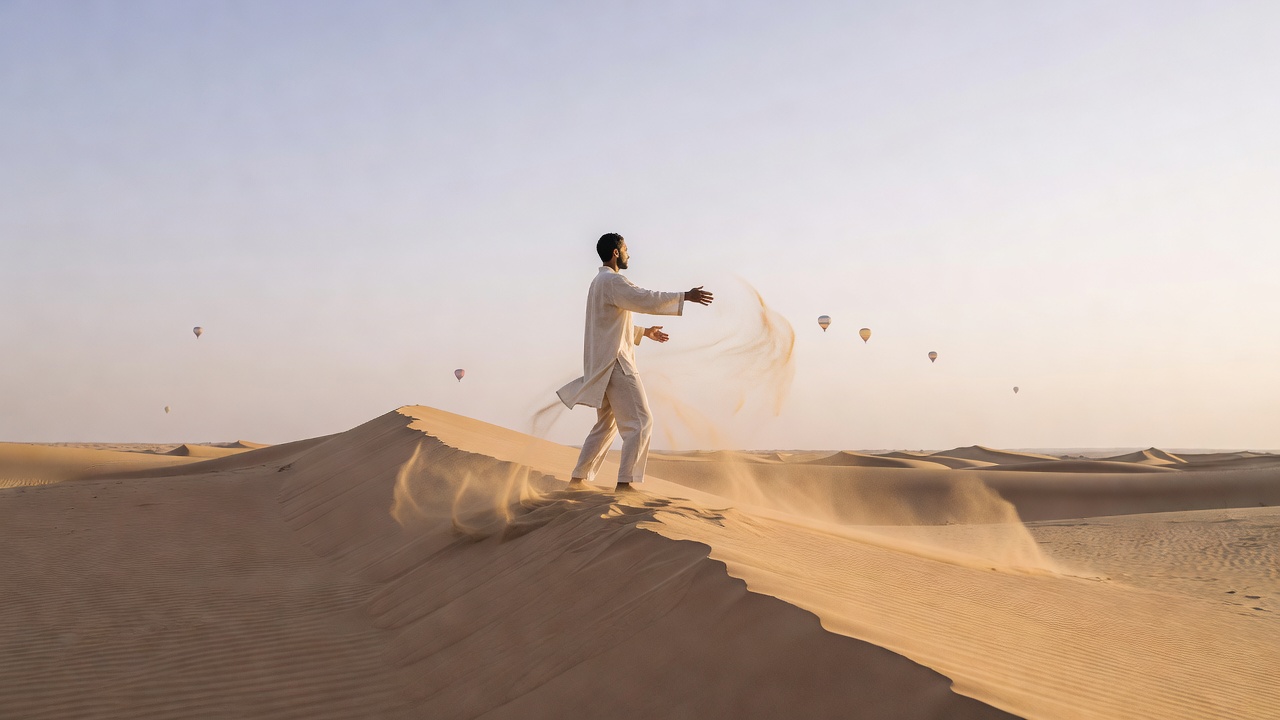
The call came at a cafe table covered in sugar packets, with a cup of tea that had given up being warm twenty minutes earlier. A woman I had met only once before, over a shared hour of slow movement and easier breathing, had passed my name along to someone planning a week long retreat in the desert. Would I come teach Tai Chi there. Seven mornings, sand in everything, a group of people who had never held a horse stance in their lives. I have a habit I am learning to look at honestly. I say yes before I have finished understanding what a thing will cost. Not from courage. From a kind of softness that would rather keep the room bright than ask where the shadows have gathered. My first teacher, an old man who taught standing practice in a park with more pigeons than trees, called it the innocent's blind spot. He said the pure in heart walk toward the fire because it is beautiful, and
sometimes they walk in too close. The desert and I have been friends for a while now. It has already given me a sky full of hot air balloons turning like a kaleidoscope over the dunes, a rain shower that lasted eleven minutes and rearranged the whole year, a plaza where strangers started dancing without anyone announcing that dancing had begun. I love that country. I had simply never been asked to work in it. ## The Yes That Came Too Easily The invitation itself was easy. Delightful, even. I heard week long, I heard desert, I heard teach, and something behind my ribs began humming a note I could not name. I said yes on the spot. I said yes twice, once for the teaching and once for the sand, which I had already decided would be charming. What I did not ask, and should have, was how a body holds a slow form under a sun that means it. What happens when forty people arrive tired and slightly
disappointed that the desert is hot, and one of them cannot lift an arm above the shoulder. What I do when the wind takes the mats and my voice at the same time. The innocent mind skips those questions. It is not lying, exactly. It simply refuses to look at the part of the picture it finds unpleasant, and then calls that refusal trust. I have come to think the shadow of my own cheerfulness is this: I can be so busy seeing the gift that I miss the work inside it. The desert did not punish me for that. It simply declined to pretend otherwise for a week. Ground that shifts will not let you float on a good mood. ## What Shifting Ground Asks of the Feet The first morning on sand taught me what no wooden floor ever had. You cannot push off from sand. The ground gives under the heel, slides a little, forgets your weight the moment you commit it. Every form I knew had been built on the quiet
assumption of a surface that would hold me. Take that away and the whole shape has to be rebuilt from the inside out. So we rebuilt it. From the breath first, then from the dantian (the lower center of the body, about two fingers below the navel, where breath and balance are stored), then from the gentle turning of the waist that lets a movement finish itself instead of being forced. My element is earth, the slow grounding current that turns up in a birth chart as the wish to build something that stays built. There is a particular lesson in being an earth person standing on ground that will not stay still. It is the difference between being steady and being rigid, and the desert teaches it in about four minutes. By the third morning I had stopped fighting the sand. The form got smaller and truer. I have taught that same shortened version ever since, on floors, on lawns, in one airport
corridor at an ungodly hour. Students ask why the movements are so restrained. I tell them I learned it out loud on a dune. ## Sound Where There Is Nothing to Echo Against In the evenings I brought out the bowls and the small frame drum, because a week of standing practice leaves people with more feeling in their bodies than they know what to do with. Desert air is dry and open in a way that changes sound entirely. In a room, a tone comes back to you off the walls, flatters you, fills in the gaps. Out there the tone simply leaves. There is nothing to return it. I have never heard my own voice so plainly. When nothing echoes, you find out what you actually sounded like. The group hummed with me at dusk, one long note held until it ran out, and the note did not come back, and nobody minded, because by then we understood that the point was the giving, not the hearing. Sand is an honest
audience. It absorbs everything and rewards nothing and somehow that made us all braver. Energy healing works on the same principle, or something near enough that I stopped trying to separate them. You offer, you do not push. You let your hands rest where the body is willing to receive and you wait longer than feels useful. The desert made that easy. Nothing there arrives on schedule. ## The Week We Actually Had A woman cried on the second morning, midway through a movement that opens the chest. She apologized for it. I told her that chest opening does that, that the body keeps its grief in the same place it keeps its breath, and that she was not being dramatic, she was being porous. A man who could not balance on one leg on Monday held the posture for a count of forty by Saturday and looked personally offended that anyone found it remarkable. Tai Chi does not ask you to be strong. It
asks you to be continuous. That distinction became the whole week. Not the achievement, the continuation. Not the perfect form, the willingness to come back to the beginning of it for the hundredth time with the same attention as the first. Half of them will not keep it up at home. I know that. The other half will, quietly, in kitchens and back gardens, and neither group owes me anything. ## The Cafe Table, Again Coming home was harder than going. The desert had been generous in the way that makes an ordinary room feel small for a few days. Then the invitation to lead a session at a conference arrived, and I noticed my old reflex lifting its head, ready to say yes before the sentence ended. This time I asked the questions first. How many people. How long. What kind of room. What do you actually want them to leave with. The organizer laughed and said nobody had ever asked her that before,
which worried me a little and pleased me more. The yes still came. It just came with its eyes open, and it is a different yes when the eyes are open. I told the woman from the cafe table the truth when she asked how it went. It was not what I expected. It was what I needed, which is a different thing and usually the harder one to accept. ## Closing Reflection I have not cured myself of saying yes too quickly. I am not certain I want to. The part of me that runs toward the light is the same part that agreed to stand in front of forty strangers on shifting ground, and I would be a poorer teacher without it. But I hold it differently now. I let it be a beginning instead of an answer. The innocent's gift is that it can still be astonished. Its risk is that it mistakes astonishment for understanding. A week of sand and sun and honest tones with no walls to return them pressed that lesson into
me where I will not lose it. Some mornings I still see the balloons rising over that country, turning slowly, each one a color nobody had planned. And I remember that the sky held them and the rain followed a few days later and neither canceled the other out. That is the whole of what I learned out there, and it took a week of standing still to learn it.