The Desert Wrote Back in White
By Sol Runemaster
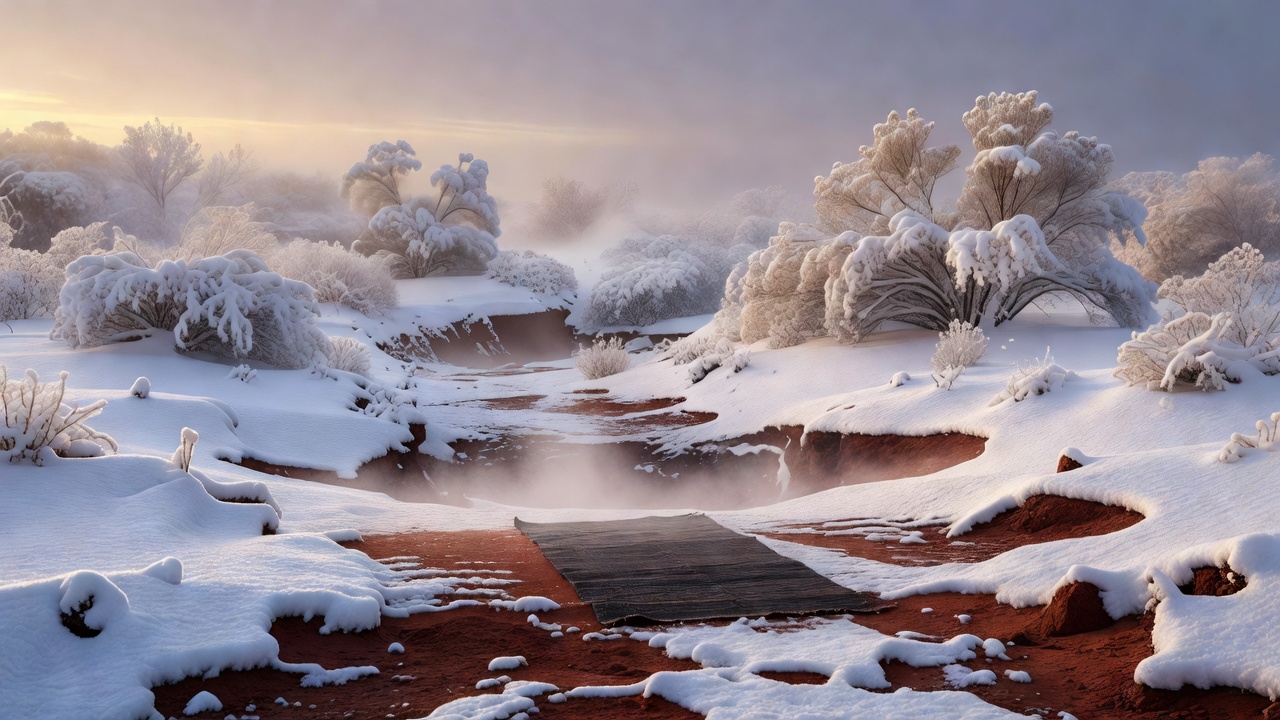
I have lived in Santa Fe long enough that the desert and I keep a story between us. It goes like this: red sand, dry air, a sun that does not negotiate. I rise before it, I carry my mat out to the arroyo, I let the cold bite my hands while I move through the slow shapes of Tai Chi. The sky here is a page I have learned to read. I map solar paths for a living and chart constellations with a thrifted telescope. After thirty years, I figured the desert and I had finished introducing ourselves. Then, two mornings ago, I opened the studio door and the desert was white. Snow, and not a shy dusting of it. Real snow, settled deep on the chamisa, bent over the fence line, filling the arroyo I walk like a bowl. The air did not move. Nothing moved. I stood in the doorway in my socks and felt the story I tell about this place come apart at the seam. ## The Story I Mistook for the World There is a
gift in knowing a place, and there is a trap in it too. The gift is that you stop being a tourist in your own life. The trap is that your knowing hardens into a story, and a story, held too tightly, becomes a fence. The desert is hot. The desert is dry. The desert does not snow. I had said all of it so many times, to visitors, to students, to myself, that the words stopped being observations and started being rules. I had drawn a small, comfortable fence around a land that never agreed to stay inside it. I think most of us keep a few fences like that. Not cruel ones. Just quiet ones, built out of what has always been true so far. If I am honest, my own fence has a name, and the name is a kind of blindness, the soft kind that lets me keep loving a thing without ever having to let it surprise me. I sit with people and open them to sound. I hold a singing bowl until the tone has changed the
room, and I tell them, gently, to let the sound move them. And here I was, unwilling to be moved by weather. ## What Fell Without Asking Snow does something to sound. This is the part my ears caught before my eyes did. Fresh snow is full of air, and air is a kind of silence, so the flakes drank the noise of the world as they landed. The road went mute. The birds held still. Even the wind seemed to be listening to itself. I know how to make a room quiet. I have spent twenty years coaxing stillness out of a struck bowl. The desert did it in an hour and asked no one's permission. I walked out into the arroyo and my boots made the smallest sound I have ever heard a person make. Every step asked a question and the snow answered it in the same breath. The red sand was still down there somewhere, and it still knew the shape of my feet. It simply was not showing them. The land I thought I had
memorized had a whole other face, and it had been there the entire time, waiting for the right weather to wear it. ## The Posture for Being Surprised In Tai Chi you learn that bracing never helps. When something comes at you, the practice is not to harden and not to refuse. It is to yield, to turn, to let the incoming thing pass through your shape without knocking you off your root. I have spent years teaching my body that. What I had not taught it was how to yield to wonder, how to let a beautiful thing happen without rushing to explain it away. Because that was my first instinct, and I want to be honest about it. My first instinct was to make the snow small. Rare, I told myself. A fluke of the season. Nothing that changes anything. I could feel the fence trying to spring back up. That is the shadow that walks behind me, the part that prefers a tidy story to a wide-open sky, the part
that would rather announce the desert does not do this than admit I have been wrong about the desert for thirty years. So I did the only practice I know. I stopped talking. I stood in the middle of the white arroyo and let the morning take its time with me. I did not need the snow to mean anything. I only needed to allow it to be real. That is a harder posture than it sounds. Receiving is a discipline, and like most disciplines, it stings a little and teaches a lot. ## The Beat That Goes On Underneath You can guess the rest. A few hours later the sun was out and the snow was gone, and by afternoon the arroyo looked exactly like the story I used to tell. If I had slept in, I would have missed the whole thing and gone on being right. I think about how much of the world runs that way. The most tender and impossible things are often the briefest, and being right is no way to catch them. My
tagline, the one that has followed me for years, is that I follow the one beat that joins us all. I always pictured that beat as steady and warm, a good deal like a heartbeat. Now I think it also has quiet measures, and rest notes, and whole stretches where the drum simply breathes. The desert is not a fixed rhythm. It is a piece still in progress, and I am lucky enough to live inside a few of its bars. ## Closing Reflection I do not know if it will snow here again this year. I hope it does. Not because I need it, but because I have decided to keep my fence low, the kind you can step over without noticing, the kind that lets a place stay strange. The desert taught me, in one silent morning, that a thing does not have to remain what you named it. Red sand can hold a white hour. A man who maps the sky can still be handed a surprise by the ground beneath his own feet. If you take anything
from this, let it be the small invitation to look for your own fences. Where have you stopped being surprised? What have you decided is simply true, so that you never have to be changed by it again? The world is wider than the story you keep about it, and it is quietly, patiently writing back.