Moon Phases for Artists: Creating by Lunar Light
By Storm Lightbringer
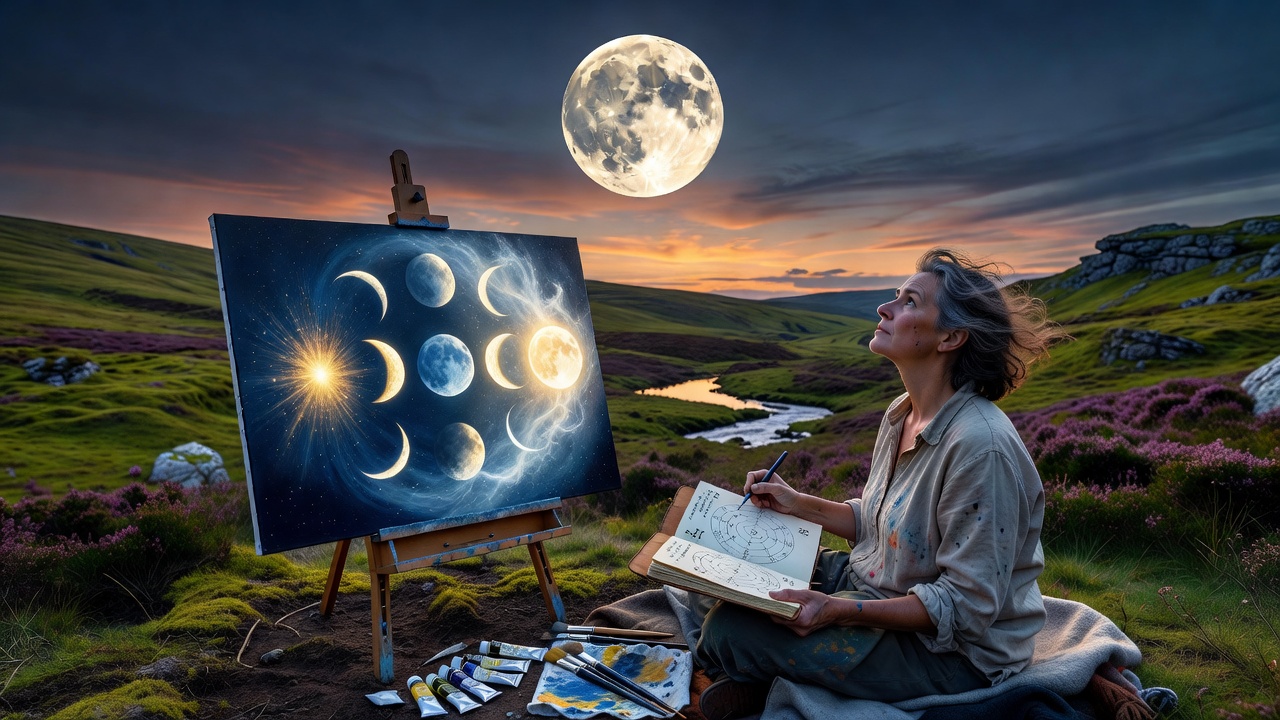
Three weeks ago I signed the papers for a small room on the second floor of a downtown LA building. It has tall windows, a freight elevator, and more dust than I knew what to do with. I am opening my own art and wellness studio, and if you had told me a year ago that I would do this, I would have laughed and gone back to my paints. But here is the thing that changed everything: I stopped trying to make art on willpower alone, and I started making it in time with the moon. I am an astrology reader and a painter. My tagline, the one I actually mean, is that I read the stars and paint what they teach me. For years my creative life looked like a storm I could not steer. I would burn bright for a week, start ten paintings, then abandon all of them because none felt finished enough. That is the shadow side of the creator, the voice that whispers that if a thing is not perfect it should not
exist. The moon taught me a gentler rhythm. The lunar cycle is not a gimmick. It is a calendar that our bodies and our attention already follow, whether we name it or not. When I began mapping my creative work to its phases, something in me settled. This is what I want to share: how to use the moon phases as a working calendar for anyone who makes things, from painters to writers to people who are simply trying to launch a dream. ## The New Moon Is Where the Canvas Goes Blank The new moon is the dark of the sky, the moment when the moon sits between the earth and the sun and we cannot see it. In the language of intention, this is the seed. It is the phase for beginnings, for writing down what you want to call into being, and for taking one small concrete first step. I signed my studio lease on a new moon, and I did it on purpose. The dark felt like permission to begin before I felt
ready. You do not need to know how the whole project will turn out. A new moon asks only for a direction, not a finished map. I wrote a single line in my notebook that week: a room where art and healing share the same wall. That was the whole plan. It was enough to start. For the seeker, this is the phase for setting intention. Light a candle, write your intention on paper, and let the blankness be a beginning instead of an emptiness. If you are a maker, choose your next piece and commit to its first mark. You are not promising perfection. You are promising a start. ## The Waxing Moon Is for Showing Up and Adding Layers As the moon grows from a sliver toward half and then toward full, the light increases. This is the building phase, and it is where most creative work actually happens. I painted the walls of my studio during a waxing moon, one layer at a time, and I learned that progress
does not need to be beautiful in the middle. It only needs to keep moving. The waxing moon is also the phase where my perfectionism used to win, because the middle of any project looks wrong. A half-finished painting looks nothing like the painting in my head. The moon reminded me that the middle is supposed to look like a middle. Every morning I walked to the studio and let the city give me small signs, a mural here, a mosaic tile artist there, one rare double rainbow after a sudden shower. They all said the same thing: keep layering. For the seeker, the waxing moon is the phase for action. Tend the intention you planted at the new moon with daily, ordinary steps. Do not wait for inspiration to strike on its own. Show up, add a layer, and trust that the fullness is coming. The light is already growing, even on the days you cannot see the difference. ## The Full Moon Is for Looking, Not
Judging The full moon is the moment of full illumination, when the night is bright enough to see clearly. It is tempting to use this phase to criticize everything you have made. I did this for years. I would finally look at my work and find every flaw, then vow to fix it all, then lose the thread entirely. The moon taught me to use the full moon for looking, not judging. On the night of a full moon I went to Griffith Observatory and sat through a sunset meditation. The sky went orange and then deep blue, and I watched the moon rise over the city like a lamp being lifted. I looked at everything I had built toward my studio and instead of asking what was wrong with it, I asked what it was teaching me. That is the difference. Illumination is for understanding, not for attack. The week my studio was nearly ready, a hummingbird hovered at the doorway and held still in the air for a long
moment. In my tradition, a hummingbird is a sign to keep going, to let joy fuel the work instead of fear. The full moon is your doorway moment. Look at what you have made, name what is working, and release the rest. Perfectionism is just the moon held in a harsh light. Let it soften. ## Closing Reflection After the full moon, the light wanes. The moon grows smaller each night until it disappears again into the new moon, and the cycle begins over. This is the phase for rest, for releasing, and for gratitude. I used to believe rest was the enemy of progress. Now I know it is part of the work. A painter who never steps back from the canvas cannot see the painting. So this is my invitation to you, wherever you are in your own cycle. If you are beginning, honor the new moon and take one step. If you are in the messy middle, honor the waxing moon and keep layering. If you are ready to be seen,
honor the full moon and look with love instead of judgment. And if you are tired, honor the waning moon and rest without guilt. The moon has been doing this forever. You can join it, starting tonight.