The Fog That Softened Los Angeles: How One Grey Morning Became a Collection
By Storm Lightbringer
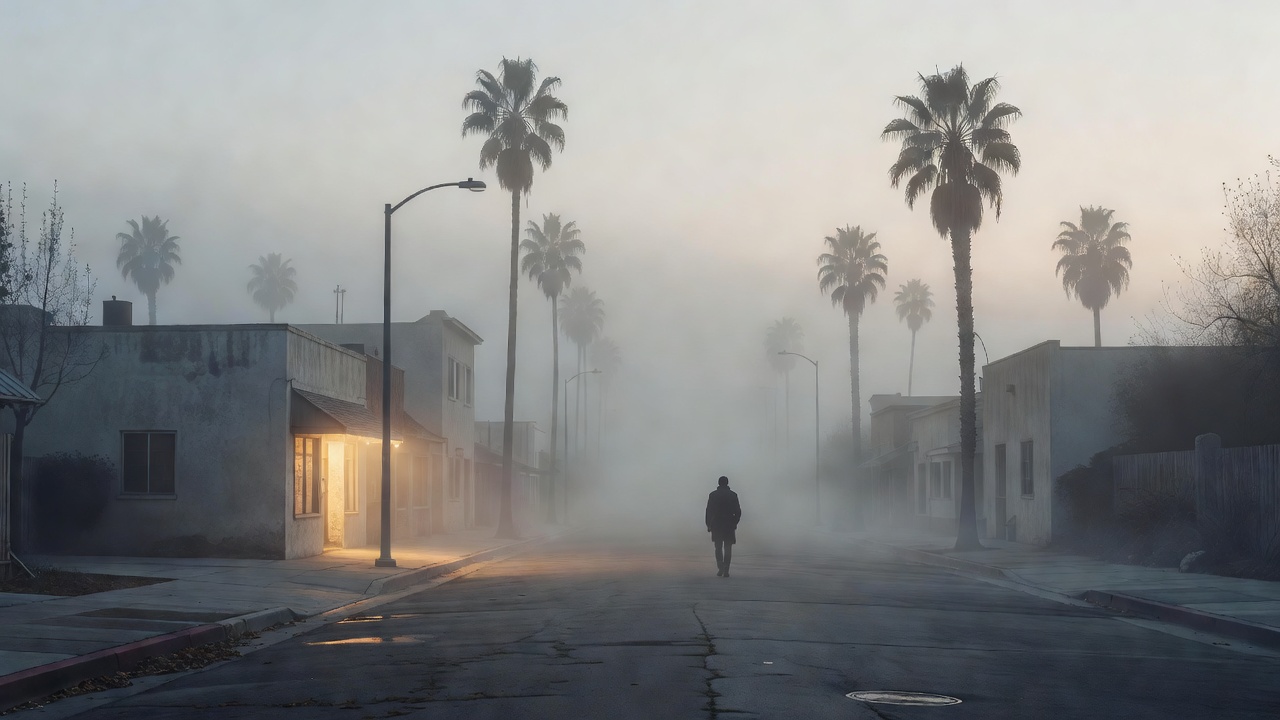
Los Angeles does not do fog. We are the city of sharp shadows and harder sunlight, of mountains you can read from thirty miles away and skies that refuse to be subtle. So when I stepped out of my apartment before sunrise and the street was simply gone, I stopped walking. Not vanished, exactly. Softened. The corner market, the palm trees, the billboard I had been ignoring for a year: all of them were still there, but they had been edited down to their gentlest shapes, like a sketch before anyone dares to add a line. I was on my way to the studio, the art and wellness space I opened this year, carrying a canvas I had not yet decided what to do with and a head full of to-do lists. The fog did not care about any of it. It had turned my familiar morning route into a place I had never seen, and it had done it by taking things away: the names off the stores, the tops off the buildings, the
distance out of the street. I have spent most of my life as an artist who believed that making something means adding: more color, more detail, more hours. That morning the city painted a different lesson in grey, and I walked the whole way to the studio in a silence that felt less like absence and more like a held breath. By the time the door clicked behind me, I knew I was going to try to paint it. I did not know yet that the fog was the beginning of my first real collection. The City That Had Its Edges Removed Fog is the opposite of Los Angeles in every way that matters to a painter. Light here is usually a fact: hard, present, insisting on every outline. Fog turns light into a rumor. It arrives and suddenly the buildings are not objects but suggestions, the traffic lights are small suns floating in grey, and the people on the sidewalk become silhouettes moving with a quiet that the
city almost never grants them. What struck me most was how intimate it was. I walked past the bakery I visit every week and could not see its sign, only the warm glow of its window, and that glow felt more personal than the sign ever had. The fog was not hiding the city from me. It was showing me the city the way you see a sleeping person: close, careful, and without any of the usual performance. I have walked that street hundreds of times, usually fast, usually with a podcast in my ears and a list in my hand. The fog did what no retreat or meditation app had managed in years. It slowed me down simply by making speed pointless, because there was nothing to rush toward and nothing to prove. You cannot hurry through a world that has been turned into soft edges. Softness Is Not Emptiness Back at the studio I did what I always do when something moves me: I reached for paint. And then I sat
there for a long time, because I discovered that painting fog is a humbling problem. If you paint the grey, you get a flat and lifeless wash. If you paint the buildings too clearly, the fog disappears. The only way to make a viewer feel the mist is to paint the space where the buildings used to be, and to trust that the absence will carry the presence. That is the hardest thing I have ever tried to learn as an artist, and it is the opposite of everything my hands want to do. My hands want to add. They want to finish, to define, to make sure the viewer understands exactly what they are looking at. But the fog paintings only worked when I stopped explaining and started suggesting: a corner here, a glow there, a figure that is more shape than person. I kept the first failed attempt, the one where I tried too hard. It hangs in my studio now as a reminder that softness is not emptiness. A
soft edge is not a missing edge. It is an edge that asks the viewer to lean in and complete the line themselves. Hard lines tell you what things are. Soft lines ask you what they might be. The Sacred Was Always on This Street People ask me why I call the new series urban mysticism, and the honest answer is that the fog showed me where the holy actually lives. I used to think a mystical experience required the right setting: a mountaintop, an ancient temple, a desert at night. Los Angeles has all of those within driving distance, and I have chased them all. But the most profound morning I have had this year happened on the two blocks between my apartment and my studio. There is a reason every spiritual tradition talks about veils. A veil does not remove what is behind it. It makes you remember that something is there, that the world is larger than what you can currently see. Walking
through that fog felt like the universe had pulled a curtain across the city and whispered: look closer. Everything you think you know is still here, and it is stranger and softer than you remembered. It also changed my morning yoga practice, which surprised me. The studio was quieter that day, or maybe I was. I moved through the same sequence I always do, but the fog had done something to my attention. I was not rushing toward the next pose. I was actually present in the one I was in. It was the first time I understood that stillness is not a posture. It is a kind of seeing. Letting the Weather Paint The collection grew slowly, the way fog does. I painted the market, the palms, the intersection near the studio, the silhouette of a neighbor walking their dog. Each painting taught me the same lesson from a different angle: you cannot capture mist by gripping it. You can only make room for
it, the way you make room for a person you love, by getting quiet enough to notice what they are actually showing you. For an artist who built a practice on control, on finishing, on knowing exactly what a piece means, this has been the most uncomfortable and the most freeing work of my life. I still believe in craft and in showing up every day. But the fog reminded me that the best things I make will not be the ones I dominate. They will be the ones I witness, the ones where I am disciplined enough to stay out of the way. I am finishing the series now, and I have started to look for soft edges everywhere: in the shadows under the freeway, in the light through the haze at sunset, in the tired faces on the bus at the end of the day. The city is full of them. You just have to slow down long enough to let the grey do its work. Closing Reflection The fog lifted by noon, of course. Los
Angeles returned to its sharp self, and the street was a street again. But something in me stayed softened. I notice now that the most beautiful light in this city is almost always the light that arrives uninvited, the light that refuses to behave. If you live in a city that thinks it has no mystery, I want to tell you this: it does. It is hiding in plain sight, waiting for the day the world goes grey and the edges come off. Do not run from that day. Walk into it slowly, with your eyes open and your hands empty. That is where the first brushstroke of your next chapter is waiting.