The Shelf I Built for the People Who Raised Me
By Storm Lightbringer
My landlord texted me a photo of a shelf bracket on Tuesday. Not the shelf. The bracket. He was doing a walkthrough of the unit below mine and wanted to know if I wanted the hardware back before he patched the wall. I said yes before I thought about why. I have been opening an art and wellness studio for eleven weeks. In that time I have painted two murals, repainted one of them, hung a mirror that used to be a window, and built exactly no furniture. The shelf itself has been leaning against the baseboard since September, waiting for me to decide what it was for. Then the festival email landed. I had been invited to host a workshop at a local wellness festival, which is the kind of sentence that sounds like a compliment until you have to write a description for the program. Twelve slots. Two hours. Saturday. Saturday is October 31. ## The Date on the Flyer Samhain, pronounced roughly
SOW-in, is the old Celtic new year. It is the holiday most people now call Halloween, minus the plastic pumpkins. It lands on a cross-quarter day, which just means the halfway point between an equinox and a solstice. The harvest is in. The light has been shrinking for six weeks. The year closes its accounts before winter gets serious. Older Celtic practice treats it as the night when the boundary between the living and the dead runs thin. I want to say that plainly, because it is easy to make it sound like a haunted house. It is less about ghosts showing up and more about the fact that the people you have lost do not stop being part of the household. Once a year the calendar stops pretending otherwise. I did not grow up with Samhain. I grew up with candy and costumes and a plastic mask that smelled like a balloon. But the same weekend is Dia de los Muertos, November 1 and 2, and in Los
Angeles that is not an obscure observance. There are marigolds at the corner market three blocks from my studio. Crates of them, orange as traffic cones, stacked beside the limes. ## Two Traditions, One Shelf My practice is Hindu-rooted with a lot of California improvisation layered on top. Hinduism has its own season for the dead: Pitru Paksha, a fortnight in the lunar calendar set aside for ancestors, when families make offerings and feed people in their name. Different month. Different rules. Same instinct. So I had two perfectly good doorways in front of me and my city had a third, and I spent a week standing in the middle of all of them, not moving. I told myself I was being respectful. I was researching. I was making sure I did not do it wrong. That is the part I want to be honest about. I was not confused. I was waiting for permission. I have a studio full of half-finished things
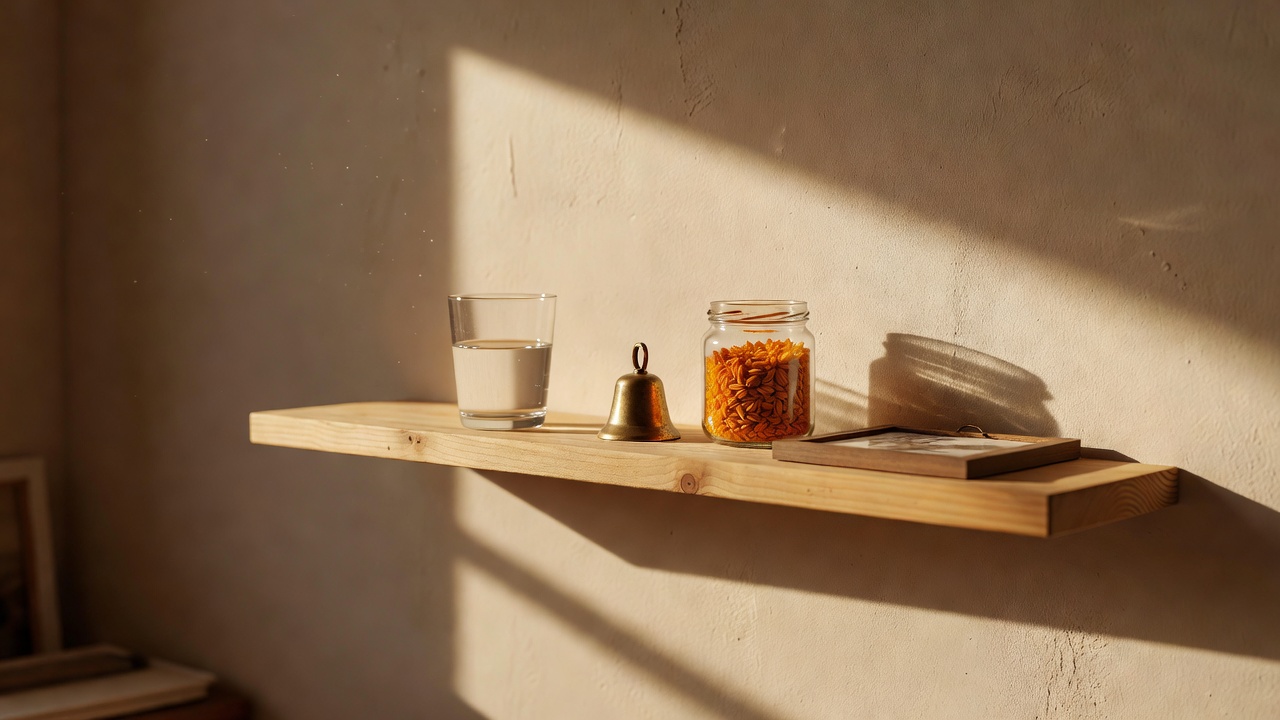
and a long history of needing the version to be correct before anybody sees it, and apparently I extend that policy to grief. Nobody was coming to grade the shelf. That is the entire problem with waiting for permission. It never arrives, and the day arrives anyway. ## What Ended Up on It The shelf went up on Thursday. Twenty nine inches of pine, two screws, one bracket the landlord did not want back. It is not an altar in the way a museum would label one. It is a shelf with things on it, and the things are the argument. A cup of water. A plain glass tumbler, because I could not find the good one and then realized the good one was a weird thing to want. A photograph, face down. I know whose it is. I am not ready to turn it over, and nothing about this holiday requires me to perform readiness. It can stay face down until it does not want to. A jam jar of marigold seeds. Not the flowers.
The seeds, because the market was selling flats of blooms and I only had six dollars in my wallet, and because I would rather grow the orange thing on my own windowsill than buy it already finished. A small brass bell from a sound healing training I took in the spring, back when I thought I would be teaching in a finished room by summer. That is the whole altar. If you are looking for intention statements and a color coordinated cloth, I do not have them. I have a glass of water and a picture I am avoiding and a jar of seeds that have not done anything yet. ## Water Costs Nothing In my practice the simplest offering you can make is water. Jala. You pour it fresh in the morning, and you do it because it asks nothing and costs nothing, and because a guest who has traveled a long way is thirsty before they are hungry. That is the whole theology of it. No object, no altar cloth, no correct
words. I have been thinking about that all week, because it is the one thing both of my traditions agree on and the one thing my perfectionism cannot make complicated. There is no advanced version of a glass of water. You cannot overthink it into being better. You can only refill it. Last night I walked to the studio around nine and the moon was a waning gibbous in Cancer. Waning gibbous means the moon has already passed full and is on its way back down, still bright enough to throw a shadow, already handing back what it borrowed. Cancer is the sign of the home, the family line, the container you were raised inside. I am not going to pretend I planned that. I noticed it on the walk and then stood in my empty studio for a while feeling caught out by the sky. ## What I Am Handing Out on Saturday The workshop description is one line now. Bring one object that belonged to somebody who raised
you, or to somebody who is gone. We will paint a small frame for it. I bought twenty frames at the craft store on Sunset, four by six, unfinished wood. Nineteen of them sit square on the counter. One is warped. The miter joint on the bottom left does not close all the way, and the corner lifts when you press it, and I am keeping that one for myself. Two hours, twelve people, one object each. I am not going to stand at the front and explain what the veil is. If somebody brings a grandmother's thimble and a person who has never lost anyone brings a coffee mug their dad used every morning, both of those are the same assignment. The frame is only there so the object has somewhere to live that is not the bottom of a drawer. I will probably cry in the first ten minutes. That is fine. It is not the students' job to manage my face. ## Closing Reflection The water gets changed in the morning. The
photograph stays face down until it stops wanting to. The marigold seeds are in a jar by the window doing absolutely nothing, which is the correct amount of nothing for October. Samhain is the old new year, and I keep coming back to that part rather than the spooky part. A new year is a chance to look at what you are carrying into the next one and decide what gets shelf space. The dead, it turns out, take up very little room. A glass, a photo, a jar, a bell. Under a foot and a half of pine. If you are standing between two doorways this weekend, waiting to find out which one you are allowed to walk through, I want to save you some time. The shelf does not care about your credentials. It only needs a wall and about forty minutes.