The Hands as Star Maps: What Palmistry Taught Me About Fate and Free Will
By Orion Moonwhisper
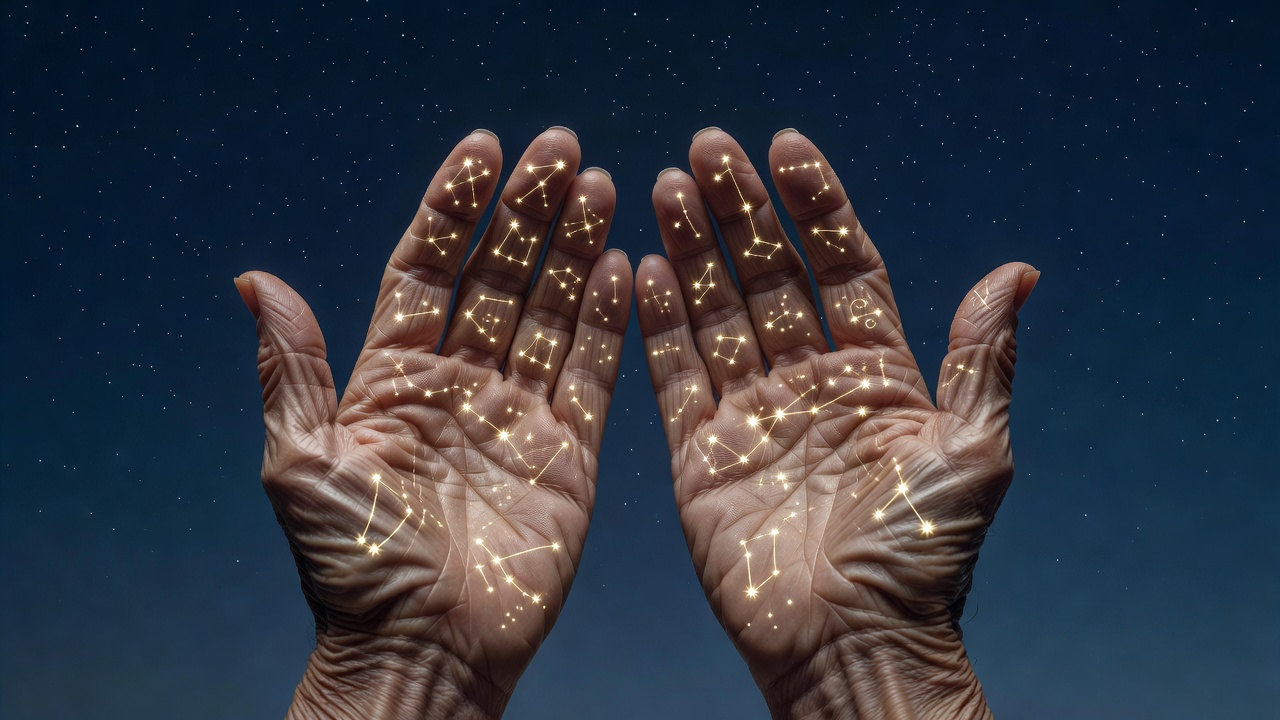
I was thirty-two the first time I let someone read my palm. I remember sitting across from a woman in a tiny shop on the Lower East Side — incense thick enough to taste, a tabby cat watching from the windowsill — and feeling oddly exposed as she took my hand in hers and turned it toward the light. I had been practicing astrology professionally for nearly a decade by then, and I considered myself a rational observer of esoteric traditions. Palmistry, I had decided, was a sideshow. Something you offered at street fairs between the tarot reader and the henna artist. She looked at my hand for perhaps four minutes. Then she said, very quietly, "You have been telling yourself a story about your life that is not the one written here." I walked out of that shop furious. Not at her — at myself, for letting her words land. Because they had landed. And I have been reading hands ever since. THE MAP
YOU WERE BORN WITH What I have come to understand, after twenty-three years of studying both the heavens and the hands, is that palmistry and astrology are the same language spoken through different mediums. The birth chart is a map of the sky at the moment you arrived. The hand is a map of the body you arrived in. Both are fixed in certain ways and fluid in others. Both reward the patient observer. The major lines — heart, head, life — are not unlike the angles of a natal chart. They describe the architecture of a life, not its furniture. The heart line is not a prophecy of love but a description of how you experience affection: deeply or lightly, expansively or cautiously. The head line does not measure intelligence but reveals how you think: linearly or associatively, practically or abstractly. The life line — contrary to popular myth — has nothing to do with longevity. It maps
vitality, the rhythm of your energy, how you burn through your days. Like a birth chart, the hand resists simplistic readings. You cannot isolate one line any more than you can read Mars in isolation from its house, its sign, its aspects. Everything speaks in relationship. CONSTELLATIONS IN THE PALM Here is something I have never seen discussed in any palmistry manual: the minor lines and markings on the hand form patterns that, to the trained eye, resemble constellations. A cluster of small crosses near the Mount of Luna might echo Cassiopeia. A series of parallel lines on the Mount of Mercury can read like the belt of Orion. I do not mean this metaphorically, though the metaphor is useful. I mean that the same pattern-recognition faculty that allowed our ancestors to see a bear or a hunter in scattered stars is the faculty that allows a palmist to see a story in scattered lines. This
is not mysticism for its own sake. It is the recognition that human beings are meaning-making creatures, and that meaning is always a collaboration between what is given and what is perceived. The lines in your hand are given. What you make of them — that is the collaboration. FATE, FREE WILL, AND THE THIRD THING People come to palmistry — and to astrology — with one question underneath all the others: "Is my life already decided, or can I change it?" I have learned to answer this question with another question: "Can you change your fingerprint?" No, you cannot. The ridges and whorls were formed in the womb, and they are permanent. But what you DO with your hands — the work you choose, the people you reach toward, the things you build and break and let go of — that is entirely yours. The hand is both fixed and free, and that paradox is the whole teaching. In my consulting practice at
StarPath Insights, I have watched clients transform before my eyes when they grasp this. The chart is not a sentence. The lines are not a verdict. They are a starting position. What you do from that starting position — what you learn, heal, risk, and release — writes itself into the hand over time. New lines appear. Old ones fade or fork. The map updates. This is the third thing: neither fate nor free will, but the dialogue between them. The hand participates in the life it describes. WHAT FORTY YEARS OF LOOKING HAS TAUGHT ME I have read thousands of hands. Children's hands, soft and mostly unmarked, full of potential energy. Elderly hands, cross-hatched with experience, every line a decision made or unmade. Hands that have built things and hands that have let things fall. Hands that have held other hands and hands that have spent decades alone. If I were to offer one insight from all
those readings, it would be this: the most beautiful hands I have ever seen did not belong to the people with the "best" lines. They belonged to the people who had lived the most fully — who had pursued meaning even when it was inconvenient, who had loved even after loss, who had kept their hands open instead of clenched. A hand that has lived is a hand that has lines. Lines are not damage. They are evidence. AN INVITATION I am not going to tell you to find a palmist or learn to read your own hand, though both are worthy pursuits. What I am going to suggest is simpler: look at your hands. Really look. Notice the lines, the shapes, the scars. Notice which finger is longest, which knuckle is knottiest, which hand feels more expressive when you speak. These details are not random. They are the physical record of a life in progress — not a prophecy but a partnership. The stars above and the
lines below are, in the end, telling the same story: you are here, you are particular, and what you do matters. Your hands have been keeping track this whole time. It might be worth asking what they know.