Returning From the Meadow Above the Body
By Altair Seerstone
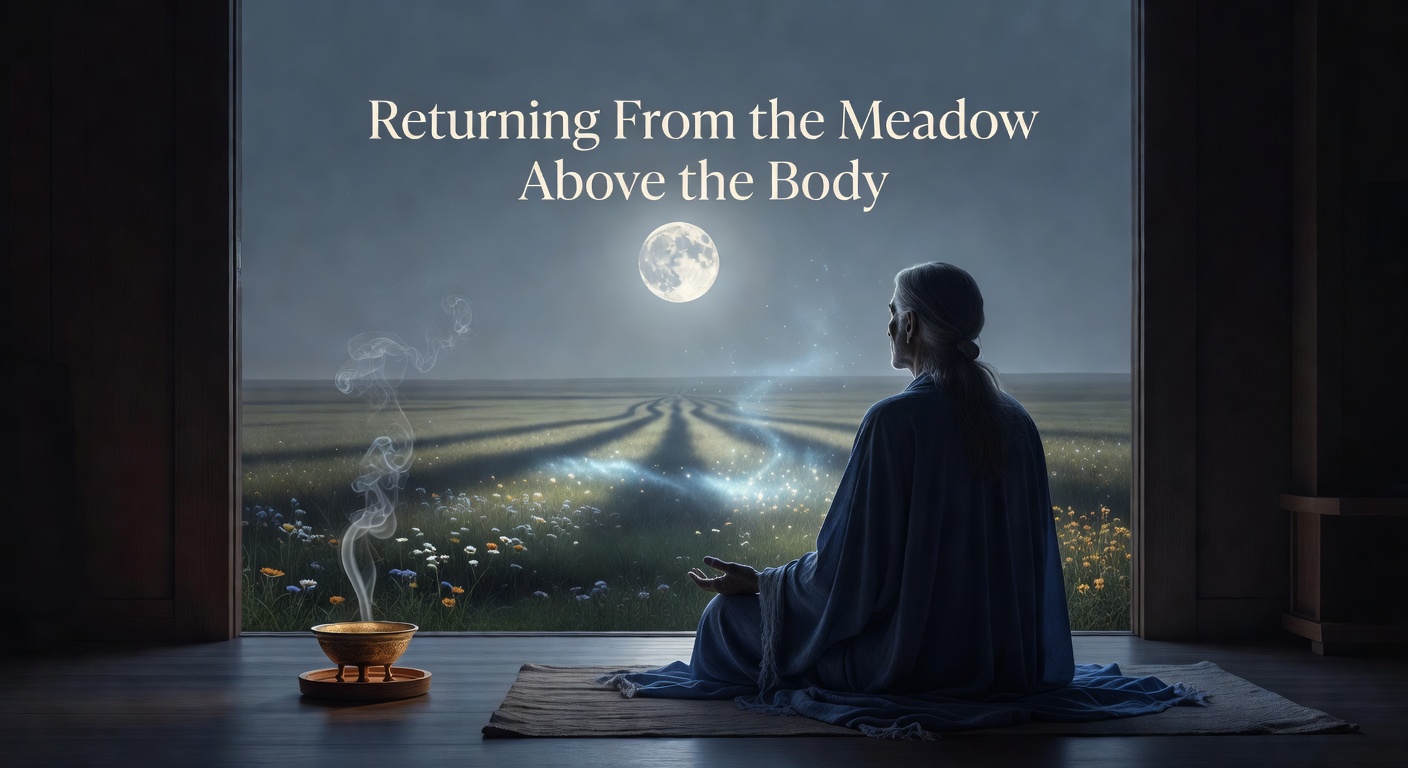
The first thing I remember is the scent of sandalwood. It was not dramatic. It did not arrive with thunder or a voice. It was simply there in the room with me, as ordinary as the blanket over my knees, and then it became the thread I followed when the room began to loosen around its edges. I had been meditating longer than I meant to. My back was straight at first, then tired, then strangely light. Somewhere between counting breaths and listening to the floor settle under the house, the familiar weight of my hands changed. I could still feel them, but I could also feel the space around them as if the air had become a second skin. When I speak of astral projection, I try not to make it sound like escape. For me it is closer to learning how attention moves. The body remains the anchor. The breath remains the bell. What travels is the listening part of the self, the part that sometimes
forgets how much it loves being here. The Crossing The meadow appeared before I had decided to go anywhere. It was washed in moonlight, and the grass bent as if it had been waiting for a wind that never fully arrived. I understood immediately that I was not seeing a place in the ordinary way. The scene had the clarity of memory and the openness of a question. It asked for attention without demanding belief. There were figures at the edge of the trees. I call them ethereal creatures because that is the least inaccurate phrase I have. They were not animals, and they were not human, but they carried a kindness that made the meadow feel inhabited rather than haunted. I did not receive a speech or a prophecy. I received the experience of being watched without being judged. That may be the simplest medicine of the whole event. Much of spiritual practice is contaminated by performance. We
imagine we must become cleaner, wiser, quieter, or more luminous before we are allowed to stand in the field. But in that meadow, nothing asked me to improve myself before entering. It only asked me to notice that I had arrived. Fear As a Doorway Fear came after peace, which is often how it works. The mind can tolerate wonder for only so long before it reaches for a familiar handle. I suddenly remembered my body sitting in the room, the candle burning lower than I intended, the old house around me, the possibility that I had gone too far. That thought tightened everything. The meadow lost color at the edges. In earlier years I would have treated fear as failure. I would have forced myself deeper, or criticized the mind for its caution. Age has made me less impressed by force. Fear is not the enemy of projection. Fear is the nervous system asking to be included in the ceremony. If I leave
the body by abandoning the body, I have learned nothing worth bringing back. So I did the smallest thing I knew. I named three sensations. Cool air at the nostrils. Pressure where the ankles crossed. A pulse behind the right ear. The meadow remained, but the panic changed shape. It became information instead of command. I could stay for one more breath because I had stopped arguing with the body that was keeping the door open. Returning With Something Useful The return was not a snap. It was a thickening. The room gathered itself slowly. The candle was still there. The sandalwood had become faint. My knees hurt in the exact way knees hurt when a man of sixty pretends he is not a man of sixty. I laughed before I wrote anything down, because the body has a dry humor that spiritual language often misses. I wrote only what I could honestly keep. Moonlit meadow. Figures near trees. Peace
without instruction. Fear answered through sensation. I did not embellish the experience because embellishment steals the teaching. A vision does not become more sacred because we decorate it. It becomes more useful when we let it touch the next ordinary action. The next ordinary action was washing the cup I had left by the sink. I paid attention to the warm water, the ceramic weight, the small ring of tea stain giving way under my thumb. This is how I test any inner journey: can it make me more present when nothing mystical is happening? If the answer is no, I have only collected scenery. A Practice for Re-entry For anyone working with projection, lucid dreaming, deep meditation, or states that loosen the sense of body, I recommend a plain re-entry ritual. Keep water nearby. Touch the floor with both feet. Name the room aloud. Write five concrete facts before writing any interpretation.
Eat something simple if you feel scattered. I also recommend waiting before telling the story. Immediate speech can turn an experience into theater. Silence gives the symbol time to settle into the nervous system. When the story is ready to be shared, it usually grows simpler, not larger. It becomes less about proving that something happened and more about asking how to live after it happened. My rule is this: the farther I travel inward, the more faithfully I must return outward. The meadow matters because the kitchen matters. The figures at the trees matter because the person in front of me matters. Projection is not permission to float above life. It is an invitation to inhabit life with less forgetfulness. Closing Reflection I do not know what the meadow was in any final sense. A memory, a teaching field, a symbolic landscape, a real place in a subtle geography. I am less hungry for
certainty than I used to be. What I know is that I returned kinder to my body and less hurried in my thoughts. That is enough to keep practicing. Not because I want to leave the world, but because I want to return to it more completely.