Tree of Life as inner map for beginners
By Aldebaran Oracleborn
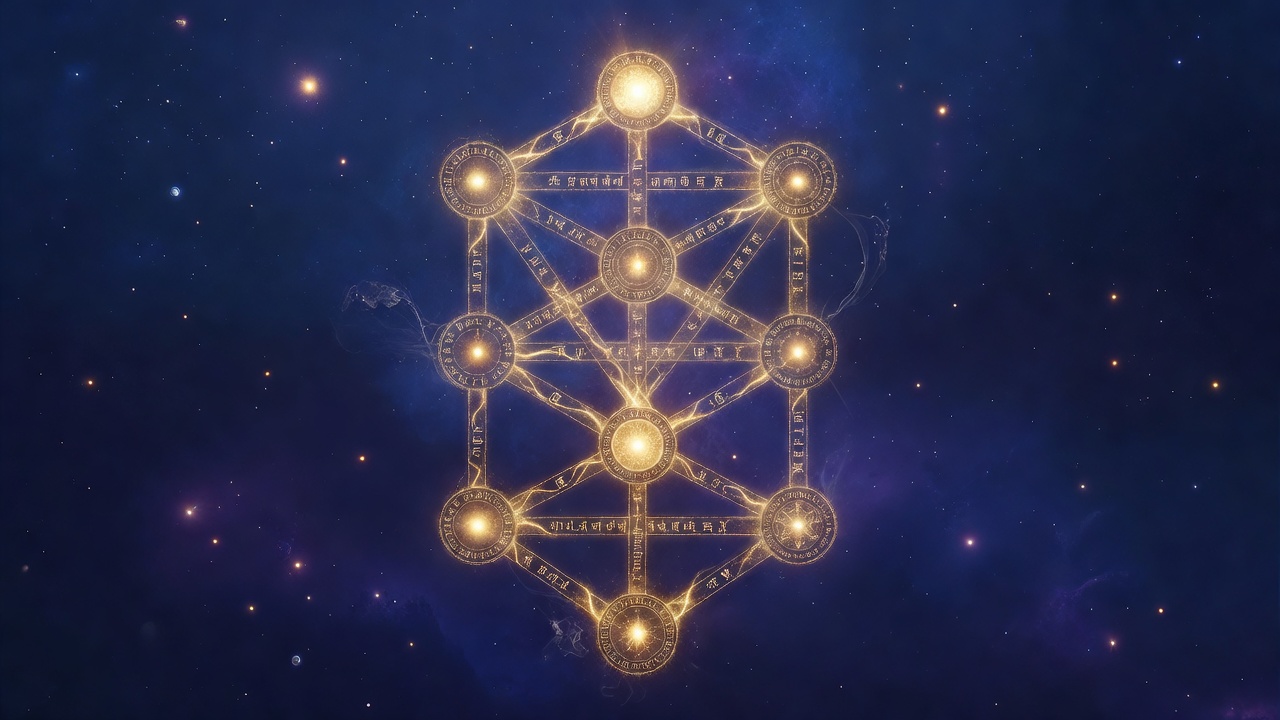
I came to Kabbalah sideways. I was already deep into astrology, already reading Theosophy, already convinced that the universe had more structure than physics alone could account for. Someone handed me a copy of Dion Fortune's The Mystical Qabalah and told me not to rush it. They were right. The Tree of Life is not a system you crack open and understand in an afternoon. It is more like a language — one that takes years before you stop translating and start thinking in it. The first time I sat down with the diagram of the Tree — ten circles, twenty-two connecting paths, overlaid with Hebrew letters and planetary symbols and the four worlds — I felt both overwhelmed and strangely at home. I had the sensation that I was looking at something I had always known existed but had never had a name for. That feeling didn't go away. It deepened. Three years later I am still sitting with the same
questions, still finding new layers, still surprised by what surfaces when I spend time with a single Sephirah for a week. This is not an academic essay about Kabbalistic history. Others have written those and written them well. This is a practitioner's account — one person's honest experience of what happens when you take this ancient map seriously and actually try to navigate by it. What the Tree Actually Is The Tree of Life is a diagram of ten spheres — the Sephiroth — connected by twenty-two paths. Each Sephirah is a quality, a mode of divine emanation, a station on the journey from pure undifferentiated being down into manifest reality, and back again. The whole structure is sometimes called the glyph of the universe, a map of everything that exists — from the most abstract reaches of pure consciousness down to the dense particularity of the physical world. Most people encounter it
as a symbol first. A poster on a wall, a tattoo, a logo on a spiritual bookshop website. Encountered that way it looks decorative, perhaps mysterious. But it was designed as a working map — a framework for meditation, for prayer, for understanding how consciousness moves through different states and qualities. The tradition that developed around it over centuries is vast and contested and alive. The ten Sephiroth are not gods, though they are sometimes personified. They are better understood as lenses or modes. Kether is pure unity, the moment before distinction, the ground from which everything else arises. Malkuth is the physical world, fully manifest, fully particular, the place where divine energy finally takes form as matter. Between them are eight more stations: Chokmah and Binah, Chesed and Geburah, Tiphareth, Netzach and Hod, and Yesod. Each one a different quality of existence.
Each one necessary for the whole. The twenty-two paths that connect them correspond to the twenty-two letters of the Hebrew alphabet and, in many Western Kabbalistic systems, to the twenty-two major arcana of the tarot. This is not coincidence — the whole system was designed to be cross-referenced, each element illuminating the others. Learning Kabbalah is learning a web, not a list. Tiphareth: Where I Keep Returning I have spent more time with Tiphareth than with any other Sephirah. It sits at the exact center of the Tree — the sixth sphere, associated with beauty, harmony, and the sun. Its traditional name in Hebrew means beauty, and the word earns its place. Tiphareth is the heart of the system. What draws me to it is its position. It is equidistant from Kether above and Malkuth below. It sits at the crossing point of the central pillar. Everything above it is rarefied and abstract —
the heights of consciousness that most of us can only glimpse. Everything below it is progressively more particular and concrete. Tiphareth mediates. It receives from the higher Sephiroth and transmits downward. In the human body it corresponds to the heart center. In spiritual terms across many traditions, it is associated with the sacrificed god — Christ, Osiris, Dionysus — the figure who descends into matter and returns transformed. What that means practically, in meditation, is harder to articulate. When I sit with Tiphareth I am not trying to achieve a particular state. I am trying to find the place in myself that already knows how to be a conduit. How to receive without hoarding. How to give without depleting. How to be present in the body without being trapped by it. How to hold beauty without turning it into possession. That sounds like a list of virtues, but in practice it is an
orientation — a way of standing in yourself that Tiphareth somehow makes possible to sense when you are moving away from it. I have had sessions in meditation on Tiphareth that produced nothing discernible and sessions that cracked something open I did not know was sealed. The inconsistency is part of it. The Tree is not a vending machine. You put in time and attention and you receive something, but you do not always receive what you expected. The Four Worlds and the Question of Context One of the things that separates Kabbalah from simpler cosmological schemes is its insistence on multiple levels of reality operating simultaneously. The tradition describes four worlds — Atziluth, Beriah, Yetzirah, and Assiah — from the most divine and abstract to the most material and particular. The Tree of Life exists in all four worlds at once, each Sephirah manifesting differently at each level.
This is not just metaphysical decoration. It has practical implications. When you are working with the Tree and something resonates particularly strongly, it matters whether you sense that resonance at the level of pure idea, at the level of emotion, or at the level of physical sensation. The same Sephirah speaks differently depending on which world you are accessing it from. I found this almost impossible to understand intellectually before I found it in experience. Sitting with Chesed — the fourth Sephirah, associated with mercy and expansive love and abundance — I could read the attributions and nod. But it was a different thing entirely to encounter Chesed during a period when I was genuinely learning how to let generosity move through me rather than calculating its cost. The Sephirah lit up from inside. The theory became lived. That is the promise of the Tree, I think. Not that
studying it will make you wise — reading a map does not take you anywhere. But that working with it, returning to it, sitting with its images and qualities over time, can gradually align you with something larger than your particular habits and fears. Why This Is Not Just Theory I know people who study Kabbalah entirely intellectually. They can recite every attribution, trace every historical development from the Sefer Yetzirah through the Zohar through the Lurianic school through the Western magical tradition. That knowledge is real and I respect it. But it is not the same as having sat with the Tree during a difficult period of your life and found that it actually illuminates something about what you are going through. I went through a year a few years ago when everything I thought I understood about myself turned out to be partial. Old patterns surfacing, things I had assumed were
resolved proving to be unfinished. It was uncomfortable in the specific way that growth is uncomfortable — not crisis, not catastrophe, but the persistent low-grade friction of a self that is being asked to expand beyond its current shape. The Tree helped me hold that without dissolving. It gave me vocabulary for what was happening. I could see I was being moved — not by anything external, but by the logic of the path itself — from Netzach toward Tiphareth. Netzach is the sphere of emotion and desire, passionate and sometimes directionless, in love with the image of things. Tiphareth is the sphere of the heart that has found its center. The journey between them requires something to be surrendered. The desire to feel everything intensely has to be tempered by something more stable. That is not the death of feeling. It is its maturation. Knowing that did not make it easy. But it made it
navigable. It made the discomfort legible. And that, I think, is exactly what a map is for — not to make the terrain easier, but to help you know where you are when the terrain gets hard. Closing Reflection I still do not consider myself an expert in Kabbalah. I am not sure the tradition rewards that kind of confidence, or that confidence is really what it is asking for. What I have is a practice — irregular, honest, sometimes frustrating — of returning to the Tree and asking it a question. Sitting with the question. Noticing what arises. Usually the question is the same one I started with: where am I on this map right now? The answer changes every time. The map does not. That consistency, that patient staying-in-place of the structure itself while everything else moves, is what I keep coming back for. In a world that offers endless novelty, there is something deeply reassuring about a
diagram that has been asking the same questions for a thousand years and still has not run out of answers.