The Night I Let the Eclipse Mean Nothing
By Altair Seerstone
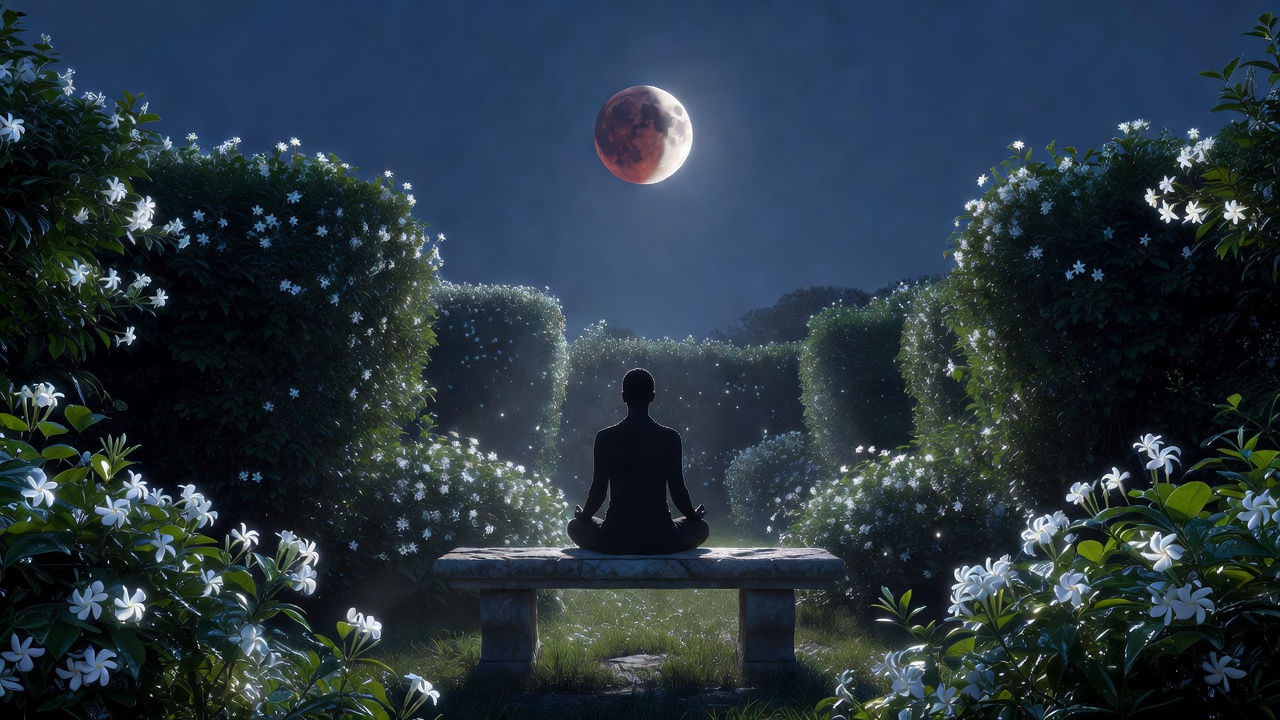
It began as an ordinary night in the garden. I had gone out to meditate, the way I have done for thirty years, with a cushion on the stone bench and the scent of night jasmine settling around me. The moon was full and bright, high over the wall, and I remember thinking that the sky looked unusually patient, as if it were waiting for something. Then the edge of the moon began to dim, slowly, the way a lamp dims when a hand passes over the glass. I knew what was happening. A lunar eclipse, rare and unannounced, was unfolding right above my own hedges. My first reaction was pure reflex. I should run inside for the notebook. I should note the time, the phase, the angle, the feeling, so that later I could sit with it and find what it meant. That is who I am. For sixty years I have treated every celestial event as a message with my name on it, every meteor and aurora and alignment as a letter
from the universe that I am obligated to open. The habit has served me well. It has also, I am beginning to understand, never once let me rest. What happened next surprised me. I stayed on the bench. I did not move. I did not reach for meaning. I simply watched the shadow take the moon, and something in me that had been running for decades finally sat down beside me. The Garden and the Darkening Moon The eclipse moved slowly, the way all real things move. The shadow of the Earth crossed the face of the moon like a tide coming in, and the garden changed color with it. The jasmine went from silver to gray. The stone bench grew cold. Somewhere a neighbor's dog stopped barking, and I realized the whole street had gone quiet, as if the world understood that it was being asked to witness something and had agreed. In the old traditions I have studied, an eclipse is a moment when the ordinary
rules are suspended. The I Ching speaks of darkness at midday, the hour when the light is hidden and all that remains is what you truly are. I have written about such moments. I have given talks about them. And yet here, sitting in my own garden with the real thing overhead, all my knowledge felt like a coat that no longer fit. I did not need to understand the eclipse. I only needed to be present for it. That is the part I almost missed, because my mind kept offering me exits. It offered me the notebook. It offered me the lesson. It offered me a dozen elegant sentences about shadow and light that I could polish later and offer to the world. Every one of those exits was comfortable. Every one of them was a way of turning the moment into a possession, something I could own and file and use. And every one of them, I saw clearly now, was a way of refusing to simply be there. The Habit of
Reading Everything I have spent my life as a reader of signs. The steam rising from my morning tea swirls into patterns that mirror the symbols of my meditations, and I notice. The aurora borealis dances over the mountains and I sit for hours, decoding its colors. The meteor shower streaks the sky and I take it as a personal performance. It is a beautiful way to live, and it is an exhausting one. Everything must mean. Everything must be carried. Nothing is allowed to simply happen and pass. This is the shadow of my calling, the part I rarely name: the compulsion to find meaning before I have allowed myself to rest. I have been preparing for a symposium and writing a book of my metaphysical experiences, sorting a lifetime of visions into chapters. It is good work. It is also, I have started to notice, a way of holding the door open for every experience that ever knocked, so that none of
them can leave. The book grows. The chapters multiply. And somewhere behind the desk, the man who once watched the sky for wonder has become a man who watches the sky for inventory. The eclipse did not argue with any of this. It did not offer a counter-lesson or a correction. It simply kept moving, a slow and patient darkness, and let me sit with the shape of my own habit. That was the teaching, if there was one: not that meaning is wrong, but that meaning has a season, and the season was not now. Doing Nothing as a Discipline I have practiced minimalism for years. I own almost nothing. I have let go of houses and books and belongings that once defined me. And yet I had never once considered applying the same practice to my inner life. I had never asked myself what it would mean to own fewer interpretations, to keep fewer lessons, to let an experience pass through me unclaimed. So I
tried it, there on the bench, as the moon slipped deeper into shadow. I let the eclipse be an eclipse. I let the darkness be weather, the way rain is weather, with no instruction attached to it. The garden was quiet. The air was cool. The moon hung in the Earth's shadow like a coin at the bottom of a well, and I did nothing with it. I did not file it. I did not open it. I just watched, the way water watches, the way my own element would: moving, reflecting, asking for nothing. It was harder than any meditation I have ever done. Harder than the astral projections, harder than the long vigils in the sandalwood room. Because those were all forms of effort, ways of reaching for something. This was the opposite. This was sitting with my hands open and letting the night be enough. And after a while, the strangest thing happened: the urge to interpret began to loosen. The mind, finding no task,
finally did what the body had been doing all along. It rested. The Shadow's Turn Here is what I know now, days later, writing this by lamplight. The shadow that crossed the moon was not an absence. It was the Earth itself, the very ground I stand on, coming between the moon and the sun. The dark was not the enemy of the light. It was my own world, doing what it does, sheltering the night. When I have been in shadow, when meaning has been hidden from me, I have called it a crisis of faith or a season of silence. But the eclipse says otherwise. The shadow is not the loss of the light. It is the place where the light is held, protected, allowed to rest before it shines again. I am sixty years old. I have spent most of those years trying to earn my place in the light by understanding everything. The eclipse offered me a different bargain: sometimes the most meaningful thing you can do with a
sacred moment is nothing. Sometimes the deepest participation is to sit still and let the dark have its turn. I have been writing a book, and I had planned a long chapter about the sky. When I write about this night, I think it will be a short chapter. Maybe only a few lines. That used to frighten me, the smallness of it. Now it feels like the point. Not every moment needs to be carried into the future. Some are allowed to stay in the garden, in the dark, and be complete. Closing Reflection The moon is full again now, bright and untroubled, as if nothing happened. But something did happen, and it was not what I expected. I did not receive a message. I did not unlock a code. I received permission, which is a rarer thing: permission to put the notebook down, to let the universe be beautiful without being instructive, to rest in the shadow of my own good earth. If you are someone who reads
signs, who carries meanings, who cannot let a coincidence pass without turning it over in your hands: consider the eclipse. Consider that some darkness is not a puzzle. It is a bed. And the bravest thing a seeker can do is climb in, and sleep, and trust that the light knows the way back.