The Night the Map Looked Back
By Aldebaran Oracleborn
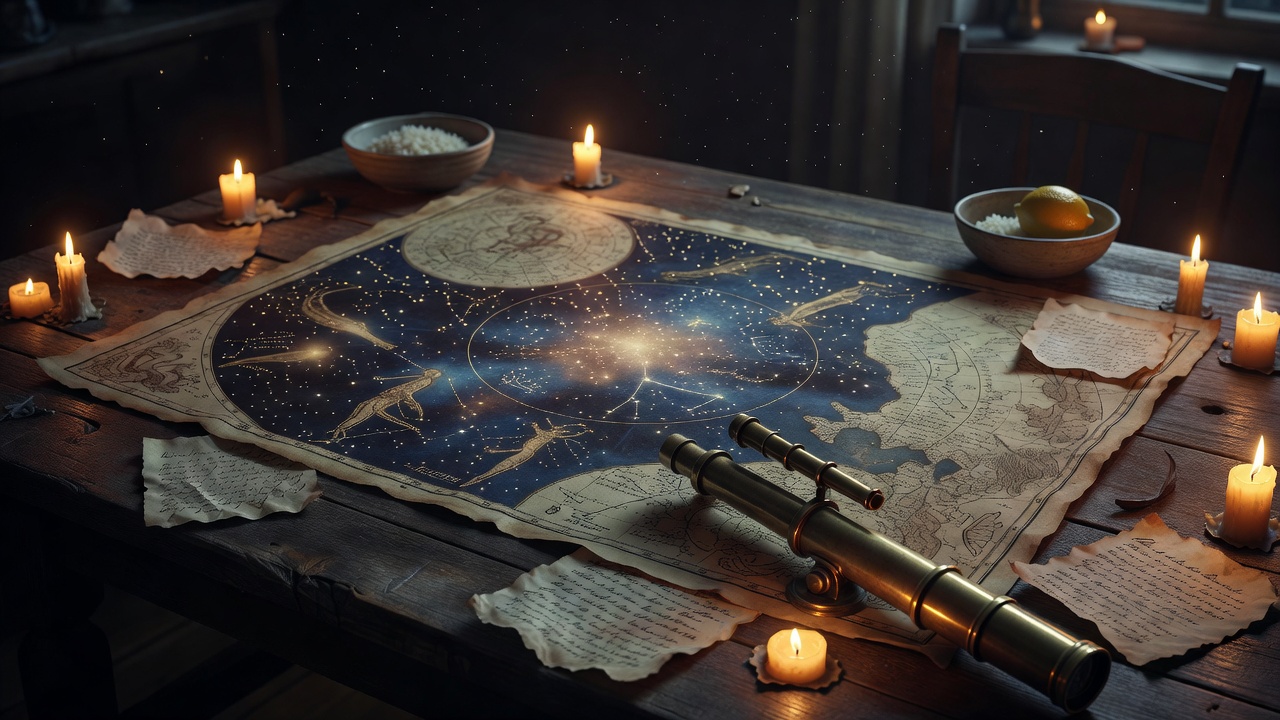
Tonight I understood why old sky maps are rarely quiet objects. They look flat when you first unroll them. Ink on vellum, pinprick stars, a bull drawn with ceremonial patience, names placed where someone once believed a watcher should stand. Then the longer you sit with one, the less it behaves like a diagram. It starts behaving like a room. You enter it. You discover that the edges have weather. You notice which constellations have been given too much certainty and which ones are only half admitted into view. The observatory asked me to help curate an exhibition of ancient celestial maps, which is a generous sentence and also a dangerous one. Curate sounds clean. It suggests labels, glass, lighting, and a polite public moving from one case to the next. The real work is messier. It is choosing what not to pretend. It is learning which damaged corner deserves a footnote and which missing
name deserves silence. It is admitting that every map of the heavens is also a map of the person who drew it. A map is an argument A celestial map does not simply say, here are the stars. It says, here is how we chose to arrange attention. Here is what mattered to us. Here is where we believed order lived. Two cultures can stand under the same sky and draw different animals, different heroes, different warnings. Neither is lying. Each is revealing the grammar of its own awe. This is why I am suspicious of clean exhibition labels that make ancient things sound finished. When I place one map beside another, I am not looking for the winner. I am listening for the friction between systems. The manuscript that started this whole season of my life has taught me that friction is useful. A symbol that refuses to translate cleanly may be a failed reading, or it may be evidence that the reader has
not yet earned the right question. I am trying to build an exhibition that lets visitors feel that difficulty without drowning them in it. The star pattern from last night Last night, before sleep and after too much tea, I saw a pattern through the telescope that matched one of the marginal figures in the manuscript. Not exactly. Exactness is where pride likes to hide. But close enough that I put the kettle back on, opened the notebook, and forgot what hour it was. The figure in the margin looks like a gate drawn by someone who had never seen a gate but had dreamed one. The sky gave it a temporary body. I am wary of making too much of that. Our minds are expert pattern makers, and astrology without humility becomes a machine for turning coincidence into command. Still, there are nights when the coincidence is not an instruction but an invitation. This was one of those nights. I wrote the
observation down in plain language first: three stars, shallow arc, faint companion below the eastern point, visible only after the eye adjusted. Then I let the symbol sit beside the sky without forcing a marriage. Cooking keeps the scholarship honest By midnight I was hungry enough to stop pretending the mind can live on revelation. I made rice with lemon, black pepper, and a small amount of butter, because not every meal has to become a myth. The pot gave me the same correction it always gives: attend to what is happening, not to the story you prefer. Water boils. Grain absorbs. Heat does not care about your theory. This is why the kitchen keeps appearing in my notes like an unpaid editor. Cooking has become my safeguard against ornamental spirituality. If a sentence about the stars cannot survive next to a practical task, I do not trust it yet. If a translation makes me feel brilliant
but cannot explain why the manuscript pairs a star cluster with a harvest instruction, I set it aside. The hands know when the head is performing. I have learned to let chopping onions interrupt bad metaphysics before the public has to hear it. How I want people to move through the exhibition I do not want visitors to leave thinking ancient people were quaint, wrong, or magically superior. All three responses are lazy in different costumes. I want them to feel the labor of attention. I want them to see how much patience it takes to live under a sky without pretending you own it. A good map does not conquer mystery. It gives mystery a place to meet you. The first room will probably begin with orientation: the familiar constellations, the large recognizable forms, enough comfort that no one feels mocked by the material. The second room should complicate that comfort. Alternate names,
broken correspondences, harvest notes, devotional marks, a diagram that refuses to be only astronomical. The final room, if I get my way, will have fewer labels and more space. Some objects should be encountered before they are explained. What the map asked of me The strange thing about working with old sky charts is that eventually you realize you are also being charted. Your habits appear. Your impatience has coordinates. Your need to be impressive has a season. I noticed today how quickly I wanted the exhibition to prove that I deserved the invitation. That is not scholarship. That is a young man asking a wall label to become a mirror. So I am writing this down while the impulse is still visible: I do not need the maps to prove me. I need to serve them carefully. I need to build a path that lets other people enter the old conversation without being bullied by expertise. The best
curators I have known are not the ones who dominate the room. They are the ones who teach the room how to listen. Closing Reflection There is a version of this exhibition that becomes too polished, too sure of itself, too eager to make the ancient sky digestible. I am trying not to build that version. I want the seams to show where they are honest. I want uncertainty to be framed as part of the work, not as a defect to hide behind decorative language. The map from tonight is still on the table. The rice pot is clean. The telescope is covered. I am left with the same feeling I had when I first found the manuscript: not mastery, not even clarity exactly, but the sense that something old has agreed to keep speaking if I agree to keep listening. That feels like enough for one night. talk soon.