The Clipboard and the Firecracker: Directing a Festival of Happy Accidents
By River Stormcaller
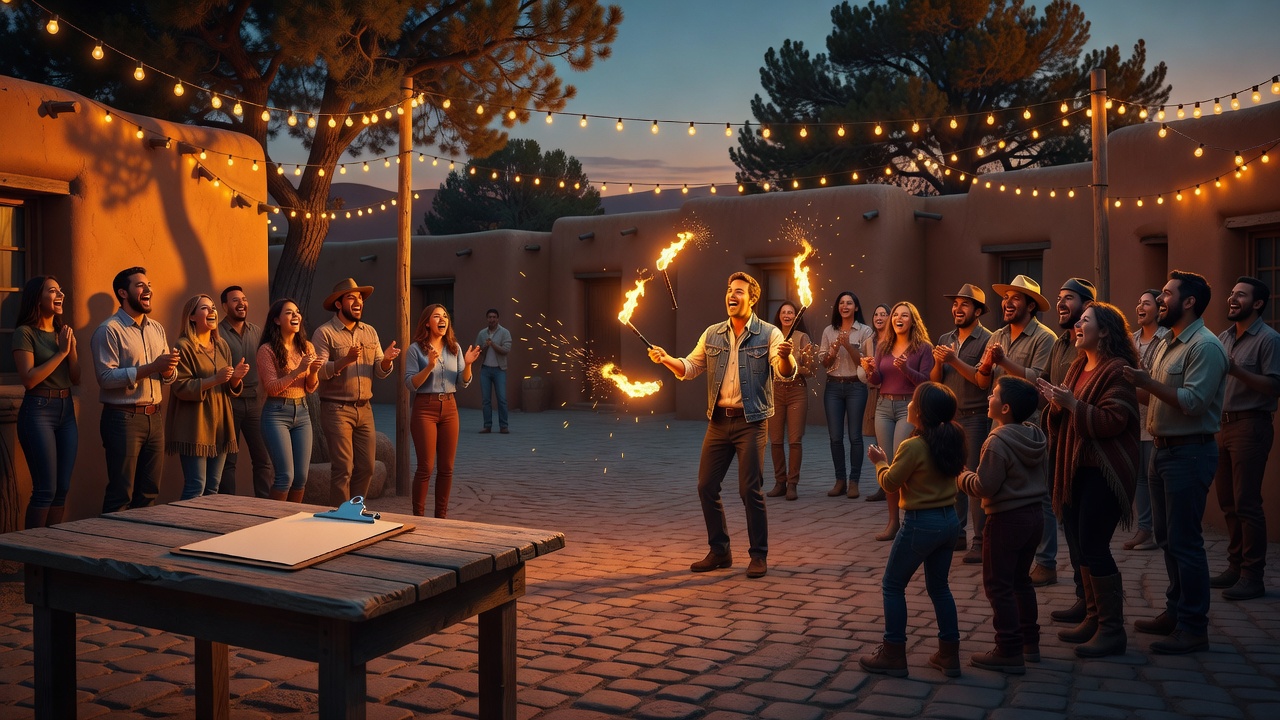
Last week I was hiking the high desert outside Santa Fe when a line of clouds arranged itself into the shape of a river, and a breeze carried the sound of water that was not there. No creek for miles. The desert playing a joke on my name, or a greeting. Either way, I laughed out loud, alone, and it echoed off the rocks. I took it as a sign to say yes to something I had been circling for weeks: the offer to be creative director of the Santa Fe Improv and Street Art Festival. The job description, as far as I can tell, reads: make magic happen, on a deadline, in public, while smiling. It is the most ridiculous and the most honest job I have ever taken. A festival built on improvisation and street art is a festival whose entire premise is that the best things cannot be planned. And yet somebody has to book the stages, print the programs, and hang the lights. Somebody has to hold the
clipboard. This is what happened when I tried to schedule joy for three hundred strangers, and what the unplanned moments taught me about the difference between control and craft. The Job That Shouldn't Exist In the first planning meeting I sat across from the festival board with a spreadsheet and a very small, very honest panic. How do you schedule spontaneity? The improv troupes needed times. The muralists needed walls. I had proposed pop-up laughter yoga sessions in the plaza, which meant I was now professionally obligated to lead strangers in fake laughter at noon on a Saturday, which is exactly the kind of thing I normally do for free and would now be doing with a lanyard. The board looked at me like I had an answer. I did not. I had a notebook full of little drawings of clouds shaped like rivers. Here is what saved me: the performers themselves. Every improviser I called said the
same thing. Give us a frame and we will fill it. Give us a stage, a time, a theme, and we will make the rest up in front of everyone, and it will be better than anything we wrote down. The structure is not the enemy of the surprise. The structure is the trampoline. The Clipboard So I became a believer in the clipboard. Not because I love schedules. Because I learned that a frame is not a cage. The fence around a garden is what lets the garden exist at all. The stage is what makes the unscripted moment legible: people gather because the stage says something will happen, and then something happens that no one could have written. I scheduled the laughter yoga for noon and the drum circle for five and I scheduled forty minutes of nothing at golden hour, which the board flagged as a gap and I defended as a feature. You cannot schedule the moment when the light goes marigold and a stranger
starts juggling and the whole plaza stops moving. But you can leave a hole in the program exactly big enough for it. The clipboard taught me that directing is mostly this: choosing where the holes are. The Firecracker The unplanned part arrived, as it always does, on the second day. Max, the street performer I met at a laughter yoga session, showed up with a camera strap around his neck and a wild idea. He wanted to photograph laughter itself, the exact millisecond it breaks through. We had talked for weeks about a photo series on laughter and street art, and here was the festival, full of both, handing us the shoot. We worked the crowd for three hours. He shot, I laughed, and somewhere in the middle of it I stopped performing the laugh and actually laughed, the kind that hurts your ribs. I realized I had been treating laughter the way I treat everything: as a tool to keep things light.
My whole brand, my whole screen name, my whole act. Keep it breezy. Never let it get heavy. But you cannot photograph a laugh you are hiding behind. The lens does not lie. It caught me, mid-laugh, with my guard down, and in that frame I looked more like myself than in any portrait I have ever posed for. Laughter as Spiritual Technology I have a line in my bio that I stole from my own heart: laughter is a legitimate spiritual technology. I believed it as a performer. The festival taught me to believe it as a witness. I watched a woman laugh so hard she cried, then hug a stranger, then sit down in the plaza and write a letter to someone she had not spoken to in years. I watched a kid with a balloon and a half-finished mural behind her, laughing at nothing at all. The river in the sky that day on the hike: I could not schedule it, could not summon it, could not keep it. But I could keep
walking through the desert with my eyes up. That is the whole craft. You cannot make the unplanned thing happen. You can only make a life with room in it, and show up with your eyes open. Closing Reflection The festival is still running as I write this. The clipboard lives in my bag. I have learned that joy is not a contradiction to plan for; it is a guest you set a place for. You cannot guarantee the guest will come. But you can leave the chair empty, put the kettle on, and trust that the desert will send its river when you least expect it. Next time you see me in the plaza with a lanyard and a notebook, know this: I am not there to control the moment. I am there to hold the frame so the moment can happen inside it. And if you catch me laughing, really laughing, take the photo. That is the one I want to keep.