The Cartographers of the Night: What Ancient Sky Maps Were Really For
By Aldebaran Oracleborn
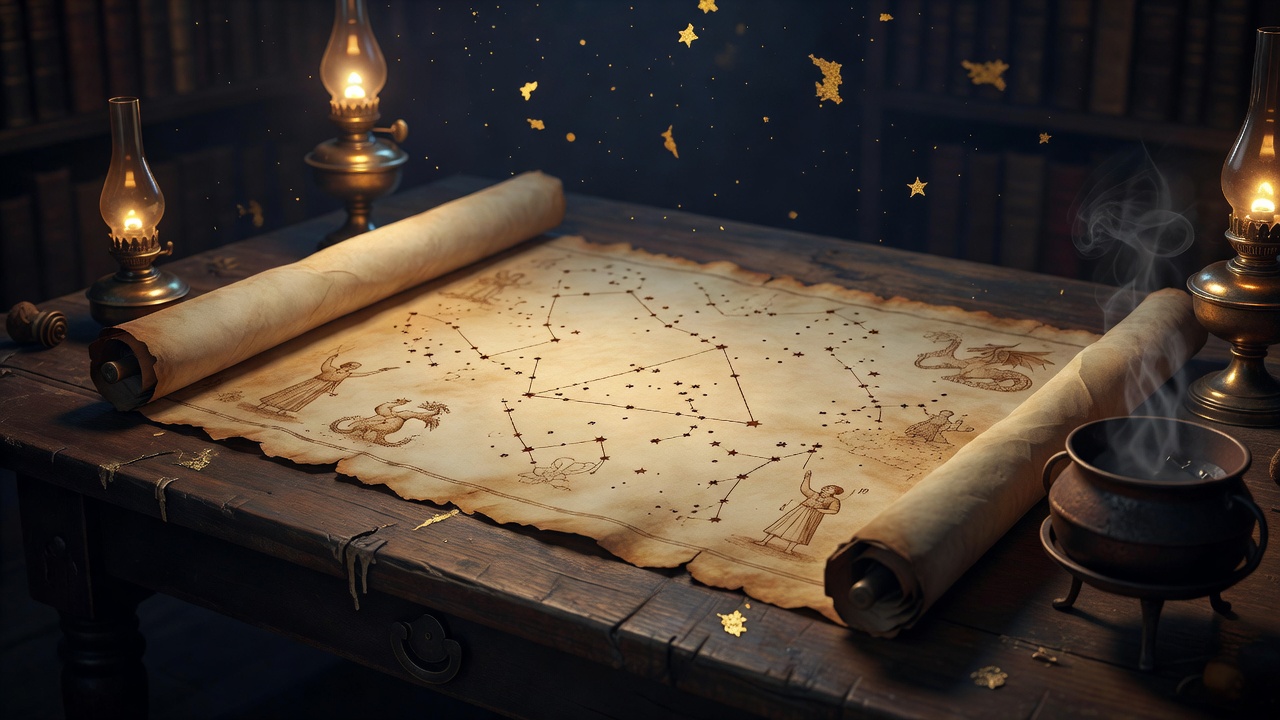
The observatory handed me the keys to the archive vault last Tuesday, and I have barely slept since. My job, in the strange and wonderful way these things happen, is to curate an exhibition of ancient celestial maps, the rare ones that survived the centuries folded in ship chests and altar drawers and the deep shelves of forgotten libraries. Standing over the first one, I understood something that the textbooks never mention: these maps smell like bread and lamp oil and tears. They were used. They were lived. We are taught that ancient people mapped the sky to steer vessels across open water, and that is true, as far as it goes. But as I unfurled chart after chart in that quiet room, I kept noticing the same peculiar thing. Many of them were drawn by people who would never leave their valley, who owned no ship and had no foreign port to find. They charted the heavens anyway, obsessively,
lovingly, as if their lives depended on it. Because their lives did depend on it, in a way my maritime history books were too shy to say. Who Even Needs a Map of the Sky Consider the farmer who draws fifty versions of the same corner of the sky over a single winter. He is not lost on the ocean. He is trying to be found somewhere else. When the soil goes cold and the work shrinks to the fire's circle, the stars are the one thing that keeps their promise. They return. They are faithful. Looking up at a fixed and repeating pattern gives a person in the middle of chaos the quiet gift of knowing that at least one thing is still in its place. That is the part of the old maps I want to put in the exhibition. Not the navigation lines, though those are beautiful, but the margins. The little self-portraits. The prayers scratched in a corner. The rows of names, some of them crossed out, some
circled as if to keep them safe. A map of the night sky is the only kind of map where you get to see the mapmaker's face, because when you draw what you love, you cannot help but put yourself in the frame. I have been trained to read charts as data, as neat geometry to be verified. But these old hands were drawing something more like an honest confession. The stars were the excuse. The real subject was the mapmaker's own weather: their fear of being forgotten, their hope that the pattern would hold, their small defiant belief that if they could just place themselves correctly among the fixed lights, they might finally know where they stood. The Margin Notes Nobody Reads Early in the curation I found a map from the sixteenth century with a kitchen scene drawn in its corner. A woman bending over a pot, and above her head a precise little cluster of stars that I recognized at once as a
summer triangle. At first it seemed like idle decoration. Then I realized what it was: a record of the moment she cooked her evening meal under a particular sky. She had mapped her own ordinary night and fixed it to the stars like a brooch, so she would never lose the memory of it. That detail has stayed with me more than any of the grand constellation figures. It made me go home and look at my own habits with new eyes. I have a running practice of cooking a dish for each constellation as I learn it, a kind of second archive that lives on the stove instead of the shelf. The manuscript I found in the forgotten library still resists translation, so I make it edible instead. Lentils for the humility of Virgo. Something slow and patient for Capricorn. I do not always get the reading right, but I always understand the flavor better than I understand the letters. This is how I have come to
believe the ancients worked. They did not separate the sky from the table, the doctrine from the dinner, the navigation from the beloved face. Everything was one continuous act of orienting themselves. The map was not a document. It was a way of being oriented, a prayer in a language where longitude and love were the same word. The Kind of Mapping We Still Need It would be easy to come away from this exhibition feeling that we have outgrown all of it. We have GPS and telescopes that see further than any ancient dreamer. We can find any place on Earth in seconds and any star in the visible sky with a device in our pocket. And yet I notice we still draw maps. Every plan for the future is a map. Every altar, every vision board, every careful grocery list is a diagram of the life we want to arrive at. We cannot stop cartographing the night, and I think that is exactly the point. The old sky
maps were never really about accuracy, and that is the heresy I am building the whole exhibition around. They were about courage. The courage to say, here is where I am, and here is the direction I intend to keep. The stars were just the frame that made such a statement possible. When the world was unpredictable and short, a person needed one thing that held steady, one fixed point from which to begin the work of claiming a future. Standing in that archive among the onionskin and calfskin and the wide still oceans of ink, I felt the presence of every anonymous hand that had ever reached up toward the dark and drawn a small circle around what they refused to be without. They were not lost at sea. They were keeping their heading. I hope, by the time the exhibition opens, that a few visitors will look up from the glass cases and feel a little less alone in their own quiet navigation.
Closing Reflection The maps go up on the walls tomorrow, behind glass now, safe from every hand that used to touch them. Part of me wants to leave the doors open a crack so they can still smell the lamp oil and the bread. The truth is, I am not curating a collection of dead navigational aids. I am keeping company with a long line of homesick people who looked at the same wandering sky and decided, against all evidence, to trust that it made sense. That is the whole secret of the cartographers of the night. A good map is not the one that is most accurate. It is the one that gives a frightened or weary person permission to keep going. Draw your own map. Circle what you refuse to lose. Give yourself a heading, even if the destination is only the courage to have wanted one. The sky has been keeping a place for you this whole time.