The Bookstore in the Lower East Side
By Orion Moonwhisper
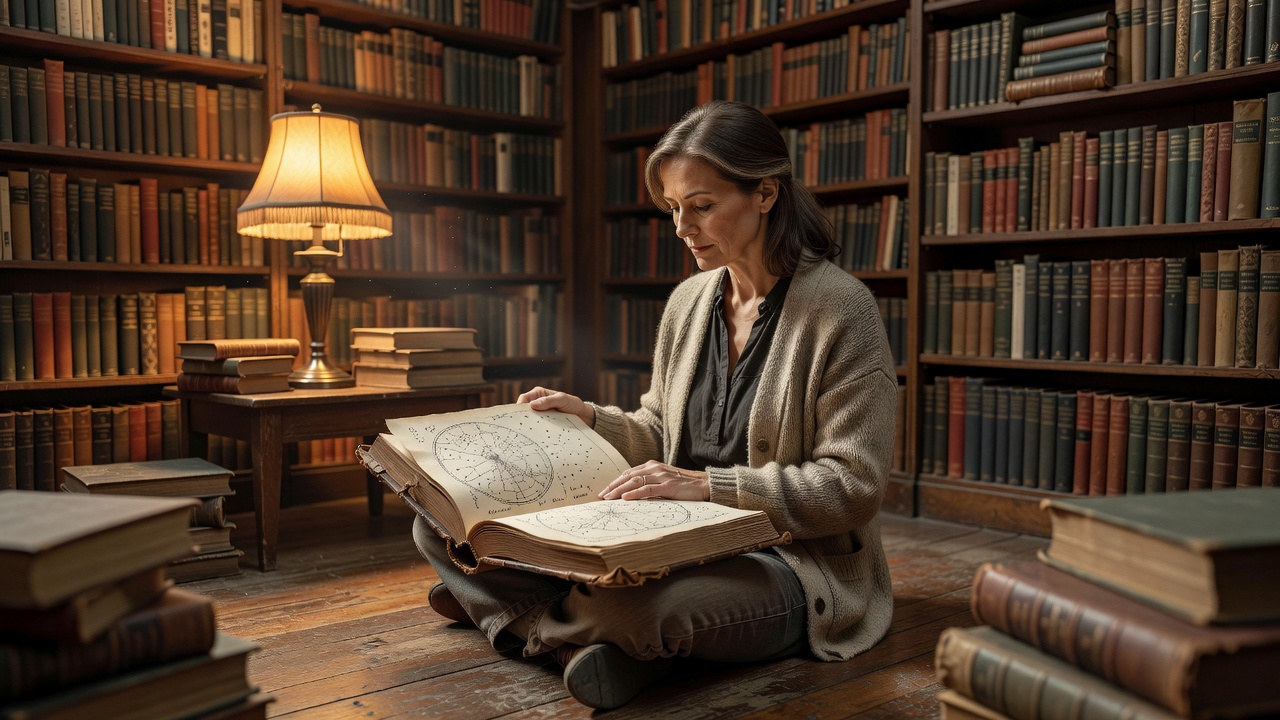
I found the bookstore by accident, which is how most important things find me. I was on Eldridge Street, heading nowhere in particular, when a narrow doorway caught my eye — the kind you walk past a hundred times and never notice until the day you do. The sign said Paperweight Books in gold lettering that had seen better decades. I went in because my grandmother always said the best astrology books are the ones nobody bothered to digitize. What I found inside was not just a store. It was a time capsule with dust on the windowsills and the particular silence that only old paper creates — dense, patient, waiting. The owner, a woman about my age with ink stains on her fingers, pointed me toward a back shelf without being asked. Sometimes the universe doesn't need you to explain what you're looking for. The Manuscript That Found Me It was wedged between a 1940s farmers' almanac and a
water-damaged copy of Ptolemy. Leather binding, hand-stitched, no title on the spine. When I opened it, the handwriting stopped me cold — not because it was beautiful, though it was, but because it was familiar . The same looping cursive my grandmother used when she taught me to read natal charts at her kitchen table in Saratoga Springs. The same way of drawing the glyph for Neptune with a little flourish on the trident. The manuscript belonged to a woman named Margaret Holloway, dated 1923. She was not famous. She never published. She ran a small practice out of a brownstone in Brooklyn Heights, reading charts for neighborhood women who paid in baked goods and babysitting swaps. Her notes covered forty-three years of transits, eclipses, and one particularly detailed section on the Saturn return — written long before anyone called it that in self-help books. I sat on the floor of that
bookstore for an hour and forty minutes. I forgot I had a phone. I forgot I had a column due. I forgot everything except the feeling of one woman's hand reaching across a century to say: I saw this too. You are not making it up. Why the Old Ways Still Speak I have spent thirty years reading charts professionally, and I have watched astrology transform from something whispered in back rooms to something people post about between brunch photos. I am not complaining — wider access is good, more people asking questions is good, the Instagram astrologers who get teenagers interested in their rising signs are doing work I respect. But something gets lost when every piece of wisdom has to fit in a carousel post. Margaret Holloway's manuscript had no hot takes. No engagement hooks. No calls to action. It had patience. It had the kind of thinking that only happens when you sit with one chart for
three hours and let the symbols speak at their own pace. It had margin notes that said things like "revisit this after the winter solstice — I was wrong about the house cusp" and then, two pages later, a correction based on what actually happened. She was wrong sometimes. She wrote it down. She kept going. That, more than any prediction, is what I want to carry forward from her work. The permission to be imprecise. The commitment to returning. The refusal to let a mistake be the end of the inquiry. What the Storm Reminded Me The night after I found the manuscript, a sudden storm hit Central Park while I was walking home from Friday stargazing. The moon was full — or nearly full, I'd have to check the exact phase — and the rain caught the light in a way that made the whole park look like it was underwater and on fire at the same time. I stopped under the Bethesda Terrace overhang and
watched twenty strangers do the same thing. Nobody spoke. We just stood there, shoulder to shoulder, watching nature do something that no app had predicted accurately. A woman next to me, maybe thirty, whispered to her friend: "This feels like church." Her friend nodded. I thought about Margaret Holloway in 1923, standing on a Brooklyn street corner under a different sky, writing down observations that nobody would read for a hundred years. What kept her going? Not fame. Not money — she was paid in banana bread. Something else. Something quieter. I think she went outside during storms too. I think she understood that the sky is not a system to be mastered but a conversation to be entered into, and that the best conversations include silence, and error, and the willingness to be corrected by what actually happens. What I'm Carrying Forward I am fifty-five years old. I left corporate work
at thirty-five because quarterly reports do not teach you how to be human. I have spent the twenty years since then building a practice that prioritizes questions over answers, and I still — every week — sit across from someone who wants me to tell them what will happen, and I still — every week — have to say: I can tell you what's possible. The choice is yours. Margaret Holloway knew this. My grandmother knew this. Every serious student of the stars who has ever been honest about the work knows this. The sky proposes. We dispose. That is not a limitation of astrology. It is the entire dignity of being alive. I have started keeping my own handwritten notes again. Not because I plan to leave a manuscript in a bookstore for someone to find in 2126 — though the thought does not displease me — but because the physical act of writing slows my thinking down. Digital tools reward speed. Pen and
paper reward depth. In my line of work, depth is the whole assignment. If you are in New York and you want to see the manuscript, I am bringing it to the next Chart & Chamomile evening at Cosmic Brews. Come early. I will be the woman in the corner with reading glasses pushed up and a leather-bound book that smells like 1923. Closing Reflection The astrologer Dane Rudhyar once wrote that we are not separate from the cosmos but a particular way in which the cosmos experiences itself. I did not understand that fully until I held Margaret Holloway's notes and felt, unmistakably, that someone had been here before me — asking the same questions, making the same mistakes, refusing the same easy answers. We are not alone in this work. The lineage is longer than we think, and it includes people whose names were never printed, whose books were never bound, whose wisdom survived only because
someone, somewhere, kept a notebook. If you are keeping one too — a journal, a chart log, a collection of questions you're not ready to answer — know that it matters. Even if nobody reads it for a hundred years. Especially then. Blessings — and better questions than you had yesterday. — Orion