One Brushstroke on a Stranger's Wall: Learning to Make Room for Other Hands
By Storm Lightbringer
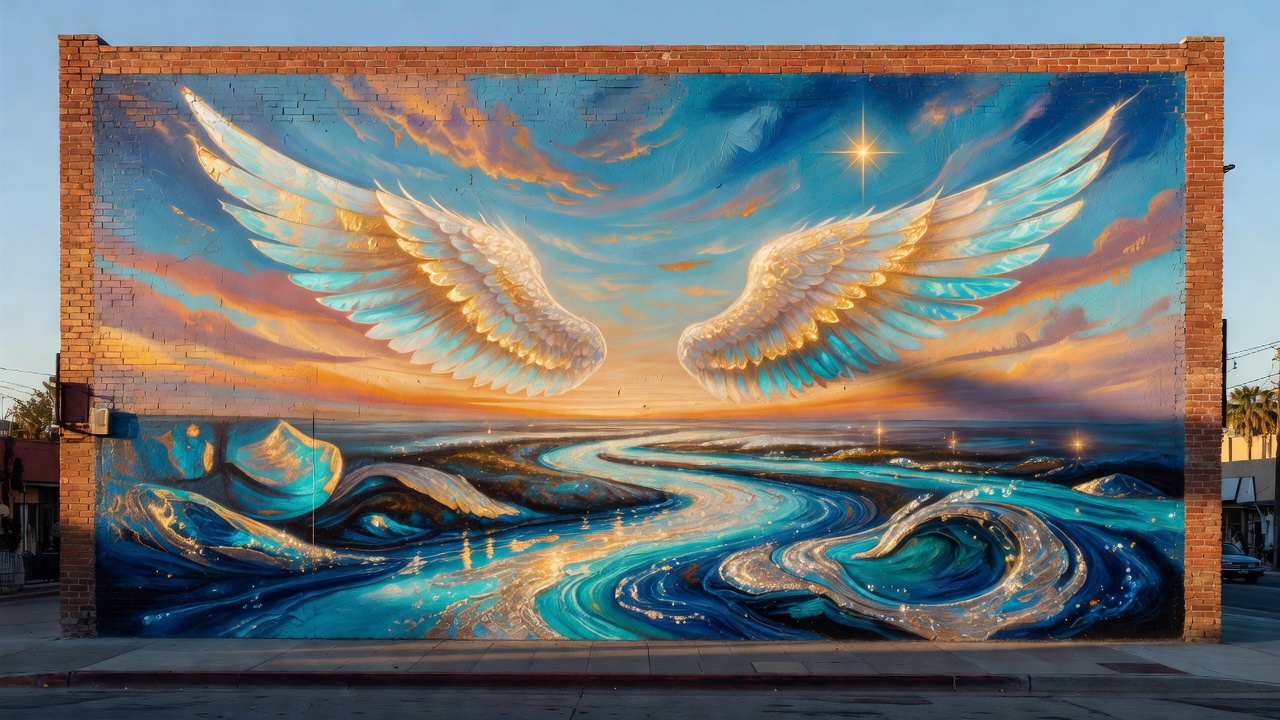
The mural was not finished when I first saw it, though I did not know that yet. It was a Saturday morning and I was walking to my studio through the Arts District when I noticed an artist perched on a ladder, her brush moving in small patient circles across a wall of salmon-colored brick. The painting was enormous: a sky full of wings and rivers, painted in colors that seemed to glow from inside the plaster. I stopped, the way you stop for something you cannot quite name, and stood there long enough that she climbed down and smiled at me. We talked about her process, the way she built the composition from the center outward, the paint she mixes with marble dust because it catches the afternoon light. Then she did something I did not expect. She held out her brush, handle first, and asked me to add a stroke. My first thought was a single word: no. I am a creator too, an astrologer who
paints what the stars teach me, and I know exactly how precious a canvas becomes once a stranger's hand has touched it. But I also know the feeling that follows, the quiet horror of a mark that cannot be taken back. I looked at her wall, at all that wild color, and I felt my whole perfectionist heart go cold. The Canvases I Could Not Finish My studio has a corner I do not show visitors. It is where the abandoned paintings live, leaned face to the wall like guests who arrived at the wrong party. There is a sunrise I started in spring, a portrait of my grandmother, a sky study that was almost right until it was not. I begin every piece with a ritual, the same way I begin a chart reading: I wait for the sign, I mark the first line with intention, I believe the work will tell me where to go. And then I reach a certain point, usually the point where the painting starts to have a will of its
own, and I find a reason to stop. Perfectionism sounds like a love of excellence, but I have learned it is really a fear of being seen mid-creation. A finished work is a verdict; an unfinished one is still a promise. Standing in front of that mural, I recognized the same fear in myself. The artist was not asking me to approve her work. She was asking me to enter it, to leave evidence of myself inside something I had not planned and could not control. That is the exact thing I have been avoiding for years, in paint and in life. The Smallest Yes She showed me where to put the stroke. There was a pocket of sky near the top corner, a space she said she had been saving for someone else to fill. Every mural needs a mark that was not planned, she told me. That is how you know it is truly alive. I climbed the ladder with her brush in my hand, the bristles already worn to her grip, and I
understood that I was being trusted with more than paint. I chose a small golden star, the kind I draw in the margins of my chart notes, and I placed it in the empty sky with one careful motion. It took three seconds. When I climbed down, the artist looked at the wall for a long moment, and then she said the star looked like it had always been there, like the mural had been waiting for it. Maybe she was being kind. But standing there, I felt something shift in my chest. The painting was not mine and would never be, and that was exactly why my mark could belong in it. I had spent my whole creative life guarding the edges of my work, and the whole time the bravest thing I could have done was hand someone else the brush. The Wall That Belonged to Everyone The lesson did not stay on that wall. A few weeks later, a local critic called my community center mural a breath of fresh air that
captures the vibrant spirit of Los Angeles, and for the first time the praise made me uncomfortable. Not because I doubted it, but because I knew the truth: that mural was finished by a dozen hands. The lower strip was painted by the neighborhood kids. A volunteer who had never held a brush added the border. My name is on the plaque, but the wall never belonged to me alone, and I finally understood why that is the best thing about it. I have been invited to host a workshop at a wellness festival, and I have decided to make the whole session one exercise in letting go: paint a small piece in an hour with no sketch, no plan, and no erasing. First stroke lands, second stroke answers it. I cannot wait to watch people panic and then surprise themselves. The stars taught me long ago that no chart is read alone, that every birth chart is a sky seen by many eyes. It has taken a stranger's mural
to teach me the same thing about art. We are all painting on walls that belong to everyone. Closing Reflection My tagline says I read the stars and paint what they teach me. I think I need to add a second line now: and sometimes the stars paint through other people's hands. The brushstroke that was not mine is the most honest mark I have ever made, because it required no control, only trust. It is still up there on that salmon wall in the Arts District, a small gold star in a sky I did not build. Every time I walk past it, I remember that the bravest thing a maker can do is hand someone else the brush.